Full story
Flores quake toll rises
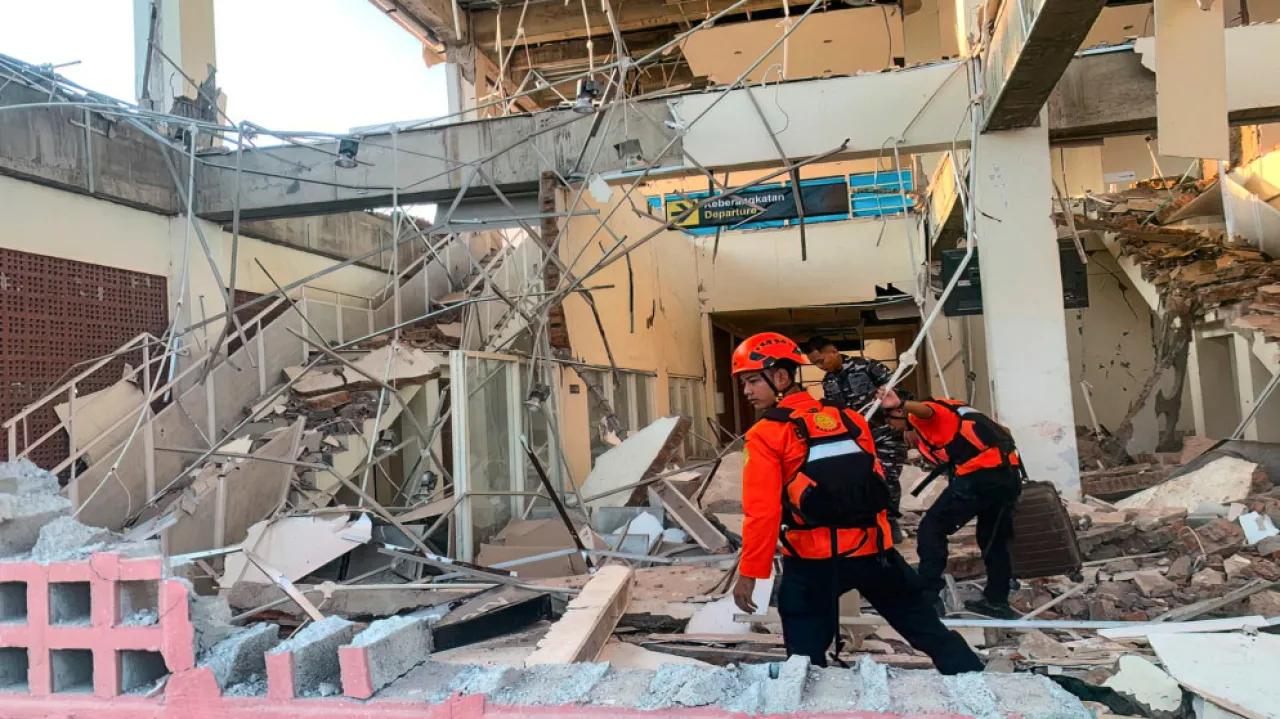
A magnitude-7.7 earthquake struck off the coast of Indonesia’s Flores island just before 05:00 local time on Saturday, killing at least 47 people and damaging hundreds of buildings as aftershocks followed.
“At least 47 people have been killed after a magnitude 7.7 earthquake struck Indonesia early on Saturday”
Indonesia’s National Disaster Management Agency said the quake hit at a depth of 15km, and the BBC reported that aftershocks included a magnitude 6.4 earthquake in North Sumatra, with the US Geological Survey measuring it at magnitude 6.9.
The BBC said the quake’s impact was felt as residents fled into the hills after a tsunami warning was issued and then lifted around three hours later when no significant sea level rise was detected.
In East Nusa Tenggara province, governor Melki Laka Lena said people were killed in their sleep by collapsing rubble, while the BBC reported that Arnold Welianto described being awoken by “very strong shaking” and seeing residents already fleeing into the hills.
The Guardian added that rescuers had yet to reach Nagekeo, the area closest to the epicentre, because roads were blocked by landslides and communications disrupted, even as tsunami waves of 1.5 metres were recorded in several areas.
Evacuation, fear, and response
As the search and rescue operation began, the BBC reported that BNPB said 2,000 people had evacuated or relocated on their own, while the Guardian said authorities had issued a tsunami warning that has since been lifted and that there were at least 235 aftershocks.
In Maumere, the Guardian reported that Fathur Rahman, the head of the city’s rescue agency, said rescuers found 20 people dead, six severely injured and two trapped under the rubble, and that eight of those dead had been killed in a landslide.

The BBC quoted Arnold Welianto saying, “I was startled awake and immediately went to my child's room,” while also describing how residents fled as the sea receded and panicked people ran inland on motorbikes.
The Guardian reported that the police chief of East Nusa Tenggara province, Rudi Darmoko, said the earthquake caused power cuts that made communication difficult between cities and villages, complicating rescue efforts.
In the BBC’s account, Yulian Juita Ekalia, a university lecturer from Ruteng, said, “I have never felt an earthquake this big,” describing the sensation as “really scary” as she cooked outside for fear of further tremors.
What’s at stake next
With roads blocked by landslides and communications disrupted, authorities warned that the full extent of destruction would take time to assess, and the Guardian said teams had not been able to reach Nagekeo while a team attempted to reach the area by ferry.
“Teams had not been able to reach Nagekeo, the region closest to the epicentre”
The Guardian reported that preliminary data showed 346 homes, 87 schools and more than a dozen health facilities had been damaged, while the BBC said preliminary reports indicated more than 150 houses had been severely damaged and dozens of educational institutions and healthcare facilities were affected.
The BBC said the BNPB advised people to stay away from coastal areas and structures showing signs of damage, and it also reported that it would take time to assess the full extent of the destruction in the remote, mountainous region.
In a separate account, the ABC said local officials were providing temporary shelters and urging people to avoid damaged buildings, while also reporting that the National Disaster Management Agency said 50,000 packages of aid were being sent with 10,500 packages already delivered to an air force base.
The ABC also quoted Lieutenant General Suharyanto saying, “These will be the initial targets of the disaster response teams,” as rescue teams searched for survivors and authorities warned people remained trapped in buildings.