Lebanon · 03 July, 2026 · 3 min read
Nabih Berri Says Israel Tries to Drag Lebanese Army Into Confrontation With Resistance
Framework agreement signed June 26, 2026 in Washington triggers internal division. Berri ready for agreement and settlement if counterpart shows willingness.
Whether the withdrawal framework is politically compatible or destabilizing.
6 of 8 outlets skipped it: secret annex grants Israel freedom to act in the security zone.
13outlets compared
Same story, two versions
tap a side to read it in full
Same disarmament goal framed as stabilization versus civil-conflict risk.
Berri attacks Israeli aim
Lebanese Parliament Speaker Nabih Berri said Israel is trying to “drag the Lebanese Army into a confrontation with the resistance,” while he declared readiness for an agreement synchronized with “Hezbollah’s withdrawal from south of the Litani River” alongside a “complete Israeli withdrawal from Lebanese territory.” In an interview with the Lebanese newspaper Al-Diyar, Berri said that “The doors to an agreement and compromise remain open,” and he argued that “no one wants the country to reach a deadlock.” Berri said he opposed direct negotiations with the Zionist regime from the start, adding that the agreement he oversaw on “November 27, 2014” led to Hezbollah’s “complete withdrawal from south of the Litani River without any direct negotiations.”
He also described a proposed mechanism for executing withdrawal based on administrative districts rather than “pilot zones,” saying it would begin in Tyre (Sour), move to Bint Jbeil, and then to Marjayoun while Lebanese Army forces deploy to establish state control. Berri said escalating demands beyond the Litani River should be handled by controlling weapons “within the framework of the Lebanese state,” and he insisted Israel’s pressure would “never happen” because the Lebanese Army and resistance “will never act in alignment with Israel's interests and objectives.”

Pilot zones spark surprise
Nabih Berri told Ad-Diyar he was “surprised” that the finalized framework agreement adopted the “pilot zones” mechanism even though he had agreed with President Joseph Aoun to demand withdrawal based on administrative districts rather than “pilot zones.” Berri described the framework agreement as an “agreement of sedition,” and he said Hezbollah is prepared to withdraw from south of the Litani River concurrent with a complete Israeli withdrawal while integrating its weapons “across all of Lebanon” within the framework of the Lebanese state. He accused Israel of seeking to drag the Lebanese Army into a confrontation with Hezbollah, but said the scenario will not materialize because “neither the Army nor the Resistance will be pushed into serving Israeli goals.”
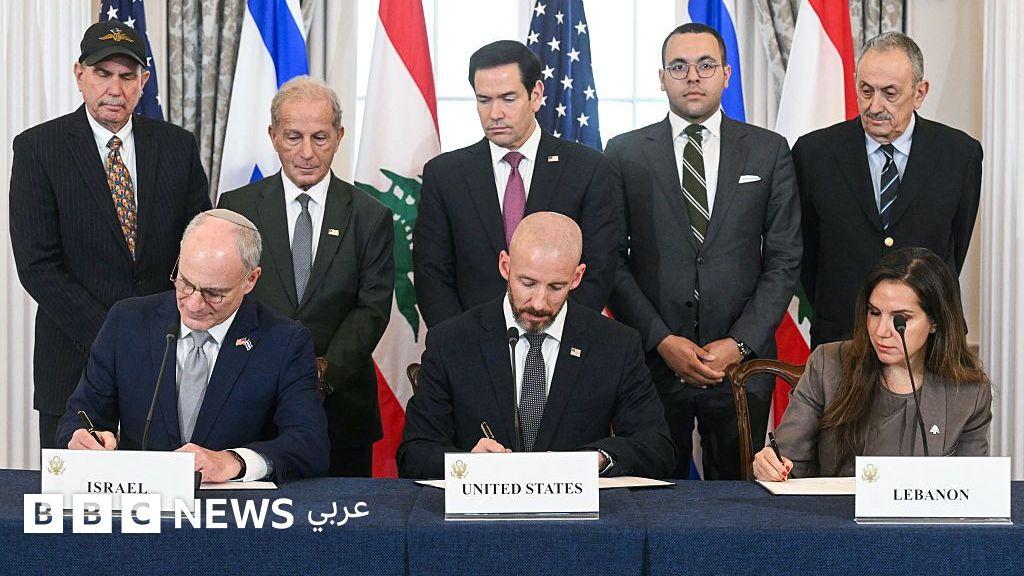
Berri also said “Lebanon needs an international umbrella” to achieve a settlement, adding that the umbrella “must include the United States, Saudi Arabia, and Iran.” In parallel, the BBC reported that representatives from Lebanon, Israel, and the United States signed a tripartite framework agreement in Washington, DC on Friday, June 26, 2026, after the fifth round of direct negotiations under American sponsorship.B
Division fears and next phase
As the framework agreement process moved forward, Hezbollah rejected the text, and its secretary-general Na’im Qassem said in a statement on Saturday, June 27 that the framework agreement in Washington is “a humiliation, a disgrace, and a surrender of sovereignty; this agreement does not exist.” The BBC also reported that US Secretary of State Marco Rubio described the agreement as “the first step in a journey that will no doubt be difficult, but important and necessary,” and it said the agreement comprises 14 clauses with a gradual, conditional process aimed at a comprehensive peace and security agreement. BMeanwhile, a secret security annex described by an official familiar with the agreement’s terms told The Times of Israel that the agreement “explicitly preserves the Israeli army's full freedom to operate against threats within the security zone in southern Lebanon.”
The same annex details, as reported, said there would be “no automatic withdrawals of Israeli forces,” and it stated that any redeployments would be based on field developments while the withdrawal would be “performance-based.” In Lebanon, the BBC said the Lebanese president Joseph Aoun welcomed the agreement and Prime Minister Nawaf Salam emphasized that the state alone has the authority to decide war and peace, while the agreement’s implementation would begin in two pilot areas where the Lebanese army would gradually take full security responsibility.B