Canadaupdated 50m ago3 min read
Ontario Makes Northwestern Communities Permanent Daylight Time Starting Nov. 1
This article is an automated aggregation of coverage from news outlets. Our editorials offer in-depth analysis curated by the NewsCord team.
Northwestern Ontario will permanently observe daylight saving time starting November 1, 2026. Ontario aims to align with Manitoba by ending biannual clock changes.
Ontario aligns with Manitoba
Ontario announced it will make daylight saving time permanent in parts of northwestern Ontario effective Nov. 1, aligning the region with Manitoba after Manitoba said it would switch to permanent daylight saving time on Nov. 1.
“Most residents, however, will still need to ‘fall back’ on Nov. 1 at 2 a.m.”
Attorney General Doug Downey said the change would help “avoid unnecessary disruptions and ensure economic stability in communities that reside in Ontario’s central time zone,” while the Ontario government said maintaining alignment with Manitoba would help businesses operate more efficiently across provincial boundaries.
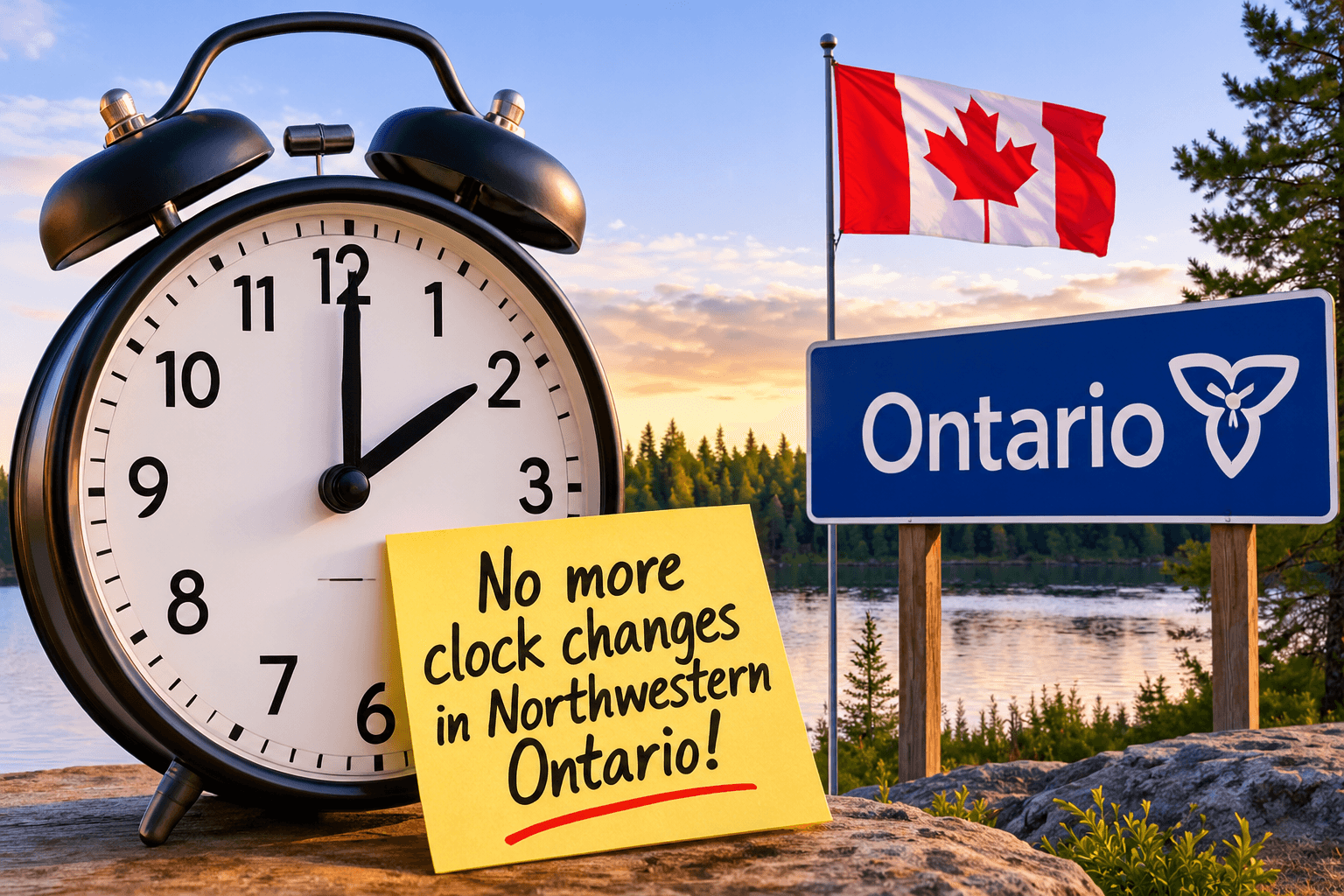
The Ontario government said the regulatory change would be made under the Time Act on Nov. 1, and the change would apply to communities west of the 90th meridian so they would not need to turn clocks back on Sunday, Nov. 1, 2026.
The province said the affected communities in Ontario’s Central Time Zone include Kenora, Dryden, Fort Frances, Sioux Lookout, Red Lake and Rainy River, while communities in the Eastern Time Zone such as Thunder Bay would continue to fall back one hour on Nov. 1.
The Ontario government said the move follows extensive engagement with communities across the northwest, including Indigenous leaders, and it said the engagement showed substantial support for keeping pace with Manitoba.
Rickford cites consensus
Greg Rickford told The Canadian Press that the province intends to make a regulatory change in the Time Act on Nov. 1 to allow regions west of the 90th meridian to align with Manitoba, and he said there was overwhelming consensus among municipalities, First Nations and businesses.
Rickford said, “The other option … we took by unanimous consensus, was to not change our clocks and go to what I’m calling Wab Kinew time,” and he described Manitoba’s move as putting northwestern Ontario “in a bit of a spot.”
Rickford said local surveys showed support ranging from 90% to 94%, and he said the province reached out to municipalities, businesses and First Nations to get their thoughts.
Sol Mamakwa said in a statement that, “after having brought the voices of our communities across the northwest to the table, we are happy the advocacy to observe daylight savings will be implemented permanently.”
CBC reported that Rickford told CBC News the decision came after consultations with municipalities and First Nations, and he said “our transactions are more typically with them” in Manitoba.
What changes, what stays
Ontario said the proposed change would keep communities west of the 90th meridian on Central Daylight Time year-round, while communities east of the 90th meridian would continue to change their clocks twice a year.
“For that to happen, Ontario says neighbouring Quebec and New York would have to make the change too.”
The Ontario government said daylight saving time is the portion of the year from March to November when the time in effect is one hour ahead of the standard time observed during the rest of the year, and it said the change would remove the need to turn clocks back on Nov. 1, 2026 for affected communities.
The province said the change impacts less than one per cent of Ontario’s population, while most Ontario residents would still set their clocks back one hour on Nov. 1 when daylight saving time ends.
Ontario said it would not make daylight saving time permanent statewide without a consensus between all parties, and it said coordination with Quebec and New York remains important for trade, the stock market and broadcasting.
The Ontario government said the Time Amendment Act, 2020 is not yet in force for statewide permanent daylight saving time, and it said neighboring Quebec and New York would have to make the change too.