Europeupdated 1h ago3 min read
MapRiot Police Deploy Around Poland’s Constitutional Tribunal After Bogdan Swieczkowski Suspension
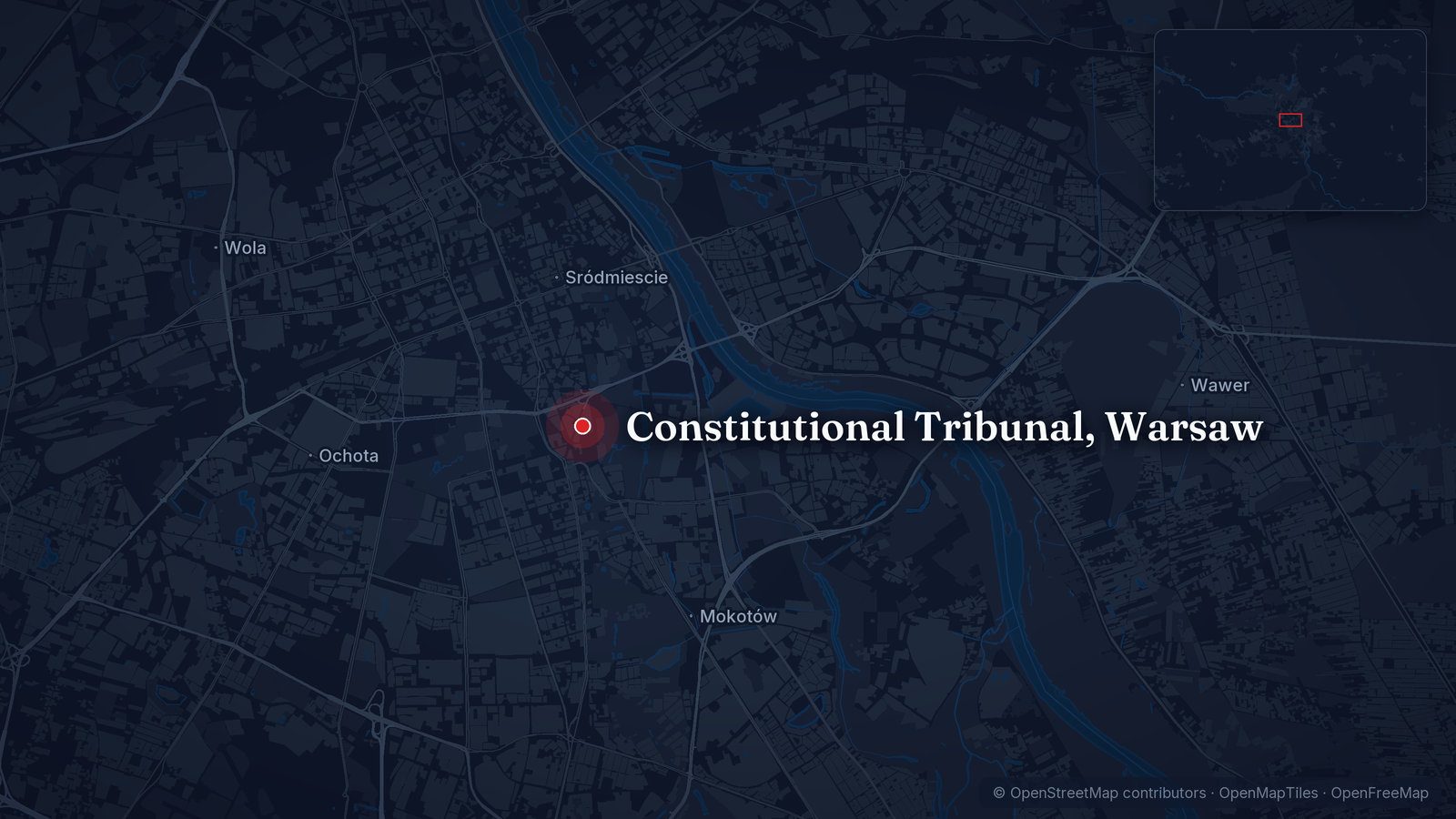
7 Western Mainstream4 Other1 Asian3 Other source typesMap: © OpenStreetMap contributors, ODbL · Cropped for layout
This article is an automated aggregation of coverage from news outlets. Our editorials offer in-depth analysis curated by the NewsCord team.
Riot police deployed around the Constitutional Tribunal after chief justice Bogdan Święczkowski was suspended. President Karol Nawrocki turned back mid-flight from Africa to Warsaw amid the crisis.
Save coverage image
Police, suspension, and return
Riot police deployed around Poland's Constitutional Tribunal as the centrist government and the nationalist right clashed after the suspension of the court's chief justice, Bogdan Swieczkowski, on Friday. Police guarded the entrance to the court while supporters of the opposition right-wing Law and Justice party (PiS) protested the ousting, and the court's official X social media account said there had been a "coup d'etat". President Karol Nawrocki cancelled a planned visit to Africa in mid-flight and ordered it back to Warsaw, after he had been travelling to Senegal.
Prime Minister Donald Tusk defended the move, saying, "Restoring the rule of law is our duty," and he vowed to end the dispute with Brussels after winning an election in 2023. Justice Minister Waldemar Zurek told journalists he had requested the lifting of the legal immunity of Swieczkowski and his deputy Bartlomiej Sochanski, as Dozens of police guarded the entrance to the court.
Competing coup claims
The Constitutional Tribunal wrote that the two judges the government wanted to prosecute were still the legally appointed senior justices of the court, and it warned that "All persons participating in these actions are committing the crime of a coup d'etat."
Tusk posted on X that "Restoring the rule of law is our duty," and he framed the action as a decisive process after years of Law and Justice's lawlessness.
Justice Minister Waldemar Żurek said he had requested stripping the court's President Bogdan Święczkowski and Vice-President Bartłomiej Sochański of their immunity from prosecution to bring criminal charges.
Nigel Farage said, "The situation in Poland is very serious. Arrests and a raid on the constitutional court - all to defend the undemocratic EU," as riot police were deployed to prevent demonstrators from entering the court building.
Law and Justice supporters outside the court chanted "Tusk traitor," while the BBC described the standoff as escalating between the government and the court's top judges.
EU stakes and legal limits
The European Union accused Poland's top judiciary of being too close to the nationalist political power of the time, and the dispute over the Constitutional Tribunal has been a major point of contention between the pro-EU government and Law and Justice. The Diplomacy and Law analysis said Article 19(1) of the Treaty on European Union (TEU) establishes obligations concerning effective judicial protection, while Article 258 of the Treaty on the Functioning of the European Union (TFEU) permits infringement proceedings. The same analysis warned that none of those provisions grants EU institutions general authority to assume control of Poland's Constitutional Tribunal or appoint its leadership, even as the confrontation followed a decade of disputes over judicial appointments and the Tribunal's composition.
The BBC said leading European courts, including the European Court of Human Rights and the Court of Justice of the European Union, ruled the PiS majority had elected three judges improperly and that the Constitutional Court was no longer an "independent and impartial tribunal." The Diplomacy and Law analysis added that the Court of Justice of the European Union (CJEU) found serious violations involving the institution in December 2025, and the European Court of Human Rights (ECtHR) issued interim measures in May 2026 concerning four judges prevented from exercising their duties.