- IMEMC News
UN Approves Remote Palestinian Participation After U.S. Visa Denial
 A tiempo noticias Puebla
The United States again denies a visa to Mahmoud Abbas to attend the United Nations General Assembly.
 Aajil
The Palestinian Authority criticizes Washington’s refusal to grant Abbas a visa to attend United Nations meetings
 Ahl Misr
The U.S. Department of State announces the denial of a visa to Palestinian President Mahmoud Abbas to enter the United States.
 Ajil
Washington refuses to grant Mahmoud Abbas a visa to attend United Nations General Assembly meetings
 Akaz
For the second year in a row, Washington refuses Abbas’s visa. Palestine: an unjustified decision.
 Akhbar Hayat
The Palestinian Authority describes not granting Abbas a visa to attend United Nations meetings as “unjustified.”
 Al Jazeera
UN to allow Palestinian President Abbas speech after US travel ban
 Al-Jazeera Mubasher
UN allows Palestinian president to deliver his speech via video
 Al-Jazira Net
For the second year... Washington deprives Abbas of a visa to attend United Nations meetings
 Al-Jazirah Net
152 countries call on Washington to reverse its decision to block the Palestine delegation from United Nations meetings.
 Al-Jazirah Net
For the second year in a row... Washington deprives Abbas of a UN meeting attendance visa.
 Al-Jazirah Net
152 countries demand that Washington back down from prohibiting the Palestinian delegation from United Nations meetings
 Al-Manar TV Lebanon
US again Denies Mahmoud Abbas Visa ahead of UN General Assembly
 Al-Sharq Al-Awsat
The Palestinian Authority describes the denial of Abbas’s visa to attend United Nations meetings as “unjustified.”
 Al-Sharq Lil-Akhbar
Washington extends sanctions that prevent visas for officials of the Palestinian Liberation Organization and the Palestinian Authority
 Al-Sharq Lilakhbar
Trump's administration is “cracking down on” the Palestinian Authority despite its compliance with its tough conditions.
 Al-Shorouq Online
For the second time... America bans Mahmoud Abbas from entering its lands
 Al-Talfaziyoun Al-`Arabi
The founder of the ‘Forgiveness for All’ initiative... the occupation arrests Palestinian journalist Alaa al-Rimawi.
 Al-Televizyoun Al-Arabi
America refuses to grant Mahmoud Abbas a visa… how will he address the United Nations?
 Al-Yawm as-Saabi'
For the second time... Washington refuses to grant the Palestinian president a visa to attend United Nations meetings.
 Al-Youm Al-Sabe
After his visa denial, Abbas addresses the United Nations via video.
 Al-ʿArabiyya
The Palestinian Authority denounces America’s denial of Abbas’s visa to attend United Nations General Assembly meetings
 Amnesty International Canada
US State Department must reverse decision to ban Palestine delegation from attending UNGA session in New York
 Anadolu Ajansı
US extends visa sanctions on Palestinian officials ahead of UN General Assembly in New York
 Anadolu Ajansı
Washington extends visa bans on officials of the Authority and members of the Palestine Liberation Organization
 AP News
Trump administration again denies visas for Palestinian delegation to attend the UN General Assembly
 Attasiaa
Visas Become a Political Tool… Washington Blocks Palestine’s Voice at the United Nations
 BBC
US blocks Palestinian leader from UN meeting in New York for second year in row
 CBC
U.S. denies visas to Palestinian delegation for 2nd year in a row for UN assembly in New York
 China Daily Global Edition
UN General Assembly allows Abbas to participate in general debate via video
 CNN Arabic
Again… The Trump administration prevents Mahmoud Abbas from attending United Nations General Assembly meetings.
 CNN Arabic
The Palestinian Authority comments on Trump administration’s prevention of Mahmoud Abbas from attending United Nations meetings
 Common Dreams
'Unjustified' Palestinian Authority Decries US Visa Ban on Abbas
 Diario Público
Is the veto of Palestinian officials at the UN General Assembly legal?
 DiarioBitcoin
United States expands visa restrictions against the PLO and the PA
 DIE WELT
Mahmoud Abbas: USA deny Palestinian president visa for UN meeting
 DW
U.S. denies visas to Abbas and members of the Palestinian Authority
 DW
US extends visa denial for Palestinian officials before UNGA
 El Nuevo Diario
Belgium questions U.S. veto on Palestinians
 El Rancagüino
152 States urge the United States to allow Palestinian participation in the UN
 El Universal
UN approves Palestinian participation in General Assembly via videoconference; the U.S. had denied Abbas a visa
 Euronews
For the second year in a row… Washington refuses to grant Abbas a visa to attend the General Assembly
 Euronews
US denies Palestine leader Abbas a visa to UN summit for second year running
 Fana News -
Arab League Welcomes UNGA Decision on Palestine’s Participation in 81st Session
 France 24
Washington deprives Abbas of a visa to attend UN meetings, and the Palestinian Authority calls the decision "unfounded"
 France 24
US again denies Palestinian leader visa for UN General Assembly
 Haaretz
U.S. approves visas for Iranian president, foreign minister to attend UN meeting
 i24NEWS
Mahmoud Abbas facing another absence from the United Nations.. Washington refuses to grant him a visa
 Independent en Español
The United States once again denies visas to the Palestinian delegation for the United Nations General Assembly.
 India Today
US denies UN visas to Mahmoud Abbas and Palestinian delegation again
 INFO7
U.S. denies visa to Mahmoud Abbas to attend the UN
 Informat.ro
US again denies visa to Mahmoud Abbas, president of the Palestinian Authority, for the UN General Assembly
 Informat.ro
The USA refuses for the second time the visa of Palestinian Authority President Mahmoud Abbas for the UN General Assembly
 Israel National News
Second year in a row: US again denies Abbas a visa ahead of UN General Assembly
 J-ru'da Al-Quds
America refuses Mahmoud Abbas’s visa to participate in the United Nations
 KCH FM
UN backs Palestinian participation with 152 votes despite U.S. veto.
 La Nación Costa Rica
United States again denies a visa to Palestinian President Mahmoud Abbas to attend the United Nations General Assembly
 La Tercera
U.S. denies visa and prevents the President of the Palestinian Authority from attending the United Nations General Assembly
 La Tercera
The UN General Assembly backs Palestinian participation with 152 votes after U.S. veto
 Middle East Monitor
UN General Assembly backs Palestinian participation; Abbas to address session by video
 Milenio
EU denies for the second year a visa to Palestinian leader Abbas to attend the UN Assembly
 Milenio
UN approves that Palestine participate in the General Assembly virtually due to visa restrictions by the US
 Mondoweiss
Palestinians are responding to Israel’s stranglehold on the West Bank economy by forgiving each other’s debts en masse
 Moneycontrol
US again denies visas to Mahmoud Abbas, Palestinian delegation for UN General Assembly
 NBC News
Trump administration again denies visas for Palestinian delegation to attend the U.N. General Assembly
 Nedaelwatan
After visa restrictions were extended... The Palestinian Popular Front denounces the American decision and insists on international action
 Newsweek
Trump Admin Denies Palestinian Officials’ Visas for ‘Glorifying Terrorism’
 Okaz
For the second year in a row, Washington refuses Abbas’ visa.. Palestine: Unjustified decision
 Proceso
EU denies visa to Palestinian Authority president and prevents him from attending the UN
 Radio 3 Cadena Patagonia
U.S. again denies Mahmoud Abbas a visa to attend the UN
 Reuters
US blocks Palestinians' Abbas from attending UN meeting, for second year in a row
 RTV News
US Denies Visa to Mahmoud Abbas for UNGA for the Second Consecutive Year
 RTVE.es
Washington denies Mahmud Abbas another year of a visa to attend the United Nations General Assembly in New York
 Sada al-Balad
Between Reform and the Right to Representation... Palestine Calls on Washington to Reconsider Restrictions and Assessments
 Shabakat Masdar al-Akhbariyya
Washington bars Mahmoud Abbas from United Nations visa
 Shabakat Rayya al-Iʿlamiya
From New Delhi to New York, when the globalization of Palestine becomes the battleground for confrontation.
 Sky News Arabia
Mahmoud Abbas is banned from U.S. visas.. after the extension of the ban
 Tabasco HOY
EU again denies visa to Mahmoud Abbas to attend the UN
 teleSUR
The United States denies, once again, a visa to Palestinian leader Abbas to attend the UN General Assembly
 teleSUR English
UN General Assembly Backs Palestinian Participation As U.S. Bars Delegation
 The Arab Weekly
US blocks Palestinian President Abbas from attending UN Assembly
 The Guardian
Trump administration denies entry visas to Palestinian officials ahead of UN general assembly
 The Jerusalem Post
‘Can’t reward terrorism and demand legitimacy’: PA’s Abbas denied US visa ahead of UNGA
 The London Economic
All the nations to vote for and against Palestine participating in UN General Assembly
 The Media Line
US Restricts Visas for Abbas, Palestinian Officials Ahead of UN General Assembly
 The National
France calls on US to give Mahmoud Abbas visa ahead of UN General Assembly
 The New Arab
Israel arrests founder of debt waiving initiative in West Bank
 The New York Times
State Department Extends Visa Ban on Abbas, Other Palestinian Officials
 The Times of India
US extends visa curbs on Palestine officials, blocks President Abbas from UN General Assembly
 The Times of Israel
US rejects Abbas’s entry visa, forcing him to again address UN virtually
 TRT World
US denies Palestinian president visa to attend the UN General Assembly for second year
 Türkiye Today
US extends visa ban on Palestinian leader Abbas ahead of UN assembly
 U.S. News & World Report
UN Allows Palestinian President to Again Speak Via Video After US Denies Visa
 UA.NEWS
US to issue visas to Iranian delegation for UN General Assembly — Cyprus Mail
 UA.NEWS
UN General Assembly backs resolution on Palestinian participation — Anadolu Agency
 UN Meetings Coverage and Press Releases
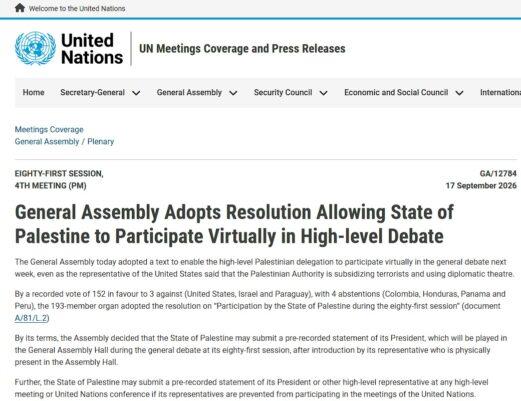
General Assembly Adopts Resolution Allowing State of Palestine to Participate Virtually in High-level Debate
 Universidad de Chile
The U.S. again denies a visa to Palestinian leader Abbas to attend the UN General Assembly.
 voz.us
US again denies visa to Mahmud Abbas, president of the Palestinian Authority, for the UN General Assembly
 WAFA Agency
Arab League welcomes UN resolution on Palestine’s participation in 81st UN General Assembly session
 Washingtonpost
U.S. denies visas to Palestinian officials ahead of U.N. General Assembly - The Washington Post
 WKMG
Trump administration again denies visas for Palestinian delegation to attend the UN General Assembly
 www.haaretz › News › Diplomacy and Defense
Palestinian President Barred From New York as U.S. Extends Entry ...
 www.jpost › World News
UN allows Palestinian president to again speak via video after US ...
 Últimas Noticias
UN approves Palestine's participation in the General Assembly via videoconference.