Iran25 August, 20263 min read
Tulsi Gabbard Warned Trump Iran War Would Close Strait Of Hormuz And Strike US Forces
This article is an automated aggregation of coverage from news outlets. Our editorials offer in-depth analysis curated by the NewsCord team.
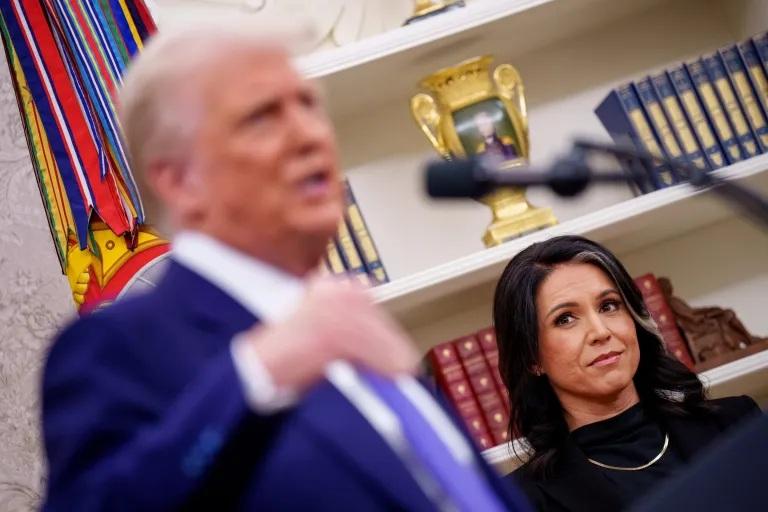
Tulsi Gabbard warned Trump against a war on Iran days before escalation. Trump summoned his intelligence chief to the Oval Office to discuss a full-scale attack.
Ynetnews was read line by line by the Watchdog: 3.8. See the score →
Warnings, then war
Days before President Donald Trump ordered the United States into war with Iran in February, he summoned his intelligence chief to the Oval Office to ask whether a full-scale attack was the right move, according to a Wall Street Journal report detailed by Ynetnews.
Then-Director of National Intelligence Tulsi Gabbard warned Trump that killing Iran’s supreme leader could produce an even harder-line government more willing to pursue nuclear weapons, and that Tehran would likely move to close the Strait of Hormuz and strike US forces and allies across the Middle East.
The Daily Beast says Trump joined Israel in launching an attack on Iran on Feb. 28, with “each of the predictions surrounding the conflict coming true,” and it quotes Eric Brewer, a deputy vice president at the Nuclear Threat Initiative, saying, “This was all predictable and predicted.”
The Daily Beast also describes a Feb. 28 Mar-a-Lago fundraiser where Central Intelligence Agency Director John Ratcliffe and Trump’s special envoy Steve Witkoff informed Trump that Israel had killed Iranian Supreme Leader Ali Khamenei, prompting a round of applause.
Nearly six months later, Ynetnews says the war Trump had said would be over within six weeks is still underway, with Iran’s Islamic Revolutionary Guard Corps remaining in control and continuing attacks on commercial vessels in the Strait of Hormuz.
Economic pressure and threats
As the conflict dragged on, the Daily Beast reports that leaders from Gulf nations such as Saudi Arabia and Qatar contacted the White House urging an end to the war, while it says Trump asked aides why Iran wasn’t folding as bombardment continued. The Daily Beast adds that Trump asked if he should “bomb the s--t out of Iran” to bring an end to the conflict, and that a friend advised him this would not be a good idea and would only pull the U.S. further into another forever war. In parallel, The New York Times reports that Treasury Secretary Scott Bessent threatened sanctions against countries that do business with Tehran during an announcement he had promoted as “economic D-Day,” while later acknowledging it was more a warning shot before a period of “quiet diplomacy.”
The New York Times says Bessent vowed that the United States would “tighten the noose” around Iran by imposing sanctions on every source or facilitator of its revenue, and it describes the new Iran sanctions as including more than 60 entities, individuals and vessels. Iran’s response, as carried by KJCT, came through Iran’s Foreign Ministry spokesperson Esmail Baghaei, who warned that “Any escalation of this situation will undoubtedly bring about consequences,” and said “Our hands are not tied.”

Stakes for trade and war
Iran International reports that Iranian officials dismissed Washington’s “Economic D-Day” as another failed attempt to cripple the country, while analysts inside Iran warned that an economy weakened by war may be far less capable of absorbing the latest US pressure campaign. Iran International says Iranian Central Bank Governor Abdolnasser Hemmati insisted the campaign would have “no impact on Iran,” and it adds that Abdolrahman Fathollahi cautioned against assuming Tehran can simply weather the latest campaign because Iran is now more economically fragile after the 12-day and 40-day wars. The same report says annual inflation reached 66 percent in July and food prices were 128 percent higher than a year earlier, and it notes that gasoline supplies have also come under strain.
KJCT reports that Iran’s demands for reopening the strait include lifting the U.S. naval blockade, withdrawing U.S. forces from the region and reparations for damages sustained in the war, and it says Iran has held separate talks with Oman on jointly managing the waterway regardless of whether a new deal is brokered with the U.S. China’s position, as described by KJCT, was that sanctions and additional pressure “will not help resolve the issue,” with Foreign Ministry spokesperson Lin Jian saying they “will only exacerbate tensions and escalate the situation,” while warning that measures could disrupt global economic development and financial stability.