Africaupdated 1h ago2 min read
MapUN Begins Liquidation of MINURSO After Security Council Fails To Renew Mandate
“the end of the MINURSO mission marks a decisive shift in Morocco’s Western Sahara file”
“Although MINURSO’s operations have now ended, the UN will keep working towards a peaceful resolution”
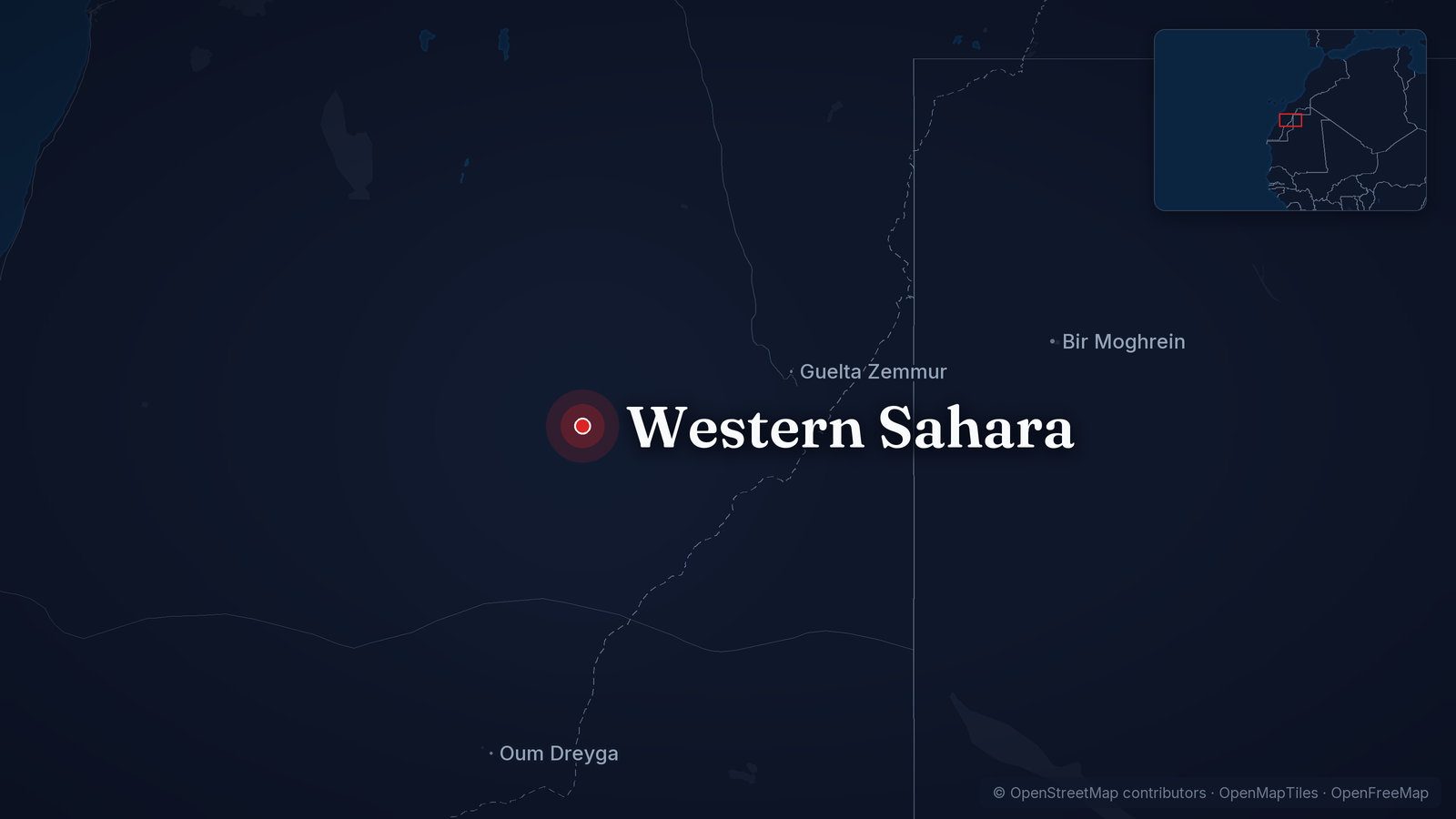
Map: © OpenStreetMap contributors, ODbL · Cropped for layout
This article is an automated aggregation of coverage from news outlets. Our editorials offer in-depth analysis curated by the NewsCord team.
MINURSO mandate expired after Security Council failed to renew it following Russia's veto. UN began liquidation of MINURSO with a reduced team reporting to Department of Operational Support.
Save coverage image
MINURSO winds down
The United Nations began the liquidation process of MINURSO after the Security Council did not renew the mission’s mandate, while António Guterres reaffirmed UN commitment to a political solution “just, durable and mutually acceptable” for Western Sahara. Stéphane Dujarric said, “November 1, 2026 marks the start of the wind-down period,” and he added that a smaller UN department would oversee the organized transfer of equipment and assets belonging to contributing countries. The UN framed the change as an end to peacekeeping operations after 35 years, while the UN said it would keep working through its Personal Envoy, Staffan de Mistura.
“November 1, 2026 marks the start of the wind-down period.”
The Security Council deadlock followed Russia’s veto of a US draft resolution, and the UN said a rival Russian text failed to win the nine votes needed for adoption. SABC News said MINURSO “has formally ceased operations after the Security Council failed to renew its mandate,” and it described the UN’s next phase as a liquidation period that began on November 1.
Rabat, Polisario, Algeria
Morocco’s royal palace welcomed the non-renewal of MINURSO, and it described the mission as a “tool for internationalizing the dispute.” The Polisario Front expressed “concern about the stalemate that characterized the Security Council session,” and it said it would not engage in any process that goes against the rights of its people. Algeria’s Foreign Ministry expressed “deep regret” over the non-renewal and blamed what it described as the United States’ “excessive bias” toward Morocco’s position.
Russia’s UN ambassador Vassily Nebenzia told the Security Council that “the final modalities for settlement need to be acceptable, both to the Moroccans and the Polisario Front,” and he argued that one-sided solutions lead to a dead end. US Ambassador Mike Waltz said the US draft would have moved the conflict forward, and he argued, “We cannot perpetuate a mission whose very name does not reflect the reality on the ground.”
What comes next
The UN said the liquidation process would be overseen by a reduced team reporting to the UN Department of Operational Support, and it would coordinate repatriation of assets owned by troop-contributing States and disposal of UN-owned equipment. António Guterres urged “all parties to fully cooperate” so the process could be completed “as soon as possible,” while he warned he was concerned about the security situation across the entire territory of Western Sahara. The UN said MINURSO’s departure “does not abrogate” the “inalienable right to self-determination,” and it called on all parties “to respect and promote the rights of the people of Western Sahara.”
Morocco’s parliament speaker Ahmed Tuizi told a joint session in Rabat that the end of MINURSO “signals the end of a phase that lasted thirty-five years,” and he linked the shift to the Security Council’s failure on October 30 to renew the mission’s mandate. El País said the UN planned to repatriate about 160 military observers and around 180 civilian staff, and it said the withdrawal included closure of the 13 mission facilities in Western Sahara and removal of its material equipment.