Africaupdated 1h ago3 min read
MapUnited Nations Orders MINURSO Dismantling After US-Russia Cross Veto Over Western Sahara
“marks not a crisis, but a long-overdue correction.”
“rather than an explicit UN decision to dissolve the mission”
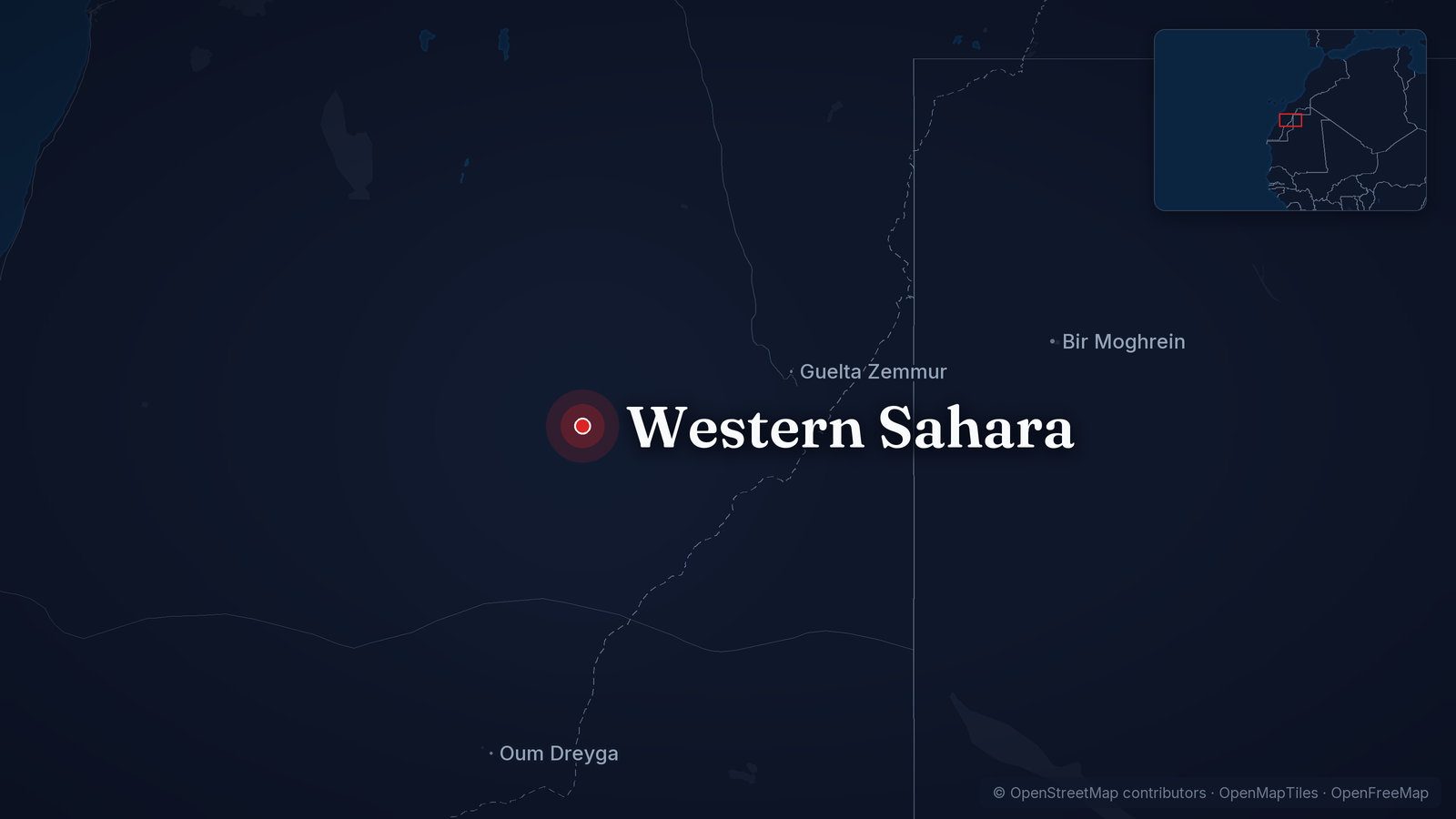
Map: © OpenStreetMap contributors, ODbL · Cropped for layout
This article is an automated aggregation of coverage from news outlets. Our editorials offer in-depth analysis curated by the NewsCord team.
Security Council did not renew MINURSO mandate, triggering its dissolution. Russia veto blocked a US draft to back Morocco's autonomy plan.
Save coverage image
MINURSO ends, escalation risk
The United Nations ordered the immediate dismantling of MINURSO after a Friday cross veto between the United States and Russia in the Security Council vote on renewing its mission, and the mission was extinguished at midnight on Saturday after 35 years without fulfilling its mandate to organize a self-determination referendum. UN Secretary-General Antonio Guterres asked the parties in conflict to cooperate fully so that the withdrawal process proceeds in an orderly manner and in the shortest possible time, and the UN announcement said, "The liquidation period of the mission begins, during which a reduced team will supervise the orderly withdrawal of its resources and personnel." El País described the departure of observers from the former Spanish colony as threatening a military escalation between Morocco, which effectively controls 80% of the territory, and the Polisario Front, which defends its independence.
El País said the ceasefire signed by both sides 35 years ago collapsed in 2020, shortly before the United States recognized Moroccan sovereignty over Western Sahara and overturned the international status quo. El País said MINURSO had transformed into a mere observer mission of a low-intensity war fought on both sides of the land-and-sand wall that has divided Western Sahara for four decades.
Vetoes, votes, and experts
Mohammed Bentlaha Al-Dikali told Sky News Arabia that the latest developments inside the Security Council should be read on two levels, and he said obtaining the American draft’s approval by 11 of 15 members "despite being vetoed by Russia" carried political significance. Mohamed Al-Ghйth Ma’ al-Aýnīn told Sky News Arabia that what happened could not be reduced to a mutual veto or to the Security Council’s failure to choose between two equivalent projects, and he said the American draft "enjoyed a clear majority while the Russian draft did not meet the minimum votes". Al Jazeera Arabia said Russia used its veto to block a U.S. draft resolution on MINURSO, while the Russian counter-project failed to secure the votes needed to extend the mission’s mandate without changing its tasks.
عمار بن جامع, Algeria’s Permanent Representative to the United Nations, said during the Security Council session that self-determination has always been a fundamental reference for resolving the conflict in Western Sahara, adding that it is the most recent, clearest image, which cannot be questioned for a people to freely choose their future. DW said the US draft received the support of 11 members of the Security Council while three members abstained before Russia objected using its veto, and it said the Russian draft was endorsed by only three members with 11 abstentions, preventing adoption.
Liquidation, rights, and next steps
Stephan Dujarric, spokesperson for Secretary-General Antonio Guterres, said during the liquidation period a small team from UN Operational Support would supervise the orderly transport of assets belonging to contributing Member States to their countries, as well as the disposal of UN equipment or its proper disposal. Dujarric urged the parties to exercise maximum restraint and said the United Nations remains ready to continue supporting efforts to promote dialogue and reach a peaceful settlement of the conflict through the Secretary-General’s Personal Envoy, Staffan de Mistura. El País said the Polisario Front’s representative to the United Nations, Sidi Mohamed Omar, stated that the Saharawi people’s right to self-determination is "a red line that cannot be negotiated."
Algeria’s Ministry of Foreign Affairs said the excessive bias in the draft resolution made the result inevitable, and it warned of entrenching a faits accompli in the region while excluding the option of a referendum and diminishing the Sahrawi people’s right to self-determination. El País said Rabat intended to see the departure completed in the coming days, and it warned that without MINURSO’s presence the situation risks getting much worse with real regional implications for stability.