Gaza Genocide06 August, 20263 min read
UNICEF Says Israel Killed 300 Palestinian Children in Gaza Since Ceasefire
This article is an automated aggregation of coverage from news outlets. Our editorials offer in-depth analysis curated by the NewsCord team.
UNICEF: at least 300 Palestinian children killed in Gaza in 300 days of ceasefire. Ceasefire began October 10, 2025 after indirect Hamas-Israel talks mediated by US, Egypt, Qatar.

Children killed despite ceasefire
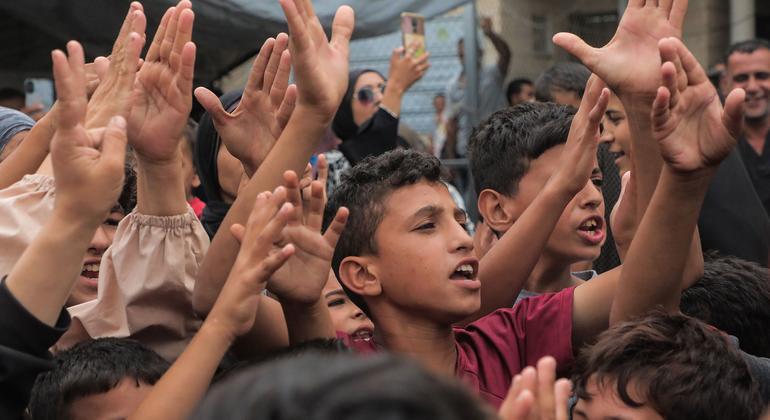
UNICEF said at least 300 children in Gaza have been killed in as many days since a ceasefire agreement supposedly came into effect last October to suspend military operations between Hamas fighters and the Israel Defense Forces. UNICEF Regional Director for the Middle East and North Africa Edouard Beigbeder said, "A ceasefire that leaves an average of one child dead each and every day is failing children," as families are confined to approximately one third of the Strip sheltering among destroyed buildings, rubble and uncleared waste. The UN Children’s Fund warned that with hundreds more children injured, children in Gaza are still waiting for the end of the violence they were promised, while UNICEF health workers described exhausted and hungry mothers arriving at health centres carrying severely malnourished children.
UNICEF spokesperson Louise Wateridge said, "In Gaza, children only days old are already fighting to stay alive," describing a lack of incubators and partially functioning hospitals lacking equipment and medicine. The UN aid coordination office OCHA said airstrikes in Gaza reportedly resulted in civilian casualties and damage to critical medical supplies and civilian infrastructure, and it cited a casualty toll since the announcement of a ceasefire agreement on 10 October 2025 of 1,209 people killed and 3,943 injured.

Violations tally and competing numbers
The Government Media Office in the Gaza Strip said the Israeli army committed 4,091 violations of the ceasefire agreement within 300 days of it coming into effect, resulting in the killing of 1,254 Palestinians and injuries to 4,121 others, in addition to the detention of 159 Palestinians. It also said Gaza received only 63,094 aid trucks out of 180,000 trucks that were supposed to enter under the understandings related to the agreement, representing about 35 percent of the agreed quantities, while Israeli authorities allowed only 10,703 Palestinians to travel out of 27,400 people who were supposed to be permitted to travel since the Rafah border crossing was reopened. In parallel, UNICEF said no fewer than 300 children were killed in Gaza in 300 days since the truce came into effect last October, and it stressed that families are now trapped in nearly a third of the territory sheltering among ruined buildings, rubble, and unremoved waste.
UNICEF Regional Director for the Middle East and North Africa Edward Namara said, "A ceasefire that averages one child killed per day fails to protect children," and he added that children in Gaza still await an end to the violence they were promised. The UN News report cited OCHA figures of 1,209 people killed and 3,943 injured since the announcement of a ceasefire agreement on 10 October 2025, while the Gaza Government Media Office cited 1,254 killed and 4,121 injured since the ceasefire came into effect 300 days ago.
What is at stake next
UNICEF said the test for children in Gaza is whether the killing stops, whether aid reaches them at scale, and whether hospitals reopen and water flow, with UNICEF asking whether children will return to school safely in September.
“Children have heard promises before. This time, agreements must translate into action.”
UNICEF Regional Director Edouard Beigbeder said, "Children have heard promises before. This time, agreements must translate into action," as the UN warned that children across the Strip continue to face acute malnutrition, disease, unsafe drinking water, and deteriorating sanitation systems.
OCHA said it included work to improve 3,000 makeshift shelters in Gaza City last week and the distribution of emergency shelter and essential items to 9,000 households, while it insisted that to scale up assistance and carry out further upgrades of makeshift shelters, timber, ropes, more solar lights and tools must be allowed to enter Gaza in a timely manner.
The Government Media Office in the Gaza Strip said it held Israel fully responsible for the continuing deterioration of humanitarian conditions in Gaza, accusing it of pursuing policies described as systematic in targeting Palestinians and continuing military operations.
The UN News report also said the UN World Health Organization (WHO) stated that after attacks on a medical storage facility next to Al-Aqsa Hospital in Deir al-Balah last weekend, essential medical supplies had been destroyed, including some delivered by the agency.