USA24 November, 20263 min read
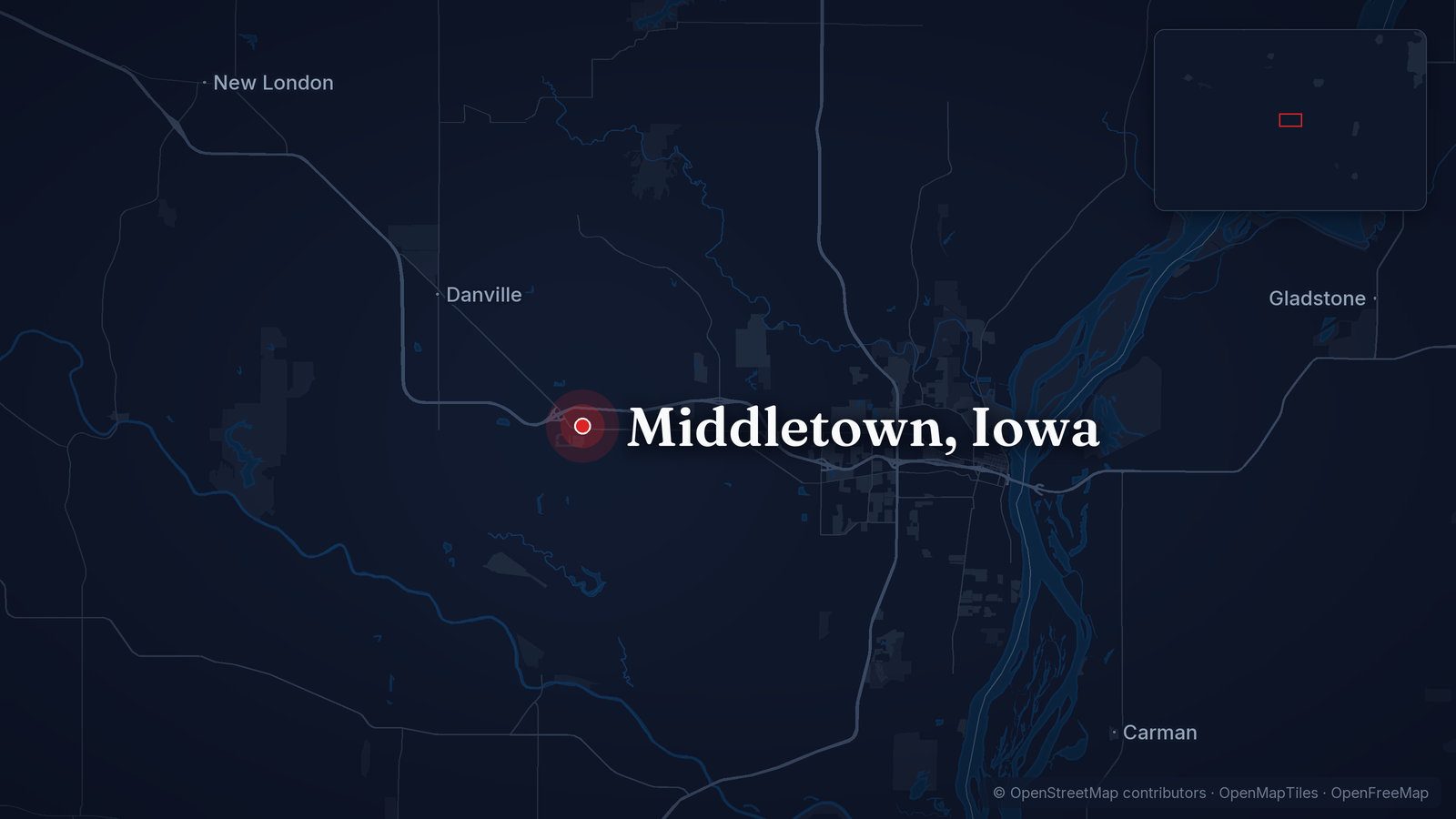
MapU.S. Army Plans Detonation of Nearly 5 Tons of Lead Azide in Rural Iowa
“Hours after Trump’s edict on Monday pausing the army’s demolition plan, the 8th Circuit sided with the EPA”
“In an unusual twist, Trump, commander in chief of the Army, said on social media earlier in the day”
Map: © OpenStreetMap contributors, ODbL · Cropped for layout
This article is an automated aggregation of coverage from news outlets. Our editorials offer in-depth analysis curated by the NewsCord team.
Detonation of roughly five tons of degraded lead azide occurred at Middletown, Iowa. Evacuation advisories issued; authorities urged residents within several miles to evacuate before detonation.
Save coverage image
Iowa blast planned
The U.S. Army planned a controlled detonation of nearly 5 tons of lead azide at an ammunition plant in rural Iowa on Wednesday, with federal officials activating an emergency response to assist with the Iowa detonation.
ABC News medical correspondent Dr. Darien Sutton warned that “with a detonation or explosion, the immediate effect is inhaling it,” and the Centers for Disease Control and Prevention said it was supporting Iowa's health department to help protect people from potential lead and air pollution exposure.
The Army said the stockpile was too unstable to be moved and that destroying it in place was the only responsible option, while the BBC said an appeals court overturned a decision to stop the blast over concerns about potential health hazards from lead exposure.
Officials announced a five-mile (8km) optional evacuation zone and a 20-mile shelter-in-place advisory, and the Army said residents should stay indoors or evacuate if in the evacuation zone until state health officials said the air was safe to return home.
Margo Sprenger, a farmer and landowner in Donnelson, said “it's going to change my life forever,” as she said her land was in the direct path of the projected plume.
Court fights and warnings
Environmental groups and local residents sought to block the detonation, and CBS News said the detonation was postponed last week after challenging the emergency permit the EPA had granted the Army to authorize it.
The 8th Circuit Court of Appeals acknowledged “the very real risks presented by the Army's planned detonation,” but found the risk of an uncontrolled explosion more harmful.
Acting Army Secretary Adam Telle told a news conference, “Our No. 1 priority here in Iowa today is the health and safety of the citizens of this region,” while Reuters also described a “controlled, mitigated detonation” as the safest option to avoid the material exploding on its own.
CNN reported that a federal court had postponed the controlled blast initially scheduled for last week, and CNN said the court on Monday reinstated a permit for the blast.
The Army set off the huge explosion in Middletown, and NPR reported that FEMA called on residents in the affected area to stay indoors with windows closed to avoid airborne lead dust, noise and vibration.
Aftermath and monitoring
The CDC advised residents to stay indoors or evacuate if in the evacuation zone until state health officials said the air was safe to return home, and the CDC also told people to close doors and windows and seal any potential gaps. ABC News said the CDC recommended that clothes that may have been exposed to lead should be washed and hands should also be washed before touching face or eating, and the Army said it would provide an all-clear before residents returned. NBC News reported that the U.S.
Environmental Protection Agency said air quality monitors were reporting “ZERO detection of airborne lead throughout the region,” while NBC News also said previous modeling suggested it would take several hours for the plume to disperse. KWQC said the EPA took a total of 1,216 samples to test for lead levels in the water, soil, dust, and air, and KWQC listed water: 210, soil: 650, dust: 297, air: 59. FEMA called on residents in the affected area to stay indoors with windows closed to avoid airborne lead dust, noise and vibration.