Iran09 September, 20263 min read
U.S. Destroys Five Iranian Oil Tankers Near Kharg Island As Brent Nears $100
This article is an automated aggregation of coverage from news outlets. Our editorials offer in-depth analysis curated by the NewsCord team.
US military destroyed five Iranian crude oil tankers near Kharg Island and Jask Port. Crews evacuated; no casualties reported immediately.

Anadolu Ajansı was read line by line by the Watchdog: 3.1. See the score →
Tankers destroyed, prices jump
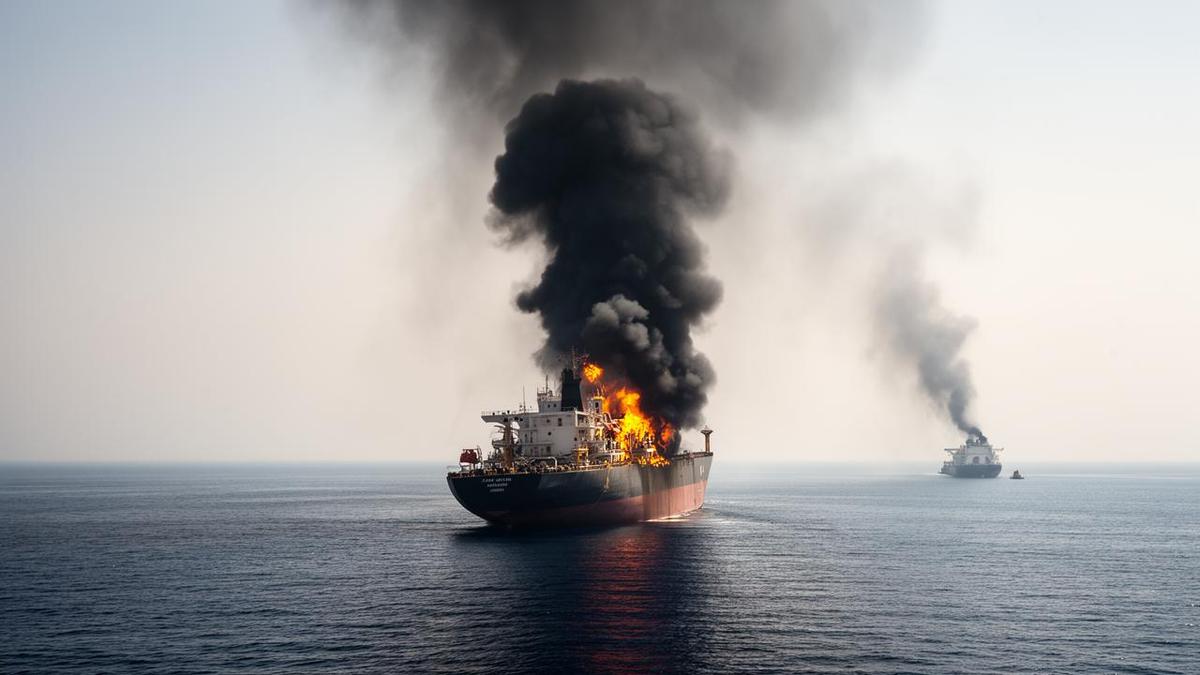
The United States destroyed five more Iranian oil tankers in the Gulf of Oman and near Iran’s Kharg Island as the U.S.-Iran confrontation escalated sharply, with Brent crude futures approaching $100 per barrel in early Asian trading.
U.S. Central Command (CENTCOM) said the tankers were the Kaviz, Charminar, Horizon 1, and Riesco in the Gulf of Oman and the Derya near Kharg Island, and that crews were ordered to abandon the vessels before they were struck with no U.S. personnel injured.

The strikes followed two failed Iranian ballistic-missile attacks on a U.S. Navy warship, according to CENTCOM, and came days after the United States said it had destroyed three other Iranian oil tankers after attempted attacks on an American aircraft carrier and destroyer.
Iran responded by firing 20 ballistic missiles toward the Muwaffaq Salti Air Base in Jordan, and Jordanian air defenses intercepted 18 while two landed in sparsely populated areas without causing casualties, according to the accounts in the sources.
As the maritime confrontation widened, the escalation was also reflected in markets, with Brent crude rising to $100.07 per barrel and West Texas Intermediate rising to $94.73 per barrel in early European trading.
Rubio hard line, IRGC threats
U.S. Secretary of State Marco Rubio said Iran will “lose tankers every time it does this, or tries to do this,” framing the strikes as retaliation for Iran’s Islamic Revolutionary Guard Corps (IRGC) targeting U.S. Navy warships with ballistic missiles twice over the previous two days.
The IRGC separately warned tanker crews anchored near Kuwaiti and Bahraini ports to abandon ship immediately, saying vessels—whether at anchor or docked—could become targets, as both Kuwait and Bahrain host U.S. military forces.
Radio Free Europe/Radio Liberty reported that the IRGC also claimed it attacked two U.S. warships and eight other tankers, while adding that those claims have not been independently verified.
The same report said Iranian currency hit a new low against major foreign currencies on September 8, with the dollar trading at up to 2.4 million rials later in the day and the euro exceeding 2.7 million rials.
It also tied the currency pressure to U.S. moves, noting that Washington announced sweeping new sanctions against Iran’s aviation sector on September 8, designating 36 targets and sanctioning all remaining Iranian airlines under its Operation Economic Outcast campaign.
Hormuz traffic falls, risks spread
Shipping activity through the Strait of Hormuz fell sharply after the latest escalation, with Kpler data cited by Reuters showing only six commercial vessels crossed Hormuz on September 8, well below the recent average. India Shipping News cited Kpler data showing an average of only about 10 commodity vessels per day transited the waterway over the preceding 10 days, the lowest level since May, and said that at one point only two vessels crossed the strait in a single day. The sources also described the economic stakes around Kharg Island, with India Shipping News calling it Iran’s principal oil-export hub and saying any military activity around its anchorage and surrounding waters could be consequential for Iran’s ability to move crude to international markets.
The confrontation was further tied to broader regional energy risk, as the same India Shipping News account warned that prolonged restrictions on tanker movements could increase voyage distances, waiting times, war-risk premiums and insurance costs, while disruptions to crude and refined-product flows could pressure Asian refineries. In the background of the maritime crisis, Folha de S.Paulo reported that the United States imposed its own blockade on Iranian ports to respond to Iranian actions and that the waterway normally transports about a fifth of global oil and liquefied natural gas exports.