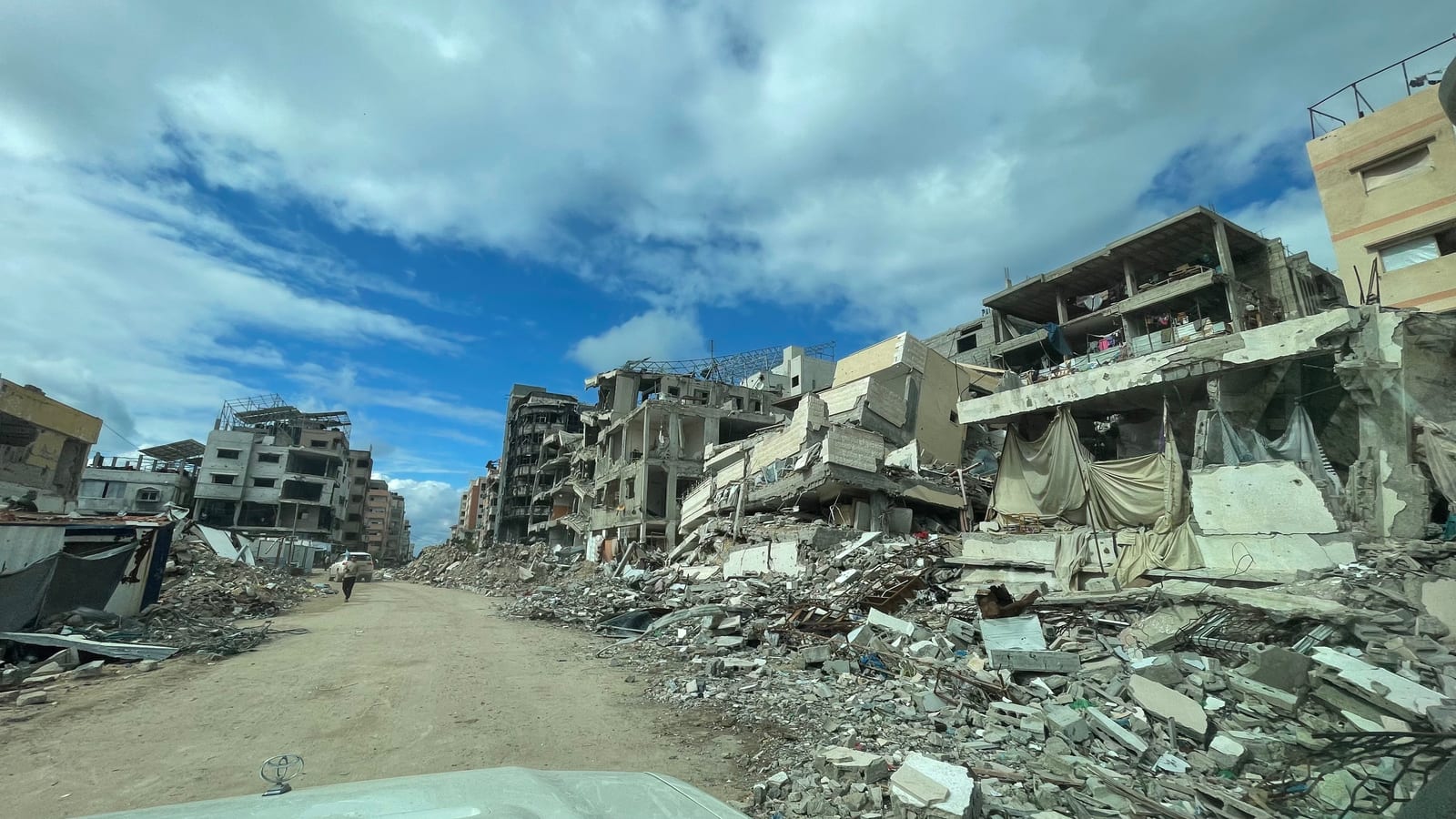
The“Ceasefire”IsaLie.
Since 10 October 2025 Israel has attacked Gaza on 252 of 279 counted days, killed at least 1,127 Palestinians, pushed its lines from about half the Strip towards 70 per cent, and its ministers now march on the fence to plan settlements. The day by day record.
The word “ceasefire” has framed nearly every Gaza headline since 10 October 2025. Under that word, Israeli fire has killed at least 1,127 Palestinians, more than 260 of them children: a child a day, on UNICEF’s average, for nine months.
The deal was specific. The guns fall silent. Israeli forces pull back to a marked “yellow line” as a first phase, holding roughly half the Strip temporarily. An international force deploys. Israel withdraws further. Aid enters at 600 trucks a day. Reconstruction begins.
Nine months on, the only phase that ever happened is the first, and even its line has moved in exactly one direction: inward. The killing has continued on an almost daily basis. The stabilisation force does not exist. Aid has run at roughly a third of what was agreed. And the people planning what comes next are not hiding it: they are announcing settlements, on camera, from the fence. Three claims, each checkable against the record below: the killing never stopped, the occupation grew, and the settlements are already being planned.
By Al Jazeera’s count, the fire actually ceased on 27 days. This is what the other 252 look like.
1,127 people killed under the word “ceasefire”.
Gaza’s Ministry of Health has counted the dead of this “ceasefire” the same way it counted the dead of the two years before it: one hospital intake at a time, relayed weekly through the UN’s OCHA and daily through the wire agencies. The curve it draws does not pause. It climbs through the 29 October massacre, through every “the ceasefire is back on” announcement, through the anniversary statements, and passes 1,000 dead on 17 June 2026.
Palestinians killed by Israeli fire since the “ceasefire” took effect, cumulative
Gaza Ministry of Health consolidated series, as relayed by OCHA situation reports, WAFA and press reports on the dates shown. The ministry counts the 800 plus bodies recovered from rubble, and deaths added retroactively once identifications are approved, in separate columns; this line is the direct killings alone. The overall toll of the genocide stood at 73,250 killed on 18 July 2026.
1,127
Palestinians killed by Israeli fire since 10 Oct 2025, plus 3,643 injured (MoH, 18 Jul)
260+
children among the dead. UNICEF: an average of one child killed every day
252 / 279
days on which Israel attacked Gaza, by Al Jazeera's tracking. 27 days without attacks
3,689
documented Israeli violations of the agreement by 14 July, about 13 a day (Gaza Government Media Office)
The single worst night came less than three weeks in. On 28 to 29 October 2025, after Netanyahu ordered strikes across the Strip, Israeli bombardment killed 104 people, 46 of them children, and the military then declared the “ceasefire” to be “back on”. It was the deadliest of many such days: 45 killed on 19 October 2025, 33 on 19 November, more than 30 on 31 January, 23 on 4 February, 14 on 17 July 2026, when a drone struck a funeral procession in Nuseirat and killed eight of the mourners.
And when nothing large enough for a headline happens, the killing simply continues at its baseline: people shot near a line that is often unmarked, drone strikes on motorcycles, tents, funerals, police posts and water queues. The UN human rights office has verified hundreds of these deaths far from the yellow line, and hundreds more near it, and put the legal position plainly: targeting civilians not taking direct part in hostilities is a war crime, regardless of their proximity to deployment lines. May 2026 was the deadliest month of the year, with 119 killed. Here is the most recent fortnight, in full.
The last fourteen days of the record, 5 to 18 July 2026
- 5 Jul2Drone strike on civilians at a water distribution point, east Gaza City.
- 6 Jul6A vehicle on al-Rashid Street; a displacement tent in al-Mawasi; a married couple in their Gaza City flat.
- 7 Jul7Strikes on Gaza City and Khan Younis; gunfire on Rafah.
- 8 Jul8Four in a tent in al-Mawasi, a 10 year old among them; a six year old shot in Zeitoun; a World Central Kitchen driver.
- 9 Jul8Nuseirat camp, a Khan Younis courtyard, a vehicle in al-Rimal.
- 10 Jul3A drone struck the courtyard of Kamal Adwan Hospital; strikes destroyed shelters at al-Mawasi displacement sites.
- 11 Jul7Seven bodies received by hospitals in 24 hours.
- 12 Jul5Nine year old Tala Jumaa Abu Matar; a blacksmith workshop in Sabra, Gaza City.
- 13 Jul8A police post at the at-Twam roundabout; a motorcycle in Tal al-Hawa.
- 14 Jul11A police post near Shadia School, Jabalia, the district police chief among the dead; a 10 year old in Rafah.
- 15 Jul13A father, mother and their six year old daughter in their Deir el-Balah flat.
- 16 Jul5Tuffah, a tent encampment west of Gaza City, tank fire in the east.
- 17 Jul14Eight killed in a drone strike on a funeral procession in Nuseirat.
- 18 Jul9Two missiles into an al-Nasr apartment killed five, three of them children; artillery on Zeitoun.
Not one quiet day. Figures are the killings reported for each day by the Ministry of Health and press tallies; counting methods differ slightly between daily incident reports and the ministry’s consolidated series, which adds a death only once identification is approved.
Four people killed a day, every day, for nine months. In any other country the word for that would not be “ceasefire”.
The withdrawal line was phase one. Israel is treating it as a border, and moving it.
The yellow line was sold as temporary: an initial redeployment line, about 45 kilometres long, behind which Israel would hold roughly half of Gaza while the next phases were negotiated. The next phases were never honoured. What happened instead is measurable from orbit.
Share of Gaza behind Israeli lines during the “ceasefire”
October 2025
~53%
The agreed yellow line leaves roughly 53 per cent of Gaza under Israeli control (some analyses put the marked line at up to 58 per cent). It is described as a first phase.
28 May 2026
~60%
Netanyahu discloses that Israel has extended its control to 60 per cent, and says he has ordered the military to extend it to 70.
May to July 2026
~65%
Independent satellite audits measure Israeli held territory at roughly 64 to 65 per cent.
July 2026
~70%
Israeli demarcation encompasses roughly 70 per cent of the Strip, metres from the Salah al-Din highway. Defence minister Katz: we are not retreating from the yellow line.
The deal’s later phases ran the other way: an international stabilisation force, further Israeli withdrawal to a “red line”, then a narrow buffer. Nine months in, not one soldier of that force has deployed, and no further withdrawal has taken place.
01
The markers themselves were moved
BBC Verify satellite analysis found more than half of 205 mapped yellow line markers placed significantly deeper inside Gaza than the agreed map, and tracked seven blocks in Tuffah moved an average of 295 metres further in over a single month. A CBC News visual investigation then tracked blocks moved by more than a kilometre, near the entrances of Nuseirat and Bureij camps.
02
The line became a fortified border
Forensic Architecture documented more than 25 kilometres of earthen berms thrown up roughly along the line, 38 fortified bases east of it and at least 13 new outposts built since the agreement. Al Jazeera's satellite review counted 40 Israeli military outposts inside Gaza by May 2026, eight of them built entirely after the 'ceasefire', linked by new roads into Israel's own network.
03
Everything behind it is being erased
More than 2,500 buildings were demolished in the first three months alone, dozens of them beyond the line in territory where Israel had agreed to halt operations. Satellite investigations describe a campaign of erasure in eastern Gaza: the town of Khuza'a razed and roads built over it, university campuses levelled with controlled detonations, kilometres of cropland burned, less than 5 per cent of Gaza's farmland left usable.
04
The officials say it out loud
The army chief of staff called the yellow line a 'new border line' for Israel. The defence minister says the military will 'never leave all of Gaza', will hold its 'security zones' indefinitely, and in July 2026 said Israel will not withdraw even if Hamas disarms. Netanyahu says he ordered control extended to 70 per cent of the Strip.
The line is not only a land grab; it is a firing line. Because it is shifting and often unmarked, Palestinians returning to check their homes cannot know where it runs. The UN human rights office verified at least 571 people killed by Israeli fire in the first four and a half months alone, counting separately those killed near the line and those killed nowhere near it. A temporary military line that moves inward, gets concreted, bermed, fortified and declared a border is not a withdrawal. It is an annexation in progress.
This is not a fringe demand. It is the cabinet, at the fence, with a map.
Every settlement in occupied territory is illegal under international law, and the International Court of Justice ruled on 19 July 2024 that Israel’s entire occupation is unlawful, that settlement activity must cease and that settlers must be evacuated. Two years later to the day, serving cabinet ministers joined a march to the Gaza fence to demand new ones. The ledger of the “ceasefire” months reads like this:
The West Bank half of this ledger matters because it shows the method working at scale: E1 signed with the declaration that “there will be no Palestinian state”, a land registration scheme rights groups call annexation through law, record displacement of Palestinian communities, and more settlements authorised under this government than under any before it. Gaza is not being offered a different future. It is being offered the West Bank’s present, minus the buildings.
The people whose job is to name this have named it.
None of the bodies that spent two years documenting the genocide believe it ended in October 2025. Their language since the “ceasefire” is not ambiguous:
“Israel's genocide against Palestinians in Gaza continues unabated despite ceasefire... deliberately inflicting conditions of life calculated to bring about their physical destruction.”
Amnesty International, 27 November 2025
“We've entered a new phase of the genocide, away from the eyes and ears of most of the international community.”
Francesca Albanese, UN Special Rapporteur, 10 December 2025
“Israel's extermination and ethnic cleansing escalate.”
Human Rights Watch, 4 February 2026
“We are out of red flags. Our many previous warnings have not been heeded.”
Volker Türk, UN High Commissioner for Human Rights, to the Human Rights Council, 15 June 2026
The word “ceasefire”, repeated in every headline over every one of the killings above, does the opposite work. It tells the reader the story ended in October 2025. It converts each massacre into an aberration from a peace that does not exist, rather than the routine of an occupation that is expanding. And it gave Western newsrooms permission to leave: our own data shows their Gaza coverage collapsed by about three quarters after October 2025, while the killing continued. We documented that collapse, outlet by outlet, in a companion piece: The West Blacked Out a Genocide That Never Stopped.
Thefireneverceased.Onlythecoveragedid.
Nothing in this file is hidden. The death counts are published weekly by the UN. The moved markers are visible from space. The settlement plans are announced at podiums by serving ministers. What sustains the lie is a single word, repeated in headlines over the bodies of 1,127 people. A genocide does not pause because its coverage does.
Act
Press the states and the newsrooms
Two live campaigns: write to foreign ministries demanding the release of Palestinian hostages, and hold the BBC to its own transparency standard on the Jabalia killings under this “ceasefire”.
Read
The companion investigation
This piece documents the killing the word “ceasefire” hides. Its companion measures the silence: how Western outlets cut their Gaza coverage by about three quarters the moment the word arrived.
Support
Keep the record public
NewsCord runs with no ads and no sponsors. Research like this, and the campaigns it feeds, cost money to deliver. If this record is worth keeping, help us keep it.
- 01Al Jazeera tracker: 'How many times has Israel violated the Gaza ceasefire?' (updated through 15 July 2026): 3,689 violations; attacks on 252 of 279 days; 73,246 killed overall including 21,500 children
- 02OCHA oPt humanitarian situation reports, October 2025 to July 2026: weekly Gaza MoH casualty aggregates and cumulative since-'ceasefire' counts used for the chart series
- 03AP (via Press Democrat), 18 July 2026: Israeli strikes kill 3 children and 6 adults; 1,127 killed since the 'ceasefire'; 73,250 killed overall
- 04AP / NPR / Al Jazeera, 17 to 18 June 2026: toll since the 'ceasefire' passes 1,000 (1,005, Gaza MoH)
- 05UNICEF (James Elder), 26 June 2026: more than 260 children killed since the 'ceasefire'; an average of one child killed every day
- 06PBS / CNN / NPR, 28 to 29 October 2025: overnight strikes kill 104, including 46 children; Israel declares the 'ceasefire' back on
- 07Al Jazeera, 18 October 2025: 11 members of the Abu Shaaban family killed in Zeitoun, seven children among them
- 08Al Jazeera / AP, 17 July 2026: drone strike on a funeral procession in Nuseirat kills eight mourners; at least 14 killed that day
- 09Gaza Government Media Office, 15 July 2026: 3,689 documented violations over 275 days; 58,664 aid trucks entered of 165,000 due (35 per cent)
- 10BBC Verify satellite analysis, January 2026: more than half of 205 yellow line markers placed deeper into Gaza than the agreed map; seven Tuffah blocks moved an average of 295 metres inward
- 11CBC News visual investigation, 8 July 2026: yellow line blocks moved by more than a kilometre in central Gaza
- 12Forensic Architecture, May 2026: 25+ km of earthen berms along the yellow line, 38 fortified bases east of it, at least 13 new outposts since the 'ceasefire'
- 13Al Jazeera Open Source Unit, 3 June 2026: 40 Israeli military outposts inside Gaza, eight built entirely after the 'ceasefire'
- 14The New York Times (via Ynet), January 2026: more than 2,500 buildings demolished in the first three months, dozens beyond the yellow line
- 15The New Humanitarian, 1 July 2026: 'Israel's campaign of erasure' in eastern Gaza; control expanded from 54 to about 65 per cent; Khuza'a razed
- 16Al Jazeera satellite analysis, 31 May 2026: erasure of southern Gaza; university campuses levelled; under 5 per cent of agricultural land usable
- 17Netanyahu statement, 28 May 2026: control extended to 60 per cent, military ordered to reach 70 per cent
- 18Defence minister Katz statements, December 2025 to July 2026: the army will 'never leave all of Gaza'; indefinite presence; no withdrawal even if Hamas disarms; three Nahal outposts in northern Gaza (France24, Middle East Monitor, JNS, Antiwar)
- 19IDF chief of staff Zamir, December 2025: the yellow line is a 'new border line' for Israel
- 20Al Jazeera, 19 July 2026: 'From settlements to blocked recovery, Israeli strategy taking shape in Gaza': demarcation at ~70 per cent; at least 1,127 killed including 265 children; ~20 per cent of needed aid permitted
- 21Euronews / AP, 28 May 2026: international stabilisation force stalled; zero troops deployed nine months in
- 22Jerusalem Post / Al Jazeera, July 2026: Smotrich says plans for three northern Gaza settlements are finalised; 'We will return to the whole of Gaza in a big way'
- 23Irish Times, 18 July 2026: Israeli ministers announce plan for new illegal settlements in Gaza and the West Bank
- 24Haaretz / Times of Israel, 19 July 2026: thousands march to the Gaza border demanding re-establishment of Nissanit, Dugit and Eli Sinai; organisers say 28 ministers and coalition lawmakers take part
- 25NBC News / +972 Magazine, February to March 2026: Nachala movement, 800 sign-ups for six planned Gaza settlements, families at border staging sites; 5 February 2026 march breaches the boundary
- 26Al Jazeera, 3 July 2026: security cabinet approves 13 new West Bank settlements
- 27AP / US News, 14 July 2026: about $434 million allocated for 34 new West Bank settlements; 104 settlements authorised under this government
- 28Times of Israel, 11 September 2025: Netanyahu signs the E1 plan: 'There will be no Palestinian state'
- 29International Court of Justice advisory opinion, 19 July 2024: Israel's presence in the occupied Palestinian territory is unlawful; settlement activity must cease and settlers be evacuated
- 30Amnesty International, 27 November 2025: 'Israel's genocide against Palestinians in Gaza continues unabated despite ceasefire'
- 31Francesca Albanese, UN Special Rapporteur, in Foreign Policy, 10 December 2025: 'a new phase of the genocide, away from the eyes and ears of most of the international community'
- 32Human Rights Watch, 4 February 2026: 'Israel's Extermination, Ethnic Cleansing Escalate'
- 33Volker Türk, UN High Commissioner for Human Rights, 15 June 2026: nearly 1,000 killed since the 'ceasefire'; 'We are out of red flags'; and 10 April 2026 statement: targeting civilians is a war crime regardless of proximity to deployment lines
- 34AP (via MPR News), 18 January 2026: Israeli troops kill Palestinians for crossing a vague 'ceasefire' line that is sometimes unmarked; at least 77 killed near the line by mid January
- 35NewsCord data investigation, 'The West Blacked Out a Genocide That Never Stopped': Western outlets' Gaza coverage fell by about three quarters after October 2025
Casualty figures are the Gaza Ministry of Health consolidated series unless stated; the Government Media Office counts run higher because they include all violation linked deaths. Where sources conflict, the lower figure is used. All figures were compiled on 19 July 2026 and reflect reporting up to 18 July 2026.