Crypto23 September, 20263 min read
EU Financial Watchdogs Warn Quantum Computers Could Undermine Bitcoin Cryptography Before Commercial Viability
This article is an automated aggregation of coverage from news outlets. Our editorials offer in-depth analysis curated by the NewsCord team.
EU regulators warn advances in quantum computing could undermine cryptography protecting blockchains. Threat could materialize before quantum tech has viable commercial application.
EU warns of quantum risk
European financial watchdogs warned that sufficiently advanced quantum computers could undermine cryptography used to secure blockchains, and they said the threat could emerge before quantum technology has a viable commercial application. The Joint Committee of the European Supervisory Authorities, which includes the European Banking Authority, European Securities and Markets Authority and European Insurance and Occupational Pensions Authority, said “Threats could materialize earlier than any viable commercial application.” The regulators warned that roughly 6.9 million Bitcoin, worth roughly $586 billion, are currently vulnerable if quantum computers one day become capable of breaking bitcoin’s cryptography, according to Cryptoquant.
The warning focused on preparation for bitcoin’s legacy addresses, because the regulators said the public key may already be visible on the blockchain for older or reused addresses. The European Commission’s post-quantum roadmap urged member states to begin post-quantum transitions by the end of 2026, with high-risk use cases to be protected by 2030.

Defense work and costs fall
StarkWare said the computing cost of preparing Bitcoin transactions against quantum-computer attacks has fallen 79% to below $67 per transaction, and it framed the reduction as making emergency use more likely for investors with large Bitcoin holdings.
StarkWare said the improvement came through the Quantum Safe Bitcoin Optimization Challenge, launched on Sept. 16 by StarkWare, Yukon Research and Eigen Labs, and it said developers, researchers and artificial intelligence agents optimized GPU efficiency.
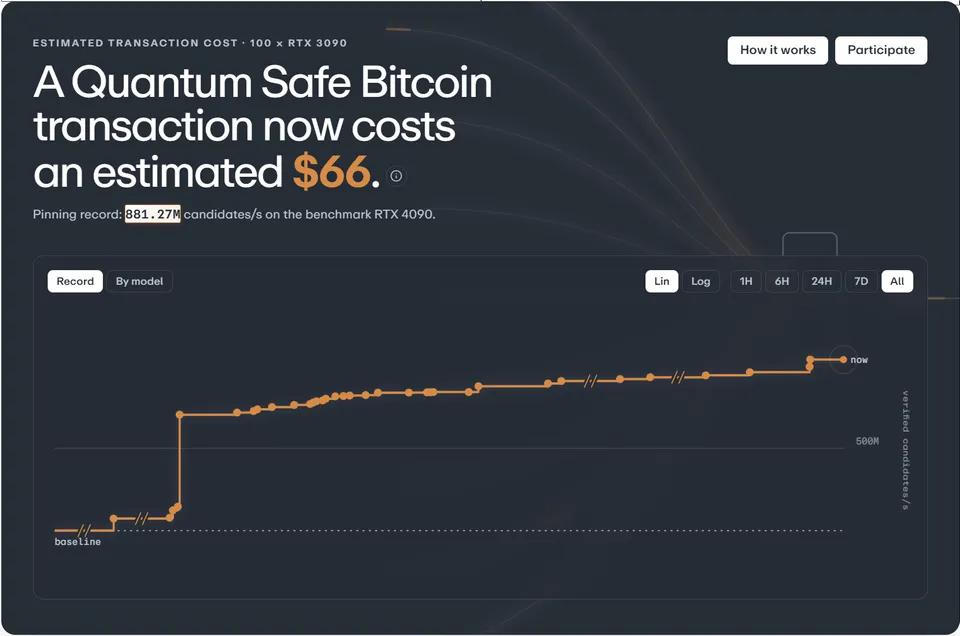
StarkWare researcher Avihu Levy first unveiled Quantum Safe Bitcoin in April, and StarkWare said the technology was proposed as an emergency safeguard against the possibility that quantum computers could render Bitcoin's digital signatures ineffective.
StarkWare said the latest cost reduction increases the chances that investors with large Bitcoin holdings would use QSB in an emergency, but it said the improved technology has not yet been applied to actual Bitcoin mainnet transactions.
StarkWare said QSB could serve as an emergency response tool, while a soft fork that changes Bitcoin's consensus rules would be better suited to defending against broad quantum-computer attacks.
Legacy handling and timelines
Bitcoin developers have proposed migration paths that would restrict fund transfers to quantum-exposed addresses, and a draft specification known as BIP-361 would impose further limits on spending coins that have not migrated to quantum-secure protection five years after implementation. The draft framework remains in draft form and has not been formally adopted by the Bitcoin network, while the Ethereum Foundation said it aims to achieve quantum resistance across the protocol’s execution, consensus, and data infrastructure layers by December 2029. The European regulators warned that information gathered today could be decrypted later in so-called “harvest now, decrypt later” attacks, linking the risk to what can be captured before quantum capability arrives.
Crypto News also reported that ESMA said practical quantum attacks remain beyond current NISQ devices despite rising long-term security concerns, and it said systems capable of threatening existing cryptography are not expected immediately. The EU warning did not say a quantum computer capable of breaking bitcoin’s cryptography exists today, but it said bitcoin cannot simply update its security in the same way a bank does because moving exposed coins would be required before an attack becomes possible.