Europe · updated 1h ago · 2 min read
Giorgia Meloni Announces Italy Ban On Burqa And Niqab In Schools, Limits Foreign Students
Ban burqa and niqab in Italian schools announced by Meloni. Cap on foreign students per class.
Whether hijab omission is highlighted.
5 of 7 outlets skipped it: italian measure needs parliamentary approval within 60 days.
30outlets compared
Same story, two versions
tap a side to read it in full
Hindustan Times
“However, the Italian PM did not mention the hijab, the headscarf worn by some Muslim women, the Associated Press reported.”Read the original ↗
Euronews
“A hijab, by contrast, covers the hair and neck but leaves the face uncovered.”Read the original ↗
Hindustan Times emphasises Meloni omitting mention of the hijab, while Euronews explains what a hijab is.
Meloni’s School Decree
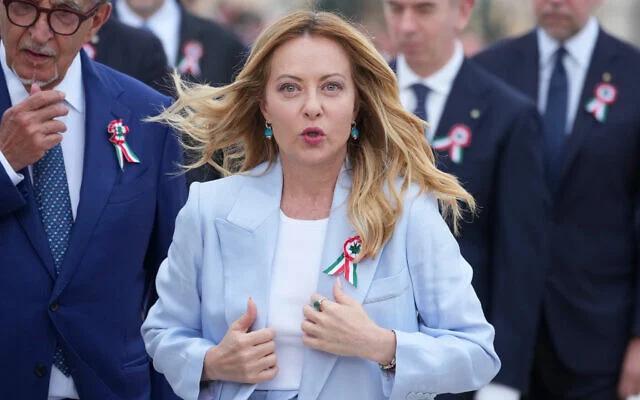
Italian Prime Minister Giorgia Meloni said her government will ban the burqa and the niqab in schools and will limit the number of foreign students per class, with a measure “soon” to be presented at a cabinet meeting.
““A measure will soon be presented at a cabinet meeting to legally set a maximum number of foreign students per class,” Meloni said”
Meloni told a youth-wing gathering of Brothers of Italy (FdI) that the proposal would also require parents of foreign students who face “serious difficulties integrating into the education system” to learn Italian.
The announcement builds on existing Italian rules, including that a 1975 law prohibits helmets or garments that hinder identification without a valid justification and a 2008 clarification allowing full-face veils for religious or cultural reasons when identity verification requires the face to be uncovered.
Meloni’s plan also references a pre-existing cap, with the National Institute of Statistics (ISTAT) saying foreign students account for just under 12% of students enrolled in Italian schools and that since 2010 the number of foreign students is limited to 30% of a class and of a school.
Language Lessons and Limits
Meloni said the measure would make Italian language lessons compulsory for parents of foreign students facing “serious difficulties integrating into the school system,” framing it as part of a broader approach to school integration.
At the same time, she said the government would set a maximum number of foreign students per class, while noting that a 30 percent limit on foreign students per class and school already exists under Italian law and that she did not spell out how that would change.

Euronews reported that Meloni’s package would go before the Italian cabinet and include the ban on burqas and niqabs in schools, a requirement for parents of pupils facing “serious difficulties integrating” to learn Italian, and a limit on places for foreign pupils.E
Hindustan Times added that once approved by the government, the new measure would need parliamentary approval within 60 days to pass into law.H
Opposition and Practical Constraints
Italian school principals pushed back on the feasibility of Meloni’s classroom cap, with Antonello Giannelli of the National Association of School Principals (ANP) telling Ansa that “it is difficult to find a technical solution.”
““In didactic terms the issue is founded and shareable, but it is difficult to find a technical solution,””
Giannelli said the school must take enrollments from the neighborhood’s children, and asked, “If the area has a majority of foreign students, what do we do? Do we send them away?”
Il Fatto Quotidiano reported that principals also said there is no actual measure in place for the burqa and niqab ban, while noting Law 152/1975 already prohibits making it difficult to identify a person without a justified reason.
In the political fight around the proposal, Il Fatto Quotidiano said Avs’ Luana Zanella criticized “still walls and bans, often senseless,” while Futuro nazionale’s Roberto Vannacci said he was “absolutely in agreement” with the burqa ban and argued that limiting foreign students is needed so “we are no longer in an Italian classroom; we are in a foreign classroom.”