
Syria · updated 1h ago · 3 min read
Hakan Fidan Says Recep Tayyip Erdogan Will Visit Syria Soon to Intensify Cooperation
Erdogan planned to visit Syria soon to deepen political, economic, and security cooperation. Turkish Foreign Minister Hakan Fidan announced the planned visit during talks in Damascus.
11 outlets, one story, no spin found.
1 of 2 outlets skipped it: target to raise trade to $10bn..
11outlets compared
Erdogan visit planned
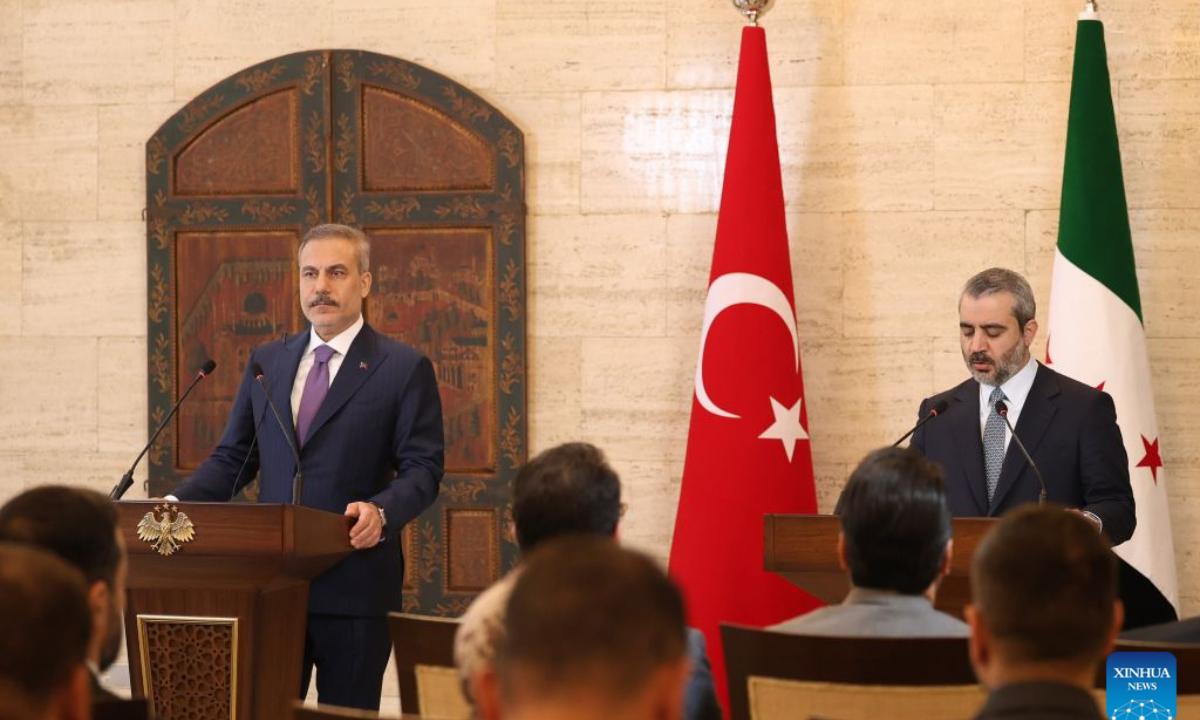
Turkish Foreign Minister Hakan Fidan said on Sunday in Damascus that President Recep Tayyip Erdogan is expected to visit Syria soon as Ankara and Damascus prepare to intensify political, economic and security cooperation.
“Erdogan is expected to visit Syria soon as Ankara and Damascus prepare to intensify political, economic and security cooperation”
Fidan said the visit would be an important step in the relationship and would provide an opportunity to review decisions and measures agreed through the Joint Higher Committee, which the two countries are seeking to turn into the main institutional mechanism governing bilateral cooperation.
The planned agenda for the committee, Fidan said, is expected to cover energy, refugee returns, education and culture, alongside wider political, economic and military issues.
Fidan also said the committee would be jointly chaired, meet regularly and operate through a permanent secretariat, with specialised sectoral committees, while Anadolu Ajansı reported the announcement at a press conference with Syrian counterpart Asaad Shiblani in Damascus.
Anadolu Ajansı quoted Fidan saying, “It is planned that President Recep Tayyip Erdoğan will visit Syria in the near future.”
SDF integration and Israel
Fidan linked the planned deepening of ties to security coordination, welcoming the SDF’s decision regarding integration into Syrian state institutions and stressing that Turkey regarded Syria’s unity, sovereignty and territorial integrity as essential.
Anadolu Ajansı reported Fidan describing the SDF’s dissolution and steps toward merging into Syrian state institutions as “an important initiative,” and he said the merger of all armed elements under the central state framework is necessary to reinforce sovereignty, territorial integrity, and social unity.

Fidan also framed Israel as a destabilizing factor, accusing it of seeking to “destabilize” Syria and calling its policies “the most serious obstacle to this positive trajectory.”
In the same joint press conference coverage, Assaad al-Chaibani said the Abou Dhouhour base strike sent a “message of sabotage to the process of building the Syrian state,” and he argued the strike had “no legitimate or legal justification.”
Atlasinfo quoted Fidan saying, “You know the name of this actor: Israel,” while also quoting Assaad al-Chaibani’s claim that the attack would “certainly have no impact on Syrian-Turkish relations.”
Trade, energy, returns
Beyond security, the sources describe an expanding economic and institutional track that Fidan said would be governed through the Joint Higher Committee, with Shibani saying the partnership had produced around 40 agreements and memoranda of understanding connecting 22 Syrian ministries and government agencies with Turkish counterparts.
“increase bilateral trade from nearly $4 billion last year to $10 billion”
The Arab Weekly reported that the two sides were seeking to increase bilateral trade from nearly $4 billion last year to $10 billion, and it said the committee’s agenda would include energy and refugee returns alongside education and culture.
In energy cooperation, Shibani said a bilateral agreement signed in May 2025 enabled electricity to flow across the border into northern Syria, and he said more than 700,000 Syrians had returned from Turkey since the political change.
Fidan also said Turkish Trade Minister Omer Bolat’s recent visit to Damascus and Aleppo with a delegation of Turkish businesspeople focused on boosting investment and expanding trade, particularly in the energy sector.
The Arab Weekly quoted Shibani on the returns scale and the trade target, while Anadolu Ajansı included Fidan’s framing that “Old Syria was a regime isolated from the world” and that the departure of old Syria and arrival of new Syria “has become a factor that brings stability to the region.”