Gaza Genocide · 31 July, 2026 · 2 min read
Trump Announces Hamas Disarmament Agreement as Netanyahu Rejects Gaza Withdrawal Framework
Hamas agrees to disarm under Trump-backed plan and hand weapons to a governing body. Board of Peace announces disarmament deal; withdrawal to follow, Trump says Israel is very happy.
390 outlets told this the same way.
4 of 5 outlets skipped it: ben-Gvir urged killing 30 to 40 Palestinians nightly.
390outlets compared
Trump deal meets backlash
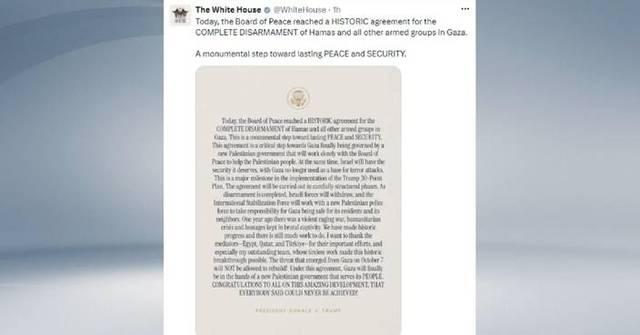
Donald Trump announced that an agreement had been reached on the disarmament of Hamas in the Gaza Strip and said on Truth Social that "the Peace Council (created for the reconstruction of Gaza) has reached a historic agreement for the complete disarmament of Hamas and all other armed groups in Gaza." In the same announcement, Trump said Israeli forces would withdraw from Gaza "as disarmament is completed," while senior Hamas officials confirmed an agreement "concerning the weapons issue" and "a gradual withdrawal" of Israeli forces from Gaza.
“The version made public does not reflect Israel's position.”
Israel’s Prime Minister Benjamin Netanyahu rejected the framework, with Doron Spielman telling Reuters that "The version made public does not reflect Israel's position." Israel also said its intelligence had established that Hamas had rearmed and recruited new people since the ceasefire announced by Trump in October 2025, even as aid agencies and the Health Ministry in Gaza reported at least 13 dead in Israeli attacks on Sunday.
Netanyahu ties withdrawal to disarmament
At a Cabinet meeting Sunday, Netanyahu said "Israel rejects the 15-point document" and that "The IDF will not make any withdrawal until Hamas is truly disarmed." In a taped interview, Netanyahu also said the Israeli state clings to security interests and that the Israeli army will remain in its current positions until Hamas is completely disarmed, while Hamas asked for clarifications from the Peace Council chaired by Trump.
Hamas officials told AFP that the council’s top Gaza envoy Nikolai Miladinov’s statement focused on the disarmament file without referring to commitments including humanitarian aspects and halting all attacks on the Gaza Strip. Qatar blamed the Israeli occupation for delaying implementation of Trump’s plan, with Qatari Foreign Ministry spokesman Majed Al-Anssari saying that "it is clear to the international community who is obstructing the implementation of the agreement" and that "the full responsibility lies with the Israeli side."
Escalation rhetoric and stakes
As negotiations over Gaza’s post-war order continued, Israel’s far-right National Security Minister Itamar Ben-Gvir called for a sharp escalation in strikes to kill "30 to 40" Palestinians every night in Gaza, breaking with Netanyahu ahead of discussions on the enclave’s future. Ben-Gvir said in a podcast with Rom Braslavski that "I think that targeted killings should be carried out in Gaza, removing 30, 40 people every night," and Iranian Deputy Foreign Minister Kazem Gharibabadi condemned the remarks on X.
The dispute over disarmament and withdrawal also fed into the broader diplomatic effort, with ABC News describing Jared Kushner’s meeting with Hamas and Netanyahu as an effort to salvage Trump’s peace plan and noting that the meeting with Netanyahu was due to follow. Meanwhile, the Acento report said Hamas accepted the agreement but that the schedule faces an obstacle because the plan states Israel would begin to withdraw in parallel with Hamas’s disarmament process, while Netanyahu demanded the Palestinian group first surrender and destroy all of its arsenal.