Iran12 September, 20263 min read
Iran-Linked Group Used Claude To Target U.S. Warships, The Hill Says
This article is an automated aggregation of coverage from news outlets. Our editorials offer in-depth analysis curated by the NewsCord team.
Iran-linked group used Claude to collect data on U.S. warships. Anthropic and WSJ reported the group gathered ship locations, satellite imagery, and aircraft data.

AI, missiles, and resilience
A report cited by The Wall Street Journal, via the U.S. company Anthropic, said an Iran-linked group used the AI model Claude to collect and analyze information about U.S. warships, including “the location of ships and aircraft” and “information about naval communications systems,” then used Claude to turn the data into “actionable targeting intelligence.” Islam Times frames the significance of that reporting as part of a broader lesson from “the recent war between Iran, the United States and Israel,” saying the U.S. and Israel’s reliance on “information and technological superiority” did not match what happened on the ground.
The Hill adds that Iran has resumed production of ballistic missiles, with the Wall Street Journal reporting Iran assembled new missiles using existing components in more limited quantities than before the war in several underground sites, including the Khojir missile facility in southeastern Iran. The Hill also says a U.S. official told the Journal that Iran likely resumed production after it and the U.S. signed an interim peace deal to end the war in June, while a White House official said the U.S. “is watching Iran and has eyes on their every move.”
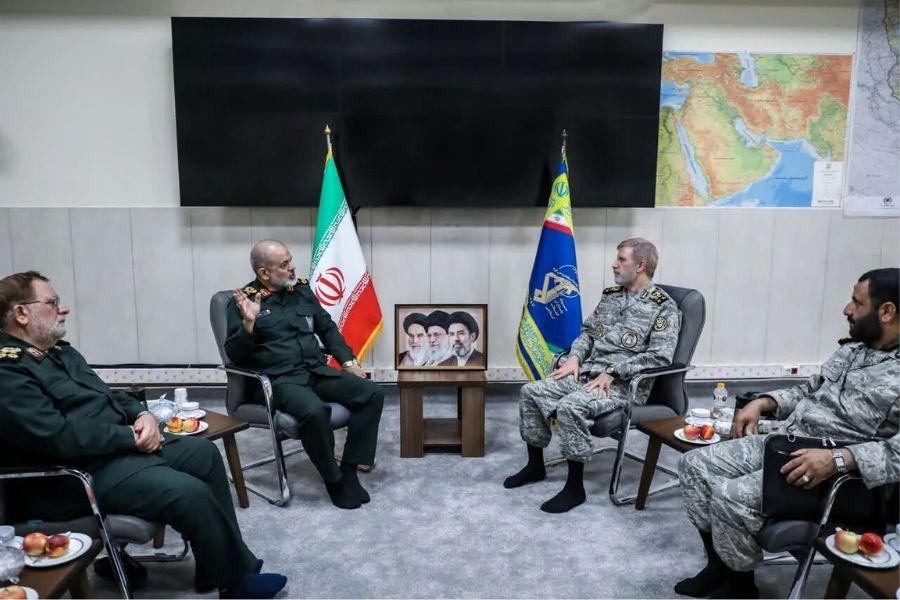
IRGC: ‘exceed enemy’s expectations’
On Sep 12, 2026, IRGC and Army commanders said Iran’s military capabilities “exceed enemy’s expectations,” with the IRGC statement describing “the miscalculations they had made regarding the strength of the Iranian military” becoming evident “on the ground.” WANA News Agency reports that Army Commander Major General Amir Hatami told the joint meeting that “any aggression would face a unified, swift, intelligent, and strong response” from the forces of the Islamic Republic of Iran Army and the IRGC.
At the same meeting, IRGC Commander Major General Ahmad Vahidi stressed national unity and cohesion as “among the most important achievements,” and described “unprecedented intelligence and operational coordination” among armed forces and law-enforcement agencies as a “key pillar for ensuring victory.” WANA News Agency also says Vahidi commemorated the memory of those killed in the recent war, including Major General Seyed Abdolrahim Mousavi and Major General Aziz Nasirzadeh, and said the Army and IRGC “brought the terrorist powers to their knees.”

What comes next, and what’s at risk
The Hill reports that the conflict has stretched into its sixth month, with no deal for peace apparently in sight, and says the U.S. and Iran have quarreled over control of the Strait of Hormuz, which Iran has closed off.
The Hill adds that the report says Tehran launched several ballistic missiles at multiple American military aircraft at Muwaffaq Salti Air Base in Jordan overnight Tuesday into Wednesday, and that Trump denied the report, telling NewsNation’s Robert Sherman that there was no damage, “none whatsoever.”
Islam Times argues that the key issue is not only the number of missiles or drones launched but “the technological, industrial and military architecture” that makes it possible to “produce, deploy and regenerate” Iran’s power.
It also points to the Shahed-136 drone as an example of a weapons concept developed by Iran becoming a model for major militaries, saying in 2025 the U.S. Air Force sought the production of a “one-to-one copy” of the Shahed-136 as an experimental platform for developing and testing counter-drone systems.