Full story
Sanctions and sovereignty clash
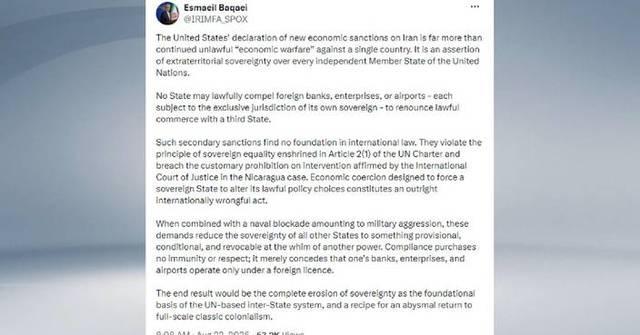
Iran’s Foreign Ministry spokesperson Esmaeil Baghaei condemned new US economic sanctions against Tehran, saying they go beyond “economic warfare” and violate the sovereignty of independent countries.
“go beyond “economic warfare” and violate the sovereignty of independent countries”
In a post on X on Saturday, August 22, Baghaei said Washington cannot force banks, companies and airports in other countries to refrain from lawful trade with Iran, and he described US secondary sanctions as contrary to international law.
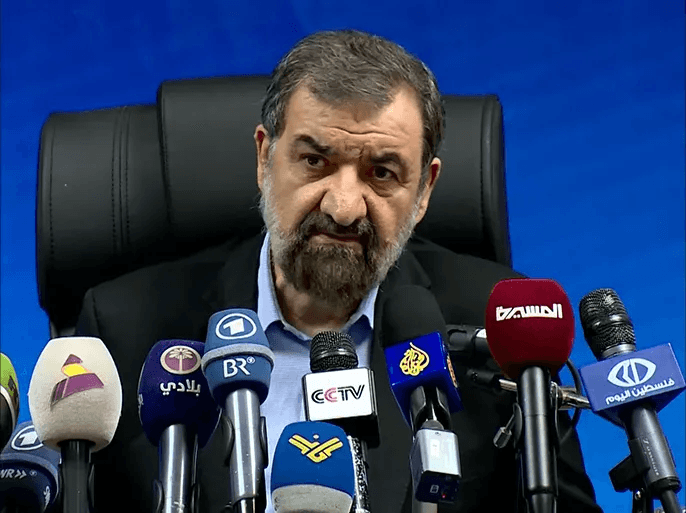
Baghaei argued that the measures amount to an attempt at “extraterritorial sovereignty” over independent members of the United Nations, and he said Washington had no legal authority to compel foreign banks, companies or airports to stop conducting lawful trade with Iran.
The Iranian criticism came as the United States announced what it called the “toughest sanctions in history” against Iran while increasing economic and maritime pressure on Tehran, according to 8AM Media and Energy Update.
Baghaei cites UN Charter
Baghaei told Kurdistan24 that “no state has the legal right to force foreign banks, companies, or airports in other countries to sever their lawful commercial relations with a third country,” framing the sanctions as an illegal economic war.
He added that secondary sanctions have “no basis in international law,” and he linked the pressure to the “provisional, conditional, and revocable” sovereignty of other states when combined with what he described as a naval blockade.
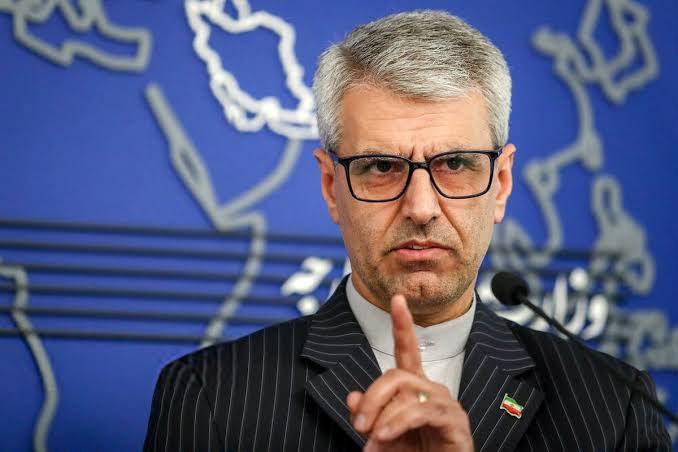
In a separate statement carried by PressTV, Baghaei said “No State may lawfully compel foreign banks, enterprises, or airports - each subject to the exclusive jurisdiction of its own sovereign - to renounce lawful commerce with a third State,” and he argued that such secondary sanctions violate the principle of sovereign equality enshrined in Article 2(1) of the UN Charter.
PressTV also reported Baghaei warning that the combination of economic coercion and military pressure amounts to “a recipe for an abysmal return to full-scale classic colonialism.”
Trump’s pressure and Iran’s response
Iran’s condemnation of the sanctions was paired with warnings that the US campaign could undermine the UN-based international system, with Baghaei describing it as a return to “full-scale classic colonialism” in the framing used by Middle East Monitor and Muslim Network TV.
“Economic Warfare and Isolation on an unprecedented scale”
Middle East Monitor also reported that US President Donald Trump announced his intention to launch “the most crushing economic operation ever taken against any country,” describing maximum-pressure as “Economic Warfare and Isolation on an unprecedented scale.”
In the Express Tribune, US Treasury Secretary Scott Bessent warned allies that they must choose between supporting or opposing Washington’s efforts to economically isolate Iran, saying, “you are either with us or against us,” and he predicted the plan would lead to the collapse of Iran’s government.
Iran’s Foreign Ministry, as quoted by the Express Tribune, condemned the sanctions as “hostile action,” while also describing “Economic sanctions and pressure are the other side of the coin of war and military aggression,” and it said it would respond to what it called hostile US actions.