West Bank26 October, 20263 min read
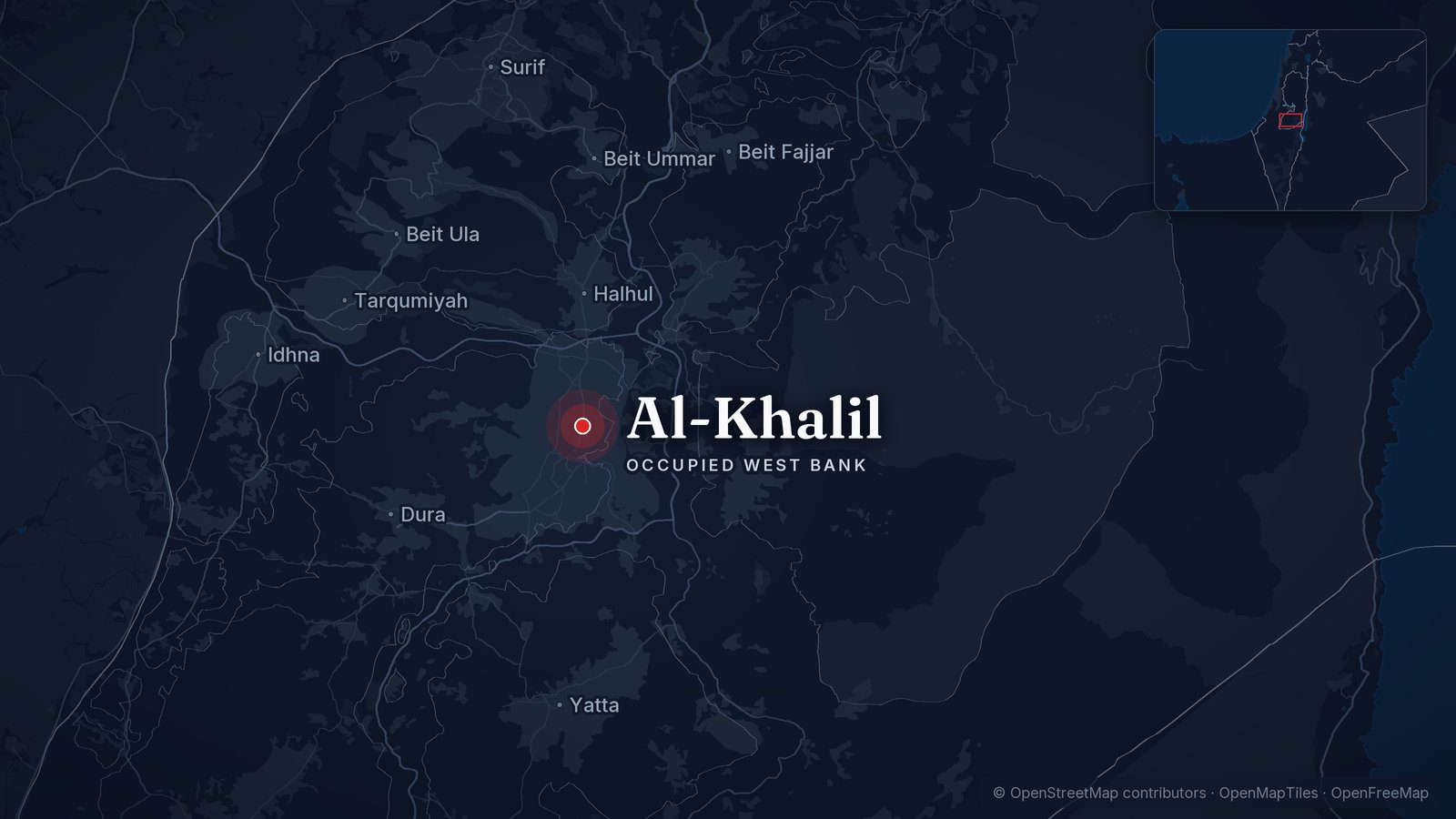
MapIsraeli Forces Raid Hebron, Detain Journalists, Fire Tear Gas and Laser Beams
3 West Asian2 Western Alternative2 Western Mainstream1 OtherMap: © OpenStreetMap contributors, ODbL · Cropped for layout
This article is an automated aggregation of coverage from news outlets. Our editorials offer in-depth analysis curated by the NewsCord team.
Israeli forces raided Hebron, detained journalists, fired tear gas and pointed lasers at reporters. CPJ documented violations including detentions, tear gas, lasers, and raids on journalists' offices.
Save coverage image
DW was read line by line by the Watchdog: 6.0. See the score →
Hebron raid and media targeting
Israeli forces launched a major raid on Hebron on Friday after an attack that left two Israeli soldiers dead, and the Committee to Protect Journalists said the operation included detention, tear gas, laser targeting, and raids on journalists’ offices. Israeli forces detained independent journalist Musab Qafisha and Rai Al-Raeda Riad Khamays for several hours on Saturday, and Suhaib Al-Ayuai documented tear gas being fired toward journalists covering the raid. Soldiers directed laser beams at journalists and raided the premises of Al-Ghad Channel in Hebron on Saturday, accusing the channel of turning the offices into a military barracks.
Israeli forces intercepted Al-Ghad Channel’s newsroom staff, and Al-Araby TV correspondent Fadi Al-Assa published on Monday a recording showing an Israeli drone flying above him and his colleagues as they worked. The Committee to Protect Journalists said the latest incidents came as part of a series of attacks by Israeli soldiers and settlers against Palestinian and foreign journalists in the West Bank, especially during the olive-picking season.
Displacement and UN warnings
UN human rights chief Volker Türk warned on Monday that Israel’s “aggressive operation” in Hebron raised serious concerns of ethnic cleansing as the number of Palestinians forced from their homes passed 3,000 on the eve of Israeli elections. The UN aid coordination office OCHA said aid partners were supporting local authorities in Hebron to meet the needs of more than 3,000 people evacuated by Israeli forces since Friday, and it said the operation demolished homes and commercial property and deprived residents of the ability to move freely. Antonio Guterres said on Monday that “settlements are expanding, evictions are unrelenting with Palestinians driven from their lands,” and he wrote that “We are seeing an increasingly coercive environment, with the spectre of ethnic cleansing looming ever larger.”
Volker Türk said the “Declarations by senior Israeli Government officials indicate that the measures implemented are punitive in nature and designed to instil fear,” and he called for those displaced to be allowed to return home. The UN also said the operation began after two Palestinian gunmen opened fire on an Israeli military checkpoint near Hebron on Friday, killing two soldiers and wounding three others, and it said both gunmen were killed.
Settler outposts and political stakes
An Associated Press report carried by Al-Manar said Israeli settlement expansion and the displacement of Palestinians in the occupied West Bank are likely to persist regardless of Tuesday’s election outcome, and it said Netanyahu’s main challengers offered little prospect of reversing policies entrenched under his government.
Mairav Zonszein, senior Israeli analyst at the International Crisis Group, said, “There shouldn’t be any illusions,” and she said at best a new government would be able to slow down “the extremely crazy acceleration that we’ve seen in the last four years of every aspect of Israel’s aggression in the occupied territories and inside Israel itself.”
The Tubasi family’s displacement from the village of Jalud continued despite an Israeli court order requiring the military to bring them home, and Mahmoud Tubasi told reporters that settlers besieged the family’s house for 19 days before forcing them out in July.
More than 250 settler outposts established under Netanyahu provided bases for extending control over surrounding land, and Dror Etkes estimated the outposts brought approximately one-fifth of the West Bank under effective settler control.
Dror Etkes said, “The story is over. There will be no massive dismantlement of settlement,” and he described the outcome as “a full and prouder-than-ever apartheid regime.”