Technology and Science14 September, 20262 min read
Rocket Lab Protests NASA’s $700M Mars Telecommunications Contract Award to Blue Origin
This article is an automated aggregation of coverage from news outlets. Our editorials offer in-depth analysis curated by the NewsCord team.
NASA awarded Blue Origin a contract worth up to $700 million for Mars telecoms. Rocket Lab filed a GAO protest alleging unfair evaluation and eligibility rule violations.

GAO Protest Over $700M
Rocket Lab formally challenged NASA’s decision to award Blue Origin a contract worth up to $700 million for the Mars Telecommunications Network, filing its protest with the U.S. Government Accountability Office on September 11.
Rocket Lab said the award decision “appears to be inconsistent with the eligibility criteria mandated by Congress,” and it alleged NASA subjected its proposal to a “punitive review” that produced “incorrect assertions and conclusions.”
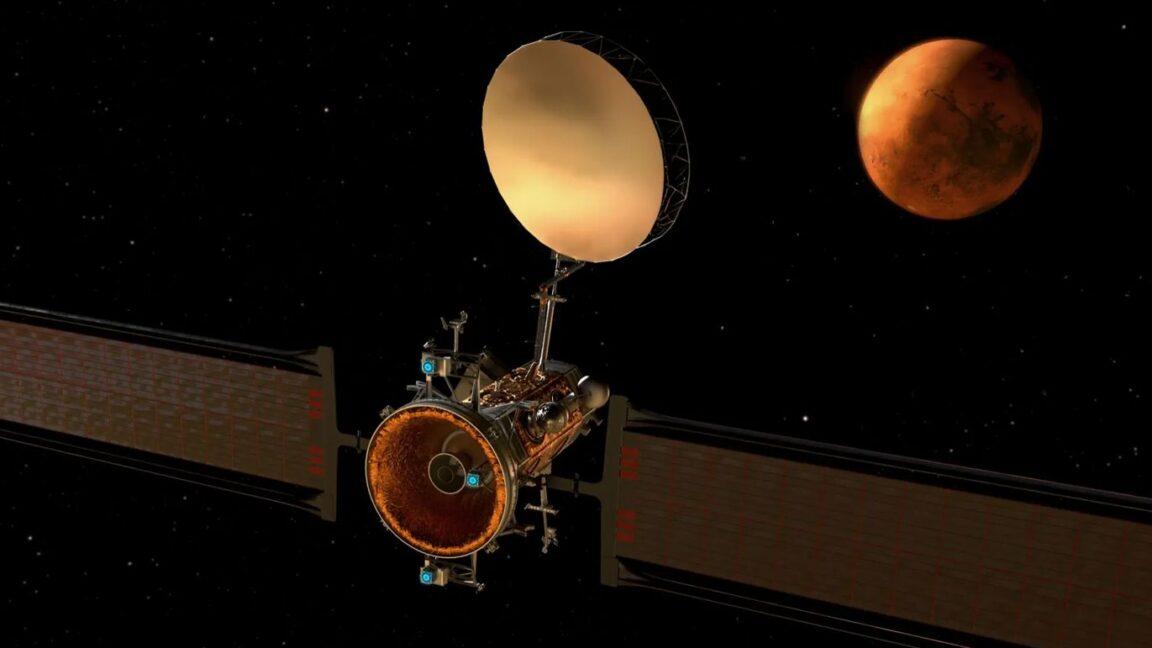
NASA’s contract is a firm-fixed-price award issued in early September after a request for proposals in May, requiring Blue Origin to deliver a high-performance Mars Telecommunications Orbiter by December 31, 2028.
NASA expects the network to be operational at Mars by 2030, and the initial architecture begins with one high-performance spacecraft in Mars orbit.
Rocket Lab argued that its lower-cost Mars Sample Return architecture included a dedicated communications orbiter and claimed it was the only commercial bidder to propose a standalone telecommunications spacecraft.
Blue Origin Warns of Delay
Blue Origin responded that the Rocket Lab protest could potentially delay the mission’s goal of launching in 2028, saying “We remain confident in the strength of our proposal, in NASA’s rigorous selection process, and in Congress’s clear intent to support competition for the Mars Telecommunications Network program.” Rocket Lab’s filing also framed the dispute as a defense of critical long-term American infrastructure at Mars, with the company saying “Procurement standards exist to ensure fair competition and protect public investment.” The dispute centers on Congress appropriating $700 million in July 2025 for a high-performance Mars telecommunications orbiter under statutory conditions for eligible bidders.
Those conditions required eligible bidders to be U.S. commercial providers that received NASA funding in fiscal 2024 or 2025 for a commercial Mars Sample Return study and proposed a separate, independently launched telecommunications orbiter. NASA selected Blue Origin to design, develop, integrate, launch, and operate the Mars Telecommunications Network under a firm-fixed-price contract, with delivery required by December 31, 2028.

Schedule Pressure and Aging Relays
The contract is intended to relay science data, imagery, navigation information and critical communications for missions on and around Mars, but the program’s architecture begins with one orbiter despite the name “Mars Telecommunications Network.” Rocket Lab’s protest comes as NASA’s primary Mars relay spacecraft are aging, with Mars Odyssey launched in 2001 and the Mars Reconnaissance Orbiter launched in 2005. SpaceDaily described the award as resolving selection unless the protest changes it, while also noting that it “does not lengthen the interplanetary schedule.”
Rocket Lab pointed to its twin ESCAPADE spacecraft built for NASA as evidence it can deliver interplanetary hardware on a fixed-price contract and tight schedule, with those probes launched aboard New Glenn in November 2025 and expected to reach Mars in September 2027. As of publication, Rocket Lab’s allegations have not been resolved in a public GAO decision, leaving the outcome of NASA’s evaluation and the eligibility-criteria dispute still pending.