Protestsupdated 1h ago3 min read
Sébastien Lecornu And Laurent Nuñez Push Intelligence To Blame LFI For France Violence
This article is an automated aggregation of coverage from news outlets. Our editorials offer in-depth analysis curated by the NewsCord team.
The executive would steer intelligence to blame La France Insoumise for October violence. Government aims to use intelligence to frame ultraleft violence as political manipulation.
14 outlets told this the same way.
Blame Game After Oct 17
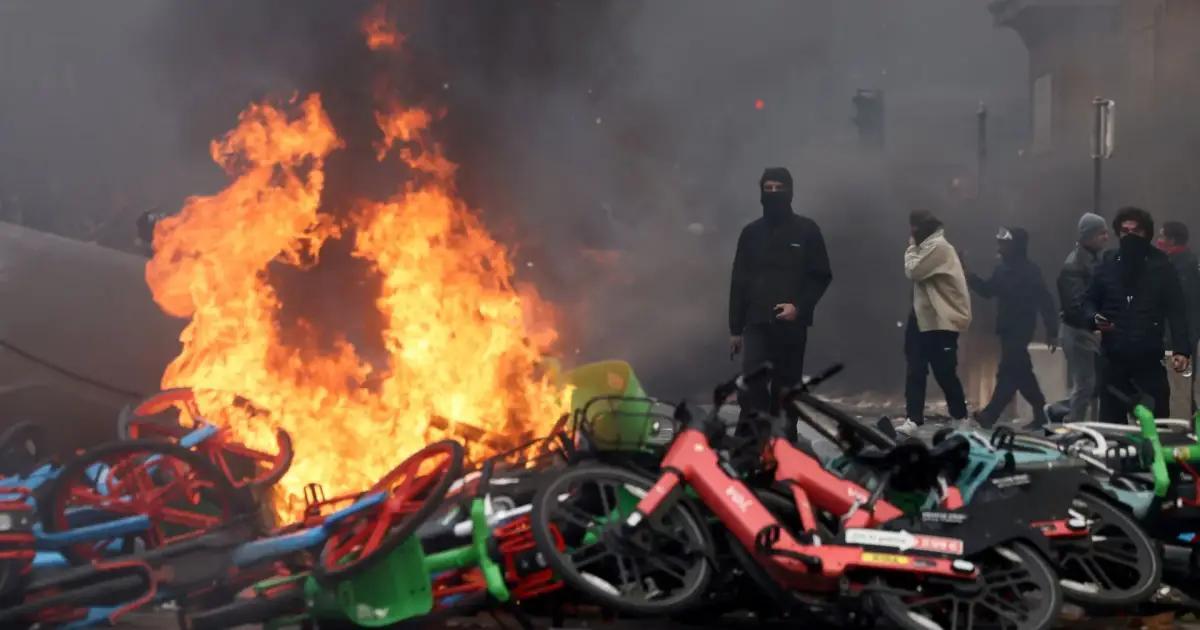
Prime Minister Sébastien Lecornu and Interior Minister Laurent Nuñez pushed intelligence work to blame the ultraleft and La France insoumise for violence that occurred this weekend, a territorial intelligence commissioner said in written exchanges dated October 18 and reviewed by Mediapart. The territorial intelligence commissioner said, "We are being told verbatim to write that it is LFI behind the movement, whereas objectively it is false according to the general view of the RT (Territorial Intelligence) services," and a police major stationed in public security in Occitania said, "the government is obsessed with trying to trash LFI and attack the far left." Manuel Bompard told France Info that "If the territorial intelligence produces false reports, if we ask them to write inside these reports things that are false … that’s called a state scandal," as LFI announced it would sue Laurent Nuñez before the Cour de justice de la République.
El Español described Prime Minister Sébastien Lecornou blaming Jean-Luc Mélenchon for being behind the extreme street violence, while Mélenchon denied it and blamed police for seeking confrontation. El País said the political spectrum united to blame Jean-Luc Mélenchon for the violence, after the prime minister pointed to responsibility of La France Insoumise from the very Saturday.
Curfews, Arrests, and Protests
French authorities promised a "massive" police presence for planned protests on Saturday and imposed localized curfews for a second consecutive night, as the country grappled with fallout from its worst rioting in years.
Interior Minister Laurent Nuñez told MPs at the National Assembly he deeply regretted the weekend violence and accepted some responsibility, saying, "I accept my share of the responsibility, but I would not want us to forget the significant responsibility" of a political camp and troublemakers.

Macron told the nation, "Those who destroyed must pay," and the president added, "Those who looted must pay back," as he promised meetings this week to discuss "concrete proposals" and to listen to protesters' demands.
More than 2,000 people were arrested by Sunday, and Paris police announced an overnight curfew from 11 p.m. Tuesday in the worst-hit areas around the Place de la République and Les Halles.
Nearly 2,400 people were arrested and almost 1,000 police officers and firefighters were injured, while Prime Minister Sébastien Lecornu said after an emergency meeting that "no one was killed and that is a miracle."
Political Stakes Ahead of 2027
Marine Le Pen attempted to profit from the crisis ahead of the presidential election in April 2027, and she railed against President Emmanuel Macron’s handling of the crisis in a video statement. Macron had "no longer has any “credibility or authority"" and Le Pen described her party as positioning it as capable of restoring order without offering firm evidence for claims about who instigated the protests. El Liberal argued that Mélenchon combined calls for nonviolence with a discourse that concentrates blame on the Government and the police, and it said, "Who breaks a storefront makes a decision."
El Liberal also said Mélenchon’s political failure was to offer an explanation where denunciation of power occupied almost all the space, warning that a leader who aspires to govern must show they know how to set limits to the mobilization they support. El Español said polls place the far left as the second or third force in next year’s elections, and it quoted a left-wing protester saying, "I wish Mélenchon would say ‘not in my name,'" as street anger risked devouring those who tried to appropriate it.