
Canada · 15 September, 2026 · 3 min read
Stephen Harper Says Canada Must Walk Away From U.S. Trade Talks To Maintain Sovereignty
Canada had no choice but to walk away from U.S. trade talks. Diversifying trade away from the United States is necessary to defend sovereignty.
9 of 10 outlets skipped it: summit event production uses a US firm, raising procurement optics questions.
17outlets compared
Same story, two versions
tap a side to read it in full
National Post
“Canada felt compelled to walk away and to see a trade war commence in earnest”Read the original ↗
BBC
“The prime minister has pledged to bring in C$1tn in investments in the next five years”Read the original ↗
Shifts emphasis from trade-sovereignty conflict to investor-relations and growth strategy.
Harper backs trade break
Former Conservative prime minister Stephen Harper closed out the Canada Investment Summit in Toronto on Tuesday by saying Canada had “no choice” but to walk away from trade talks with the United States and “must pursue diminished reliance upon the United States” to maintain sovereignty.
“must pursue diminished reliance upon the United States”
Harper delivered the remarks as chairman of the Alberta Investment Management Corporation and co-founder of the investment fund Vision-One Management, and he said Canada faced “the ongoing violations of our trade agreement by the United States” and “the current impasse in negotiations.”
The Globe and Mail reported Harper endorsed the Carney government’s efforts to diversify the economy while taking a swipe at past Liberal energy policies, and it quoted Harper saying, “It leaves no choice but for Canada to pursue diminished reliance on the U.S.”
The same Toronto summit was framed by the Globe and Mail as a day of discussions among global and domestic private and public sector investors, CEOs and other high-profile financiers, with Prime Minister Mark Carney setting a goal to raise $1-trillion in new investment over the next five years.
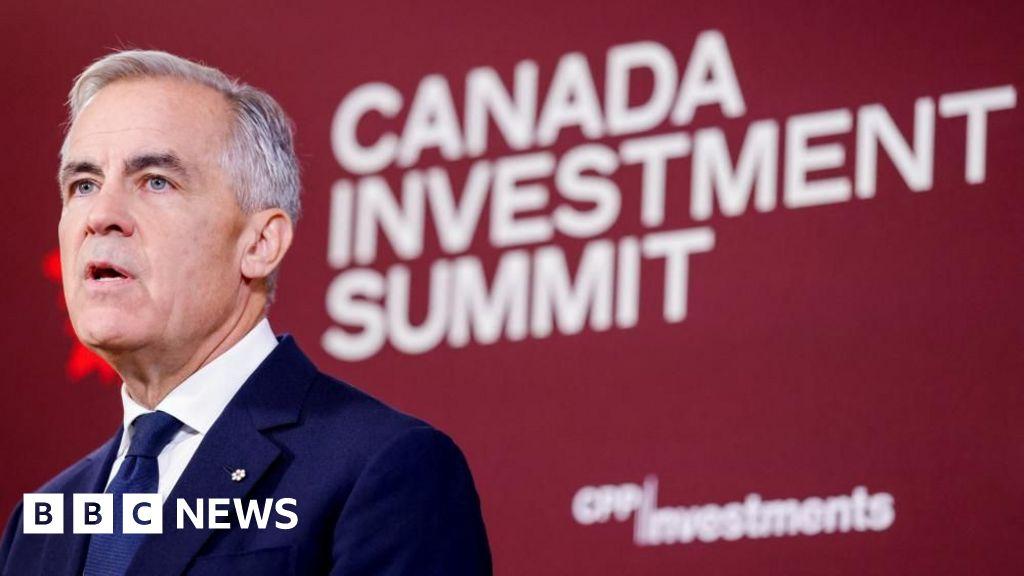
In the BBC’s account of the summit, Carney pitched Canada as a “safe harbour” and said he pledged to bring in C$1tn in investments in the next five years as he sought to reduce Canada’s reliance on the US.B
Protests and competing frames
As Carney’s investment summit unfolded in downtown Toronto, hundreds of activists rallied against the event, with Reuters saying the demonstration opposed projects that would expand fossil fuel infrastructure, increase military production and transfer greater control of public assets to private investors.
Reuters quoted Hailey Asquin of Common Horizon saying, “We don't want to see fossil fuels that are going to destroy our climate,” and it added that protesters also objected to “military-related industries” and AI that “directly threaten[s] workers' jobs.”

The Toronto Star described the protests as targeting Carney’s global investment summit as it kicked off, with Jasmine Peardon of Capitalism Can’t Be Fixed saying, “it very quickly became clear we had to resist it.”
In the same Star report, Rachel Small from the World Beyond War said, “It’s an auction of Canadian public resources, institutions, infrastructure, airports and highways and water and power plants,” linking the summit to fears of privatization and public money shifting into private hands.
While the protests gathered, the BBC reported Carney’s pitch to more than 100 major investors in Toronto and said the summit offered “more than 160 projects” ranging from data centres to pipelines and port expansions.B
Airports, tariffs, and next steps
Carney’s summit messaging tied Canada’s investment push to a changing trade relationship, with Le Devoir reporting that on Tuesday Washington imposed new 50% duties on a range of Canadian products and that Carney reiterated Canada remained ready to “develop and implement” a mutually beneficial trade agreement with the White House.
“develop and implement a mutually beneficial trade agreement”
Le Devoir also quoted Carney telling “our American friends” that “we have always maintained close ties,” and it said he argued any resumption of dialogue would have to be done “in respect of the traditions and sovereignty of each party.”
The BBC reported one of the big announcements as Carney’s plan to allow private investment in four of Canada’s main airports in Toronto, Vancouver, Montreal and Calgary, and it quoted Lily Chang of the Canadian Labour Congress warning, “In the middle of a trade war, handing profitable public infrastructure over to private investors is exactly the wrong move.”B
In the same BBC account, Nick Barry-Shaw of the advocacy group Council of Canadians called it “a privatisation summit” and said, “This isn't nation building,” as the summit generated nearly C$500bn in new investments across sectors like critical infrastructure, digital technology, energy and defence.B
Meanwhile, the CBC described the summit’s behind-the-scenes focus on investment pitches and quoted Defence Minister David McGuinty saying, “This is a great opportunity for us to reach out to the world and say come one, come all, come join us with money and with research, engineering and other capacity.”