Technology and Science06 August, 20263 min read
Syria’s Transport Minister Badour Meets World Bank Regional Director Khalifa on Rail, Road Rehabilitation
This article is an automated aggregation of coverage from news outlets. Our editorials offer in-depth analysis curated by the NewsCord team.
Transport Minister Badr met World Bank regional director Dalia Khalifa to discuss rail rehabilitation. World Bank pledged to support Syria's multimodal transport development and funding for studies.
Damascus Rail and Road Talks
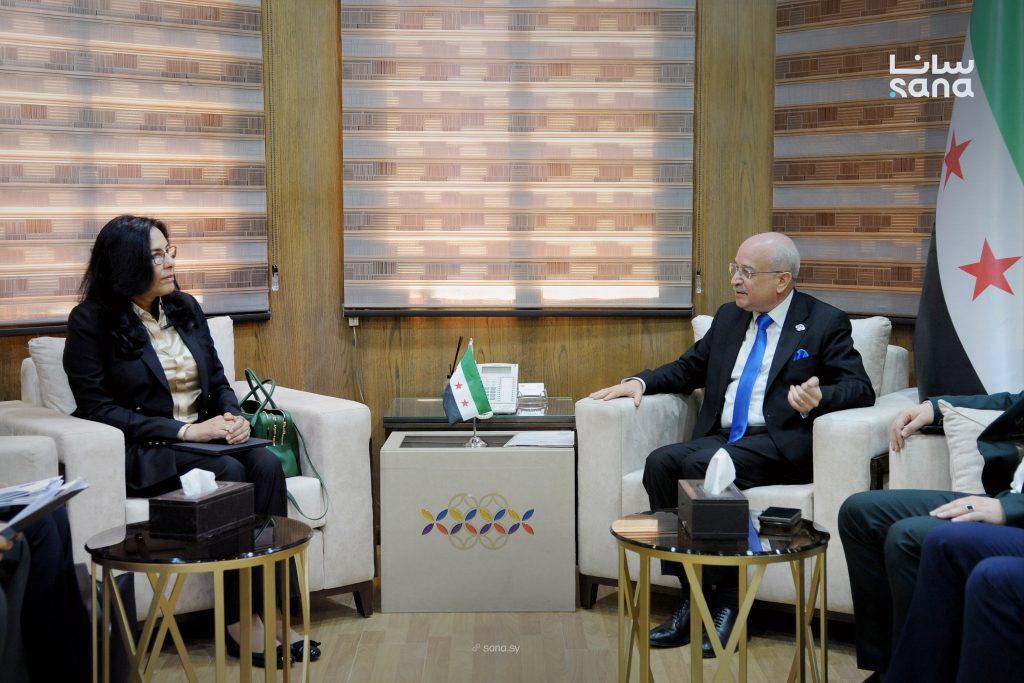
Syria’s Transport Minister Yousef (Ya’qub) Badour? (Yairab Badar) met Dalia Khalifa, the World Bank’s new regional director for the Middle East, and her accompanying delegation in Damascus to discuss ways to enhance cooperation in the transport sector and support rehabilitation and development of road and railway infrastructure.
The meeting covered CMA-CGM’s proposal to prepare a study on transporting containers by rail from the Latakia container terminal to dry ports in Aleppo, Homs, and Damascus, alongside the possibility of establishing a public-private partnership to implement the project.

Badour said Syria’s railway network stretches to about 2,800 kilometers, including 2,500 kilometers of standard gauge lines and 300 kilometers of narrow gauge lines, with roughly 1,050 kilometers of standard-gauge lines currently in operation.
He also described a phased approach to rehabilitating the Syrian railway, starting with segments that can be restarted within a short period so revenues can be directed later toward maintaining and rehabilitating other network segments.
Khalifa affirmed the World Bank’s commitment to supporting Syria in developing a multimodal transport system, saying collaboration with the Ministry of Transport would help prepare a comprehensive project for developing the railway sector.
Funding, corridors, and bids
Badour said the Syrian government allocated funding from the general budget to rehabilitate major corridors, foremost the road linking the Jordan border to Damascus, Homs, and Hama, extending to Aleppo and the Turkish border, in addition to the Damascus-An–Tanf-Deir Ezzor corridor. He put the estimated cost of rehabilitating these main roads between $300 million and $500 million, and said international bids have been issued with proposals from several companies currently being evaluated to select offers and commence implementation. The Transport Minister also said the ministry is developing a national policy for sustainable multimodal land transport, alongside a strategic vision for railway sector development, to link different modes of transport.
Khalifa explained that completing the partnership framework requirements and securing the necessary financial resources would allow presenting the project to the World Bank’s Board of Directors at the earliest possible time. In a separate account, SANA said the meeting was held at the ministry building in Damascus and discussed highway projects under the Build-Operate-Transfer (BOT) system and the possibility of reviewing previous feasibility studies.
What comes next for rail
The World Bank and Syria’s Transport Ministry also discussed how to accelerate railway development through technical and financial preparation, with Khalifa saying that leveraging currently available resources could finance technical studies, feasibility studies, support procurement processes, financial management, and project preparation. Al-Jazirah Net reported that the Ministry of Transport announced in April that about $200 million would be allocated through a World Bank grant to fund infrastructure development projects for railways, including upgrading the railway network and purchasing locomotives and new equipment. In that same report, Badr stressed the importance of the transport sector in supporting economic recovery and reinforcing ties with neighboring countries, while also noting that the ministry is working on a national policy for sustainable multimodal road transport and a vision to develop the railway sector.
Al-Jazirah Net further stated that Badr said only about 1,000 kilometers of the total 2,800-kilometer railway network in Syria remain operational, while the rest require rehabilitation to return to service. It also cited Badr’s earlier remarks that the damage to the railways is estimated at about $5.5 billion, and that the World Bank allocated $200 million for rehabilitating priority corridors in the network.