Africa08 September, 20263 min read
Tigray Authorities Accuse Ethiopia’s Federal Government of Drone Strike in Hintalo District
This article is an automated aggregation of coverage from news outlets. Our editorials offer in-depth analysis curated by the NewsCord team.
Tigray authorities accuse Ethiopian government of a drone strike in Hintalo district Ethiopia has conducted multiple drone strikes in Tigray in recent weeks

Drone strike in Tigray
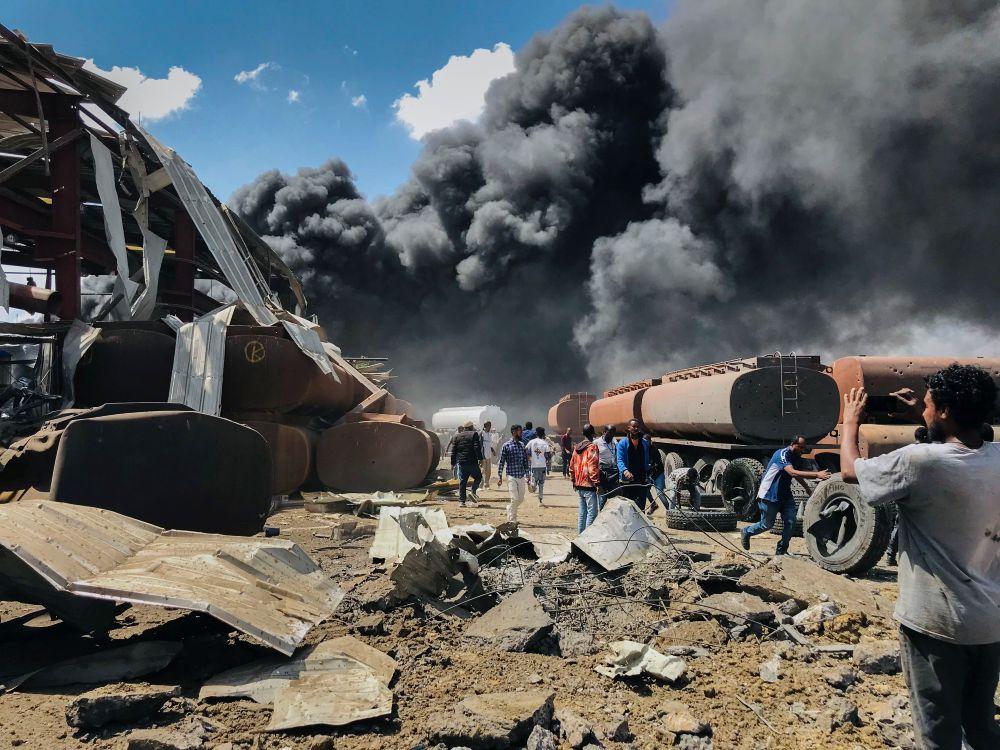
Tigray authorities accused Ethiopia’s federal government of launching another drone strike on Tuesday, saying it occurred in Hintalo district south of Mekelle. Tigray People’s Liberation Front (TPLF) vice president Amanuel Assefa told AFP, “There was a drone strike this morning in Hintalo district,” and said he was hearing that “civilians have been killed in their residences.” AFP reported it could not independently verify the claim, and said the federal army did not respond to requests for comment.
“‘There was a drone strike this morning in Hintalo district,’ south of the regional capital, Mekelle, Tigray People’s Liberation Front (TPLF) vice president Amanuel Assefa told AFP.”
A medical source at a nearby hospital, speaking to AFP on condition of anonymity, said at least three people were wounded in Tuesday’s strike, including at least one member of the Tigrayan forces. The conflict tracking group ACLED has previously recorded 14 drone strikes in Tigray this year, focused on military targets, as the federal government massed troops at the regional border and raised fears of a return to the 2020-2022 civil war that killed some 600,000 people.

Ethiopia’s drone build-up
Ethiopia has been manufacturing drones at two factories since last year and is now thought to possess a fleet numbering in the thousands, analysts say, after Turkish-made UAVs proved decisive for federal forces during the 2020–2022 civil war. Prime Minister Abiy Ahmed inaugurated the SkyWin Aeronautics Industries factory in Addis Ababa in March 2025, and the state-run Ethiopian News Agency said the facility manufactures “unmanned aerial vehicles for both civilian and military use,” designed and built by “our own young professionals.” AFP quoted Pieter Wezeman of the Stockholm International Peace Research Institute saying, “One hall with some shiny drones tells us little about what the real production capabilities are,” and said his assessment was that “a substantial part of all that is imported.”
The federal army has also acquired Turkey’s high-end Akıncı combat drones and the more basic Bayraktar TB2, alongside cheaper Wing Loong models from China and Mohajer-6 drones from Iran, while only the federal army has military drones in the country of 130 million people. A second factory, Aeroabay, opened in late 2025 and produces thousands of small weaponized drones costing between $5,000 and $10,000 each, according to Wim Zwijnenburg of PAX, with some controlled by fiber-optic cables to resist electronic jamming.
Fear, attrition, and escalation
ACLED says federal forces have carried out 102 drone strikes in the northern Amhara region since an insurgency by the Fano militia began in April 2023, and it also says drones have been used against rebels in Abiy’s home region of Oromia. Magnus Taylor of the International Crisis Group said drones have been “blamed for the deaths of civilians on various occasions,” while ACLED says the attacks sought to “disrupt mobilization and planning” during a forced recruitment campaign by the Tigrayan authorities. Amanuel Assefa, vice president of the Tigray People’s Liberation Front, accused the army of seeking “to create terror among the people, to target political and military officials, to destroy special targets and basic civilian infrastructure.”
Some analysts fear the strikes could signal preparations for a new ground campaign, and Edward Bach of Verisk Maplecroft said attacks on weapons depots and logistics routes could be “in anticipation of a potential offensive” by federal forces. But Taylor said Abiy “does not seem to want to be drawn into a costly ground war in Tigray at this point,” adding that Abiy views the conflict as “a war of attrition for now,” because he can use drones essentially unopposed to keep it going longer.