Published

Technology and Science

Trump Signs Executive Order Cutting Childhood Vaccines, Splitting MMR Into Three Shots

Order Cuts Vaccines

President Donald Trump signed an executive order on Monday laying out new recommendations for childhood vaccinations, including limiting the number of vaccines recommended for children and splitting vaccines into tiers so some are advised for all children and others for children considered higher risk.

Image via WCAX

At a glance

  1. Executive order calls for reducing recommended childhood vaccines from 17 to 11.
  2. MMR vaccine would be split into three separate injections during visits.
  3. Critics say evidence-free autism link claims accompany the changes.

The order recommends that the measles, mumps and rubella shot, known as MMR, be given as three separate shots and that, when possible, children should be vaccinated in separate visits.
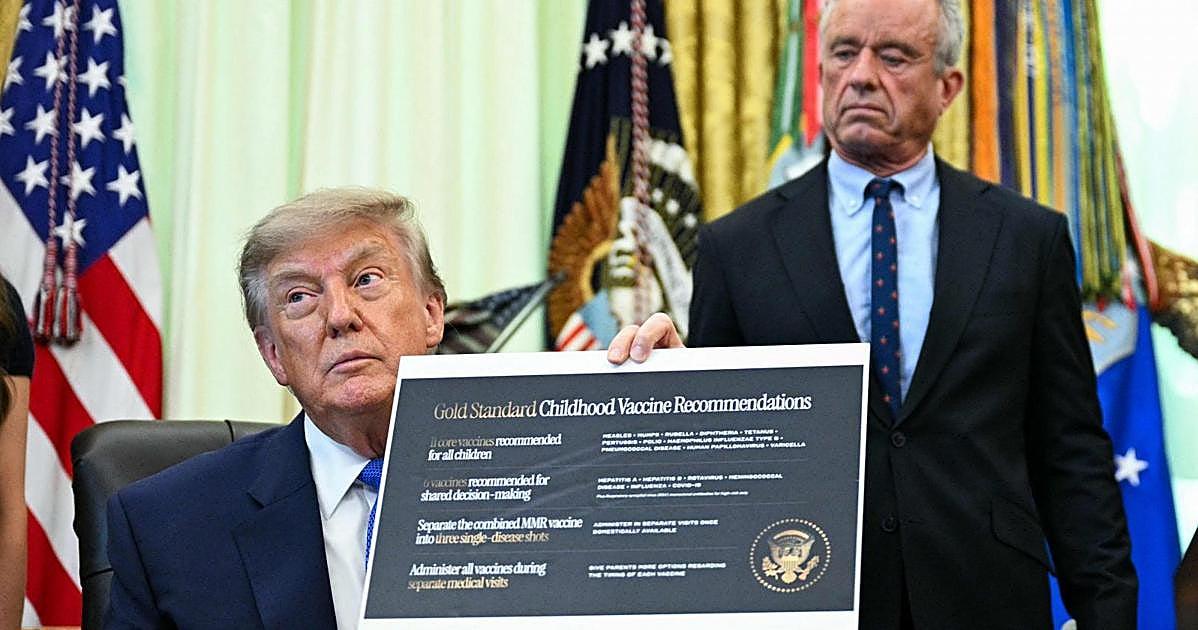
In the Oval Office with the executive order in front of him, Trump said, "Today, we're proud to officially announce the United States of America's Gold Standard Childhood Vaccination Recommendations" and repeatedly cited autism as part of the guidance.

The executive order also directed the Health and Human Services Department to reassess vaccine sequencing and timing within 90 days, and it did not mention autism even as Trump did.

CBS News chief medical correspondent Dr. Jon LaPook warned that Trump’s assertion that "nothing bad can happen" is incorrect, citing hepatitis B exposure from an infected caregiver as an example.

Doctors Denounce Plan

The American Academy of Pediatrics called the order "disheartening" and "dangerous" in a statement issued later Monday, as the plan drew immediate criticism from scientists, physicians, Democrats and some congressional Republicans.

American Academy of Pediatrics president Andrew Racine said, "The issue is not that the science isn't done. The science is done," while Reuters reported that physicians roundly rejected the action as no new science warranted a change.

Sen. Bill Cassidy, a physician who chairs the Senate Health Committee, posted on X, "I'm a doctor. This executive order is wrong. The President does not have the expertise to make these changes."

The order’s practical effect was described as uncertain, with Reuters reporting that Dr. Aaron Milstone said the main outcome would be "confusion for parents" and that conflicting messages would likely lead parents to delay vaccination.

CIDRAP quoted Andrew D. Racine, MD, PhD, saying, "Delaying or skipping shots is risky, especially as measles continues to spread and children go back to school," as it warned spacing out MMR could increase risk of infection or lead to kids missing doses.

States, Costs, and Autism

The executive order puts new pressure on states, health insurers, pharmaceutical companies and medical professional to align with the president’s approach, while also directing the Justice Department to challenge state vaccination laws over exemptions and school immunization requirements set by states.

Reuters reported that the order directs the Justice Department to challenge state vaccination laws, escalating a federal fight over school immunization requirements set by states, and it instructs the attorney general to sue over state laws the administration says conflict with parental authority, religious freedom, disability accommodations and equal protection.

The Guardian described the order as attempting to override the authority of the US Centers for Disease Control and Prevention (CDC), noting that the CDC is the federal agency tasked with recommending vaccines, not the White House.

The Guardian also said the order would require the MMR vaccine to be broken into three separate shots once it becomes available in the US, and it quoted Trump saying, "Together, there could be a possibility they’re quite lethal," about the MMR vaccine.

In response to the autism framing, Reuters reported that AAP President Dr. Andrew Racine called the administration’s plans to again look for a link between vaccines and autism misguided, adding that "40 well-designed studies had already examined the question" and found no link.

Explore the original reporting

Compare all 29 sources

How each outlet frames it

Every outlet we compared, the headline it ran, and a link to the original article.

Western Mainstream

ABC
ABC

Trump revoluciona el calendario de vacunas y reduce las exigencias gubernamentales

10 August, 2026

ABC7 Los Angeles
ABC7 Los Angeles

Trump signs an order that asks to space out childhood vaccines, contrary to doctors’ recommendations

11 August, 2026

AP News
AP News

Trump signs order calling for spacing out childhood vaccines, against medical groups' guidance

10 August, 2026

BBC
BBC

Trump signs order to limit childhood vaccines and split MMR shots

11 August, 2026

CBS News
CBS News

Trump signs order on childhood vaccine recommendations, citing autism

10 August, 2026

CNBC
CNBC

Trump signs executive order calling for fewer childhood vaccines, falsely linking shots to autism

10 August, 2026

FOX 10 Phoenix
FOX 10 Phoenix

Trump signs executive order on vaccine flexibility

10 August, 2026

NBC Bay Area
NBC Bay Area

Trump to sign executive order calling for spacing out childhood shots

10 August, 2026

NewsNation
NewsNation

Live: Trump, Kennedy make announcment on vaccine flexibility

10 August, 2026

PBS
PBS

WATCH: Trump signs executive order on childhood vaccine recommendations

10 August, 2026

Reuters
Reuters

Trump order reduces US vaccine schedule, seeks to split MMR shot

10 August, 2026

The Guardian
The Guardian

Trump signs order attempting to override CDC vaccine schedule and break up MMR shots

10 August, 2026

The Hill
The Hill

Trump order calls for fewer childhood vaccines

10 August, 2026

The Washington Post
The Washington Post

Trump demands major changes to childhood vaccine recommendations

10 August, 2026

Other

ABC7 Bay Area
ABC7 Bay Area

Doctors push back on Trump executive order to change childhood vaccine schedule

10 August, 2026

Alcanzando el Conocimiento

Trump signs order to reduce to 11 the vaccines recommended for children in the U.S.

10 August, 2026

CIDRAP
CIDRAP

Trump signs executive order to break up measles, mumps, rubella vaccine

10 August, 2026

Diario Versión Final

Trump ordena separar las vacunas infantiles y senador Cassidy cuestiona la medida

10 August, 2026

El Nuevo Herald
El Nuevo Herald

Trump firma un decreto para reducir las vacunas recomendadas para la infancia

10 August, 2026

Primera Hora
Primera Hora

Trump will change child vaccination recommendations: this is what you need to know

10 August, 2026

West Asian

Al Jazeera
Al Jazeera

Trump orders fewer childhood vaccinations including splitting up MMR

11 August, 2026

Western Alternative

DiarioBitcoin
DiarioBitcoin

Trump will sign an order to divide the MMR vaccine despite scientific evidence

11 August, 2026

Washington Times
Washington Times

Trump rewrites childhood vaccine schedule, orders shots to be spaced out

10 August, 2026

WCAX
WCAX

Trump signs executive order on child vaccines

10 August, 2026

Local Western

FOX 5 Atlanta
FOX 5 Atlanta

Trump signs order to space out childhood vaccines

10 August, 2026

NBC4 Washington
NBC4 Washington

Trump signs executive order calling for spacing out childhood shots

10 August, 2026

San Francisco Chronicle

Trump signs order calling for spacing out childhood vaccines, against medical groups' guidance

10 August, 2026

San Francisco Chronicle

The Latest: Trump signs executive order calling for spacing out childhood shots

10 August, 2026

The News-Item
The News-Item

The Latest: Trump signs executive order calling for spacing out childhood shots

10 August, 2026

Read stored source text: ABC7 Bay Area

Trump and Kennedy asserted without evidence a link between vaccines and autism. President Donald Trump on Monday signed an executive order that makes recommendations about the childhood vaccine schedule and says that the measles, mumps and rubella (MMR) vaccine should be split into three separate shots. For parents across the country, there's unlikely to be an immediate impact on vaccine access, and the executive order is likely to face legal challenges. "Today, we're proud to officially announce the United States of America's gold standard childhood vaccination recommendations. And that has to do with many subjects, but including autism in particular," Trump said before signing the order. The order is already sparking pushback from the medical and public health communities, which have continued to reiterate decades of studies showing the safety and efficacy of the childhood vaccine schedule and vaccines more broadly. They commonly note that while the political landscape on vaccines has changed, the science has not. "This executive order is part of a troubling pattern by the administration to attempt to unilaterally change vaccine guidance, particularly for children, rather than relying on the transparent, scientific review that has guided the U.S. childhood vaccine schedule for decades," said Dr. Jan K. Carney, president of the American College of Physicians. The American Academy of Pediatrics predicts it would take a decade to create a separate vaccine for each part of the MMR vaccine. Republican Sen. Bill Cassidy, who is a physician, called the order "wrong." "I'm a doctor. This executive order is wrong. The President does not have the expertise to make these changes. Vaccines are overwhelmingly safe. Vaccines are effective. Vaccines DO NOT cause autism," Cassidy posted on X. Trump said that children decades ago children received a "small fraction" of currently required vaccines. "In those times, people were much healthier," Trump said, without citing specifics. Doctors point out that about 400 to 500 people died each year in the United States before the introduction of the measles vaccine and some 48,000 were hospitalized. Now, the number is close to zero, according to the CDC. Measles was declared eliminated in the U.S. in 2000, but cases have crept back up in recent years with lower vaccine intake. "And of course, the high rates of autism now observed did not exist. So, there's a reason for such epidemic rates of autism. And we're going to bring it back to much closer to where it was," Trump said. The rates of autism have increased in recent decades, but doctors largely attribute this to better awareness and diagnosis of the condition. Trump said while "we did not know exactly what the cause is with respect to autism, it is essential to our research efforts that we have the very best vaccine recommendations in the entire world." Dozens of studies involving millions of people have not found an established link between vaccines and autism. He called the order "a major victory for parents' rights, religious and constitutional rights, and for the gold standard science." There will likely be no immediate effect on vaccine access -- the order requests reports from agencies in 90 days. And Trump said parents can still choose to get their children all vaccinations, if they wish. Typically the Centers for Disease Control and Prevention provides recommendations as to which vaccines to receive and at what age, which often guide health insurance coverage. It remains unclear how this EO may potentially reshape those recommendations. According to a White House fact sheet, the order recommends that "all children get immunizations to provide protection for 11 diseases -- a decrease from the 18 diseases recommended by the Centers for Disease Control and Prevention in 2024." The CDC had previously reduced the number of recommended shots on the vaccine schedule, though the changes had been stayed by a federal judge in March. Medical organizations pushed back on the vaccine policy changes, noting that there was no credible scientific evidence to justify them. The executive order will also recommend "separating out the combined MMR vaccine into three single-disease shots and recommends administering all vaccines during separate medical visits to give parents more options regarding the timing and frequency of this vaccine administration," according to the fact sheet. The recommendation to split the MMR into three separate doses comes nearly a year after Trump posted on his social media platform that the vaccine should be broken up "INTO THREE TOTALLY SEPARATE SHOTS (NOT MIXED!)" But a 2024 CDC article -- which was still on the agency's website Monday afternoon -- said that "[n]o published scientific evidence" pointed to "any benefit in separating the combination MMR vaccine into three individual shots." Vaccines do not "overload" a baby's immune system. Even if babies receive several vaccinations in one day, their immune systems are under significantly more pressure from the bacteria and viruses they encounter daily in their environment, according to the CDC. It is not accurate -- as Trump said -- that there is any vaccine that contains the same volume of liquid as a bottle of soda, or anywhere close. The average vaccine contains half a milliliter of fluid, about one-tenth of a teaspoon, according to Johns Hopkins. "By signing this executive order the president is helping Americans who are asking questions, especially post COVID, about vaccine requirements, and opening up a dialogue to encourage public trust," a White House official confirmed. The White House also said that it is still recommending the measles and polio vaccine. Health and Human Services Secretary Robert F. Kennedy Jr. has long espoused skepticism about the safety of vaccines, including the potential for a link between shots and autism. He and Trump made several unsupported claims about links between vaccines and autism at Monday's signing. Kennedy cited a "dramatic increase" in autism rates for the change and attacked the assertion that there are more cases of autism because there is a higher awareness. "Because if we were just noticing it more, we would notice it in older groups, but we're not differently noticing it in kids who were born around 1989 or after," he said. "The older generations are not seeing those generations. So something happened in the in the mid '90s that changed our children, and it has to be an environmental explosion because genes don't cause epidemics." Major medical groups uniformly assert that there is no single cause of autism, but it is largely attributable to genetics and early brain developement. That the safety of vaccines has been studied for decades, and there is no known link to autism.

Read stored source text: ABC7 Los Angeles

The order recommends separating the measles, mumps, and rubella vaccine (MMR) into three injections administered during separate doctor visits, whenever possible. It also instructs the federal health department to improve its vaccine research, which is already part of comprehensive studies, and to present a plan to offer separate childhood vaccines for measles, mumps, and rubella, since there is currently no such option in the United States. The measure marks a radical shift in the Trump administration’s recent efforts to emphasize less controversial health policies related to healthy eating, drug price negotiations, and actions to combat medical fraud ahead of the November midterm elections. Public health experts have expressed concern that spacing out the injections, as Trump proposes, could increase the risk that children contract a vaccine-preventable disease before returning for another visit. Childhood vaccines—and how and when they are administered in combination—undergo rigorous studies, and safety monitoring continues for years as they are used. Trump called the announcement a “great victory for parental rights, religious and constitutional rights, and for science of maximum reliability.” Regarding the order, Trump hinted on Monday afternoon from the Oval Office that the number of vaccines or the timing of their administration could play a role in the rise of autism spectrum disorder cases, even after the medical community and decades of studies have reached the unequivocal conclusion that no such link exists. The order also includes several changes to the childhood vaccination schedule that the Department of Health and Human Services (HHS) had already tried to establish but were blocked by a federal judge. A White House official, who insisted on anonymity in order to brief reporters, said Trump was within his rights to provide his own recommendation through an executive order and assured that the lawsuit blocking the implementation of the HHS-proposed schedule was a separate matter. Dr. Andrew Racine, president of the American Academy of Pediatrics, stated that the announcement spreads uncertainty, fear, and confusion where there “shouldn’t be any of that.” He rebutted Trump’s recommendations and said the previous guidelines should be maintained. “The science on vaccines and their effectiveness has not changed,” he emphasized. “The distribution of viruses and other pathogens in our environment has not changed. Children in this country have not changed in the last 48 hours.” Republican Senator Bill Cassidy, chair of the Senate Health Committee, criticized the executive order on social media, saying vaccines are safe and do not cause autism. “I’m a physician. This executive order is wrong,” wrote the Louisiana senator. “The president does not have the knowledge to make these changes.” Who is in charge of vaccination policy? Although the order calls for a review of vaccination recommendations, it is the states, not the federal government, that have the authority to require school vaccination. The order recommends that states with school vaccination mandates consider updating their laws to reflect the federal government’s preferred schedule, according to a White House fact sheet. Trump ordered HHS in December to review how peer nations approach vaccination recommendations and consider revising U.S. guidelines accordingly. The agency responded by reducing the number of vaccines it recommends for each child, a move that has already been blocked by the courts. Generally, changes to federal childhood vaccination recommendations require the approval of the director of the Centers for Disease Control and Prevention (CDC). The new CDC director, Dr. Erica Schwartz, oversaw policies to promote vaccination among military personnel while serving in a leadership role within the United States Coast Guard. However, public health law expert Lawrence Gostin of Georgetown University noted that the Supreme Court’s interpretation of Trump’s powers could allow him to override Schwartz if she disagrees with the new recommendations. “Clearly this is Dr. Erica Schwartz’s first test,” Gostin said in an email. “The president is placing her in an untenable position.” When asked during a call with White House reporters why the president was advocating splitting the MMR vaccine into three injections to combat a disease separately, the White House official did not present studies to support the decision. He said that is the view Trump has held for some time and that some countries provide single-antigen vaccines for measles in certain circumstances. Kush Desai, a Trump spokesperson, told The Associated Press that the president is “one of countless parents who have raised questions and concerns about the combined MMR vaccine” and said that the plan to develop vaccines for a single disease “would give parents more options about when and how often they are given to their children,” ultimately increasing vaccine acceptance. Studies in babies and infants in the United States have shown that using combined doses for childhood vaccines, instead of one dose per disease, increases the likelihood of completing the full vaccination schedule recommended for a 2-year-old. Other Trump administration actions on vaccination The Secretary of Health, Robert F. Kennedy Jr., an anti-vaccine activist before taking office, sought to reform immunization guidelines at HHS in the first year of the Trump term. He dismissed the 17 members of an advisory commission and replaced them with officials who presented much more restrictive recommendations, which were already blocked by a federal judge. He also personally ordered the CDC to set aside its position that vaccines do not cause autism, without providing any evidence to support the change. Yet, Trump has remained fixated on linking vaccines to autism. He recently increased pressure on the health secretary to identify the cause of autism, something Kennedy had pledged to pursue with new research presented last year. Trump publicly urged the health secretary to give an update on the status of the investigation at a cabinet meeting last month. “How is the autism research going?” Trump asked. “We’ll have an answer,” Kennedy replied. The scientific consensus and decades of studies have unequivocally concluded that there is no link between childhood vaccines and autism. Racine reiterated that point on Monday, noting that the topic has been touched on in “more than 40 well-designed studies in more than seven countries, involving more than 5 million children.” “I’m not sure there’s anything that has been examined as thoroughly as this question,” he said. “And the answer is unequivocally no.” In the Oval Office, Kennedy again said that, in his view, an unknown environmental factor is responsible for rising autism diagnoses and noted that his department would deliver the results of the investigations “as soon as they are ready.” The Monday order comes as children across the country prepare to return to school and as the nation deals with a measles outbreak that, experts warn, could lead the United States to lose its measles-elimination status. Doctors have expressed concern that Trump’s false statements about vaccines could fuel vaccine hesitancy. Federal data show that kindergarten vaccination rates in the United States have been declining, and the share of children with exemptions reached a historic high during the 2024–25 school year. ___ AP reporters Laura Ungar and Mike Stobbe contributed to this report. Swenson reported from New York. ___ This story was translated from English by an AP editor with the help of a generative artificial intelligence tool.

Read stored source text: Al Jazeera

Toggle Play Trump orders fewer childhood vaccinations including splitting up MMR US President Donald Trump signed an executive order calling for fewer routine childhood vaccinations. Among the changes, Trump wants the MMR vaccine split into separate doses, falsely claiming the combined shot could be ‘quite lethal’. Published On 11 Aug 202611 Aug 2026 Save Click here to share on social media share-nodes Share googleAdd Al Jazeera on Googleinfo More from the same show Somali referee arrives for UEFA Super Cup after World Cup exclusion Video Duration 00 minutes 40 seconds play-arrow00:40 Family watches helplessly as Colombia quake destroys home Video Duration 00 minutes 44 seconds play-arrow00:44 China’s Long March 7A rocket explodes after lift-off Video Duration 00 minutes 31 seconds play-arrow00:31 Fire rages after drone strikes Libya’s largest oil refinery Video Duration 00 minutes 23 seconds play-arrow00:23 Where did all the money go if the US is running out of weapons? Video Duration 00 minutes 46 seconds play-arrow00:46 Soldiers take cover as Colombia quake flattens military barracks Video Duration 00 minutes 33 seconds play-arrow00:33 Turkiye passes law giving thousands of PKK members chance at amnesty Video Duration 01 minutes 05 seconds play-arrow01:05 [](https://www.aljazeera.com/) Your browser does not support the audio element. audio-rewind audio-play audio-forward * audio-volume-mute close You rely on Al Jazeera for truth and transparency We and our 1019 partners store and access personal data, like browsing data or unique identifiers, on your device. Selecting Allow all enables tracking technologies to support the purposes shown under we and our partners process data to provide. Selecting Reject all or withdrawing your consent will disable them. If trackers are disabled, some content and ads you see may not be as relevant to you. You can resurface this menu to change your choices or withdraw consent at any time by clicking the Manage preferences link on the bottom of the webpage. Your choices will have effect within our Website. For more details, refer to our Privacy Policy. We and our partners process data to provide: Use precise geolocation data. Actively scan device characteristics for identification. Store and/or access information on a device. Personalised advertising and content, advertising and content measurement, audience research and services development. List of Partners (vendors) Allow all Reject all Manage preferences

Read stored source text: Alcanzando el Conocimiento

The measure also calls for separating the measles, mumps, and rubella (MMR) vaccine; doctors and health organizations questioned the decision. The U.S. president, Donald Trump, signed on Monday an executive order to modify federal childhood vaccination recommendations and reduce from 17 to 11 the vaccines recommended for children, in a new push by his administration against the current immunization schedule. The measure also proposes separating the MMR vaccine into three separate injections, which are currently given as a single dose, and distributing the doses across different medical visits. Trump defended the decision by stating that the United States has a broader vaccination calendar than other developed countries and he again questioned a possible link between vaccines and autism. The order, however, sets forth recommendations and not mandatory changes to vaccination policies. Which vaccines are covered by the new recommendation? The order identifies as central vaccines those targeting measles, mumps, rubella, diphtheria, tetanus, pertussis, polio, Haemophilus influenzae type B, pneumococcal disease, human papillomavirus, and varicella. Other vaccines, including those for respiratory syncytial virus (RSV) and hepatitis A and B, would be recommended for certain high-risk groups. For diseases such as COVID-19 and influenza, the administration proposes using a “clinically guided shared decision-making” approach, in which doctors and families individually determine whether vaccination is appropriate. According to The Hill, the order does not remove vaccines that fall outside the 11 central recommendations. It is a change in federal recommendations about when and for whom their administration is advised. Trump proposes separating the MMR vaccine. One of the most controversial points of the order is the proposal to divide the MMR vaccine into three independent applications and administer them in different medical visits. Trump claimed that the combined vaccine could be “quite lethal,” a claim questioned by specialists and medical organizations. The plan also faces a practical problem: currently manufacturers do not market in the United States standalone vaccines against measles, mumps, and rubella as a common alternative to the combined vaccine. After the signing, a White House official acknowledged this situation and stated that the Department of Health and Human Services (HHS) must present Trump with recommendations on the topic within 90 days. The proposal to administer vaccines in different visits also raised questions about costs families could face from additional copays. Trump said his administration would work with families, while a White House official said the government is awaiting HHS recommendations. The figure of “72 vaccines.” The Hill notes that Trump and Health and Human Services Secretary Robert F. Kennedy Jr. have used the figure of “72 injections” to argue that American children receive too many vaccines. However, that figure refers to the number of injections a child could receive from birth to age 18, and not to 72 distinct vaccines or 72 required doses. The calculation includes individual seasonal vaccines, such as influenza. For years, the United States has recommended childhood vaccination against 17 diseases. The measure revives a prior dispute. Trump’s order revisits an initiative that the Advisory Committee on Immunization Practices (ACIP) of the Centers for Disease Control and Prevention (CDC) attempted to push this year. The committee had voted in favor of reducing the childhood vaccination schedule. However, in March a federal court determined that Kennedy-selected members lacked the necessary experience to sit on the panel and blocked changes to the calendar. Trump referred to that litigation in the new order, though a White House official insisted that the presidential measure is independent of the committee’s actions and complies with current court orders. It also seeks to reduce school requirements. The new policy also targets vaccination requirements for school entry. The Trump administration seeks to have states lower the number of vaccines they require for children to attend schools, an aspect that could trigger fresh legal challenges given that state governments play a central role in defining these requirements. The measure comes as the dispute continues between the federal administration and medical organizations over changes proposed to the childhood vaccination schedule. Physicians and organizations reject the decision. The order drew criticism from doctors and health organizations. Republican Senator Bill Cassidy, a physician and chair of the Senate Health Committee, called the order misguided and stated that vaccines are safe and effective and do not cause autism. He also warned that separating vaccines could lead to children receiving more injections to obtain the same protection and increase parents’ doubts about vaccination. The American Academy of Pediatrics (AAP) defended the current calendar and noted solid evidence on the safety, efficacy, and necessity of the vaccines recommended in the United States. The organization also questioned public figures who have linked the number of childhood vaccines to chronic diseases or autism. PhRMA, the association representing the U.S. pharmaceutical industry, doubted that the order represents progress toward a policy based on the so-called “gold standard science.” The organization argued that the U.S. childhood vaccination schedule rests on decades of scientific research and public health experience and warned that reducing it based on recommendations from other countries could mean a lower level of protection against diseases that remain serious and, in some cases, potentially deadly for children. Trump’s decision comes as the United States faces the highest number of measles cases in more than 30 years, according to The Hill. Source: The Hill / NPR.

Read stored source text: BBC

- Published US President Donald Trump has signed an order that calls for fewer childhood vaccines and also recommends splitting the mumps, measles and rubella (MMR) shots. "Decades ago, children received only a small fraction of the vaccines required today," Trump said. "In those times, people were much healthier and of course the high rates of autism now observed did not exist." The president has long cast doubt on the safety of MMR vaccines, but multiple studies have found no connection between the shots and autism. The order also recommends that the number of childhood vaccines drop to 11 from the existing 18 recommended by the American Academy of Pediatrics (AAP). Trump's order serves as guidance, not a mandate, since shots required for school attendance are set at the state level, rather than by the federal government. Speaking in the Oval Office on Monday, the president said his administration "is recognising gold standard childhood vaccine recommendations for only 11 core vaccinations against the most serious and dangerous diseases". The immunisations recommended for all children under the order are for measles, mumps, rubella, diphtheria, tetanus, pertussis, polio, Haemophilus influenzae type B, pneumococcal disease, human papillomavirus, and varicella or chicken pox. "We're reducing them," Trump said. "It's not only that you're doing fewer vaccines, or jabs, as they say, but you're doing them in a series of visits to the doctor." The president suggested the MMR vaccine could be "quite lethal" if given at once. He compared it to pouring a bottle of soda into a child's body. When a reporter asked for evidence of the "lethal" claim, Trump said: "What I've heard is that there are some people that say it is that way." According to the Centers for Disease Control and Prevention (CDC), external, the MMR vaccine carries a very small risk of febrile seizures for young children. Those with health issues, including severe allegeric reactions or weakened immune systems, are advised to consult with healthcare providers before taking the shots. The agency says "most people who get MMR vaccine do not have any serious problems with it", and that getting the vaccine "is much safer than getting measles, mumps, or rubella". According to the CDC, there is "no published scientific evidence that shows any benefit in separating the combination MMR vaccine into three individual shots". Experts say that allowing time between jabs means children are more likely to contract diseases in the interim or that they are more likely to miss appointments if there are multiple shots. Trump's Secretary of Health and Human Services (HHS) Robert F Kennedy Jr said the proposed changes were meant to give parents choice, not prohibit access to childhood vaccines. Since taking office in 2025, Kennedy has sought to change and loosen vaccine regulations. During a tense 20-minute interview on CNN last week, Kennedy insisted he had "never questioned the efficacy of the MMR vaccine". Trump administration officials have said the order means children in the US would receive much less than the 72 shots recommended under the previous vaccine schedule, a figure that assumes annual flu and Covid-19 doses. Dr Andrew Racine, president of the American Academy of Pediatrics, said Trump's executive order was "dangerous" and not based on "gold-standard science". "Delaying or skipping shots is risky, especially as measles continues to spread and children go back to school," Racine said. Republican Senator Bill Cassidy, who was the deciding vote in the Senate to confirm Kennedy as health secretary, also admonished Trump's executive order on Monday, labelling it "wrong". "The President does not have the expertise to make these changes," Cassidy, a physician, wrote on X. "Vaccines are overwhelmingly safe. Vaccines are effective. Vaccines DO NOT cause autism." Experts fear that if parents refrain from getting their children vaccinated as a result of the discredited idea that childhood vaccines are linked to autism, it risks the re-emergence of diseases like measles. Multiple studies have found no link between the MMR vaccine and autism. A recent high-quality study from Denmark in 2019 looked at 657,461 children and concluded that the data did not support the MMR vaccine causing or triggering autism. On its website, the CDC recommends that two doses of the combined MMR vaccine be given to children, starting with the first dose at 12-15 months and the second between the ages of four and six. How often and how many vaccines children in the US receive is based on the times when vaccines will work best with their immune systems and when they are most vulnerable to certain diseases, according to the AAP. There is no medical reason to delay or skip recommended immunisations, the AAP says. Trump's order also calls for the development of alternatives to aluminium in vaccines, and to test if those alternatives are safer and more effective. But the AAP, external says studies have found no significant health risks associated with the tiny amounts of aluminium salts in vaccines. Small amounts of aluminium salts - which are found naturally in soil, water and foods - have been used in some vaccines for decades in order to boost the body's immune response. That means lesser quantities of the vaccine and fewer doses are needed, according to AAP.

Read stored source text: CBS News

Washington — President Trump signed an executive order on Monday laying out new recommendations for childhood vaccinations, and during his remarks, he mentioned that autism had a role in the guidance. The order recommends limiting the number of vaccines recommended for children and splitting vaccines into tiers so that some are recommended for all children and others would be advised for children considered to be at higher risk. Shots against RSV and hepatitis A and B are examples of vaccinations that would just be recommended for high-risk children, according to the order. It also suggests that the measles, mumps and rubella shot, known as MMR, should be given as three separate shots, and that when possible, children should be vaccinated in separate visits. Those vaccines are not currently on the market in the U.S. as separate shots. The recommendations would upend decades of federal guidance on which vaccines are administered to children, just as the school year is about to begin in many states. The American Academy of Pediatrics called the order "disheartening" and "dangerous" in a statement issued later Monday. The executive order, obtained by CBS News before the president signed it, also directed the Health and Human Services Department to reassess vaccine sequencing and timing within 90 days. The order didn't mention autism, but the president did — repeatedly. "Today, we're proud to officially announce the United States of America's Gold Standard Childhood Vaccination Recommendations and that has to do with many subjects, but including autism in particular," the president said in the Oval Office with the executive order in front of him. "Decades ago, children received only a small fraction of the vaccines required today," Mr. Trump said. "In those times, people were much healthier and of course, the high rates of autism now observed did not exist. So, there's a reason for such epidemic rates of autism. And we're going to bring it back to much closer to where it was." "While we do not know exactly what the cause is with respect to autism, it is essential to our research efforts that we have the very best vaccine recommendations in the entire world," he continued. "So we're reducing them, we're changing it to visits over the period of a year, a year and a half, so they get 20% of what they would have gotten in one big shot." The president cited no evidence for his claims. Research has found no evidence of increased rates of autism among those who are vaccinated compared to those who are not. also undergo intensive safety testing. Research shows that genetics play a role in autism diagnoses. The NIH says some possible risk factors for autism include prenatal exposure to pesticides or air pollution, extreme prematurity or low birth weight, certain maternal health conditions, or parents conceiving at an older age. HHS Secretary Robert F. Kennedy Jr. said next month, the federal government's Advanced Research Projects Agency for Health is "preparing a major new initiative focused on foundational causes and biology of autism." "We will examine every biologically plausible hypothesis and leave no legitimate, scientific question unexplored," Kennedy said. "Mr. President, you have told us you want answers, so do I. We have just over two years to finish the work and I know you're impatient. And we are moving with an urgency that that deadline demands. We will bring you actions and findings as soon as they are ready." Mr. Trump promised "nothing bad can happen" from the research his administration is doing on autism. Extensive studies have failed to show a link between autism and vaccines. A 2019 Danish study followed 657,461 children and found the autism rate in vaccinated kids was slightly lower. And a 2015 study of 95,727 American children included nearly 2,000 who had an older sibling with autism. If a vaccine had triggered autism in a genetically vulnerable child, links would have appeared, but their risk was no higher. The study found the MMR vaccine does not increase a child's risk of autism. CBS News chief medical correspondent Dr. Jon LaPook also warned that the president's assertion that "nothing bad can happen" is incorrect. "There's a widely held misconception that the only way a baby gets infected with hepatitis B is from the mother. Well, actually, a baby can get infected with hepatitis B by exposure to fluids from an infected caregiver," he explained, as one example. "It turns out more than 800,000 Americans have chronic hepatitis B and about half of them don't know it. And if a baby gets infected with hepatitis B, about 90% of the time it goes on to get chronic hepatitis B, which can be devastating." While the CDC advises states on policy, states — not the federal government — set policies for school immunization schedules. The announcement comes after the Centers for Disease Control and Prevention in January the number of childhood vaccinations to cover 11 diseases. The American Academy of Pediatrics broke with the CDC and vaccination against 18 childhood diseases.In March, a federal judge to the childhood vaccine schedule, saying the agency violated the legally required process and "undermined the integrity of its actions."LaPook said Monday's order "bypasses that open, transparent process." Monday's executive order cited to align the vaccine schedule with what it calls "best practices" from peer nations, along with protecting religious liberty and parental authority. But it acknowledges that litigation has delayed implementation of that push, leading the Trump administration to pursue additional measures."In many cases, we were requiring 72 jabs for our beautiful, healthy, lovely, delicate little children," the president said. Pediatricians warn, "Delaying or skipping shots is risky" The American Academy of Pediatrics disputed many of the president's claims and said the executive order could "sow confusion so that more people doubt the importance of vaccines." "There is no new evidence to justify significant changes to childhood immunization guidance. Dozens of studies involving millions of people show there is no link between vaccines and autism, and yet federal leaders continue to promote this outdated, disproven idea to scare families," the group's president, Dr. Andrew Racine, said in a statement. "Delaying or skipping shots is risky, especially as measles continues to spread and children go back to school." In the past, the American Academy of Pediatrics has pointed out that so-called "peer nations" have different vaccination needs, and best practices vary. It said vaccine guidance may differ across countries because they face threats from different diseases and have different population demographics, healthcare systems and vaccine availability. Republican Sen. Bill Cassidy, a doctor, blasted the president's executive order in a post on X. "I'm a doctor. This executive order is wrong," he wrote. "The President does not have the expertise to make these changes. Vaccines are overwhelmingly safe. Vaccines are effective. Vaccines DO NOT cause autism. Breaking up vaccines will mean children have to get more shots to get the same protection, not fewer shots. It will increase hesitancy and make children less safe. Parents should listen to their child's pediatrician about vaccines rather than listening to an inaccurate executive order. This is so wrong." CBS News medical correspondent Dr. Céline Gounder said that splitting the shot has been tried in the past, with some unfortunate results. "Japan split its shot in the 1990s," she said. "Mumps vaccination there fell to about a third of children — and doctors documented hundreds of kids who lost their hearing." Dr. Richard Besser, a pediatrician and the president and CEO of the Robert Wood Johnson Foundation, told CBS News, "What we're seeing now is the injection of politics into something that should be a very personal conversation between a parent and their child's doctor." Besser, who spent years working at the CDC, including a stint as acting director, said of Mr. Trump's remarks, "He is injecting fear, he is injecting concern where there shouldn't be." Asked about the idea of spacing out the shots in the childhood vaccine schedule, Besser said, "It's really important to explore that with your child's doctor. In terms of the effectiveness of the vaccines, there's no benefit in spacing them out." , director of the National Institutes of Health, was asked about plans for the executive order Sunday on CBS News' "Face the Nation with Margaret Brennan." "I think that parents, for most kids, especially for the measles vaccines, the DTP, all the standard childhood vaccines, it's very important that parents vaccinate their kids," Bhattacharya said. "I trust the science" on childhood vaccines, Bhattacharya added, and noted that he has vaccinated his own children. The executive order comes as measles cases have risen to their highest levels in 35 years. Bhattacharya, who's also been serving as acting CDC director in recent months, acknowledged that the U.S. may lose its measles elimination status, while pointing to other countries that have also recently lost their status.

Read stored source text: CIDRAP

President Donald Trump is calling to "break up" the measles, mumps, and rubella (MMR) vaccine, which would require more visits and shots, instead of using a two-dose regimen to deliver the three immunizations. Separating out the MMR vaccine is among the recommendations in an executive order signed by the president today that urges all childhood vaccines be administered at separate visits. “For example, at one year, you should have five separate visits for vaccines rather than getting them all in the same day," President Trump said at the signing. There are no data to show that spacing out the MMR immunizations—or other childhood immunizations—is beneficial, but doing so could increase the risk of infection or lead to kids missing doses. And it adds to vaccination costs. Also, breaking up the MMR vaccine could be difficult, at least in the short term, as this would require buy-in from pharmaceutical manufacturers to make three separate vaccines. And the proposed three separate vaccines are not currently licensed in the United States nor approved by the Food and Drug Administration, which would take some time. ‘None of this is reality-based’ The executive order makes no mention of autism. Yet, at today's signing, Trump and Health and Human Services (HHS) Secretary Robert F. Kennedy Jr. repeated a long-debunked falsehood that vaccinations are possibly associated with the neurodevelopmental condition. There is no link. The executive order will do nothing to support families of children with autism or advance understanding of it, said a statement from Andrew D. Racine, MD, PhD, president of the American Academy of Pediatrics (AAP).* Racine added that pediatricians recommend that children receive certain vaccines at specific ages based on when children's immune systems will respond best and when they are most vulnerable to certain diseases. "Delaying or skipping shots is risky, especially as measles continues to spread and children go back to school," he said. The president also said that the United States recommends more immunizations than peer nations. This is confusing at best. As Stat News explained earlier this year, many other wealthy countries, including the United Kingdom, Israel, and Australia, recommend kids receive more immunizations than the United States would if an HHS immunization recommendation in January were to go into effect. “None of this is reality-based,” said Amesh Adlaja, MD, a senior scholar at the Johns Hopkins Center for Health Security, on Bluesky. “It is all just nihilistic pandering to the anti-vaccine movement and will do nothing but lower standards of living for everyone.” Medical experts warn of harm to kids To date, at least 23 states have said they plan to follow vaccine recommendations from AAP, which continues to recommend immunization policies that predate the Trump administration. The order advises states and territories to consider updating their vaccine laws and regulations, and it directs the attorney general to take legal action against states with laws that violate religious freedom, disability accommodations, or parental authority. The president's directive is designed to restore parental autonomy and repair the relationship between parents and public health, said Jay Bhattacharya, MD, PhD, director of the National Institutes of Health. But public health experts worry that the order will create more confusion for parents. "Parents deserve clear, evidence-based guidance about how to protect their children, not competing recommendations issued through political processes," said Michael Osterholm, PhD, MPH, head of the Vaccine Integrity Project and director of the University of Minnesota's Center for Infectious Disease Research and Policy, which publishes CIDRAP News. Osterholm said the executive order does not change the underlying decades of scientific evidence on the safety and real-world effectiveness of childhood immunization, and that confidence in vaccination suffers when families receive conflicting messages, and children ultimately bear the consequences. Parents deserve clear, evidence-based guidance about how to protect their children, not competing recommendations issued through political processes. Jan K. Carney, MD, MPH, the president of the American College of Physicians, agrees that the administration's dismissal of proven science is troubling, and warned that the executive order could increase medical costs for patients and families, including additional copays, due to needing to schedule multiple appointments. “Children and caregivers deserve better consideration for the downstream impact of these proposed changes,” he said in a statement. Order does not trump states' legal authority The executive order comes as the president grapples with a historically low approval rating ahead of the midterm elections. At the same time, public trust in vaccines has dropped, and an important part of the coalition that led to Trump's second term is Kennedy's Make America Healthy Again movement, which includes voters who are skeptical of vaccines and resistant to government influence. Still, it is the Centers for Disease Control and Prevention, not the president, that sets federal vaccine recommendations, said Dorit Reiss, PhD, who specializes in vaccine law at the University of California College of the Law, San Francisco. But, Reiss noted, the executive order could create political pressure on states to make changes to vaccine policy. Under the order, vaccines for 11 diseases—including measles, polio, and whooping cough— would be recommended for all children. Other vaccines, like those for meningococcal disease and hepatitis B, are recommended only for high-risk children, while flu and COVID vaccination should be based on discussions between doctors and parents. That part of the order is similar to the new childhood vaccine schedule announced by HHS on January 5. Those changes, which were based on an HHS scientific assessment, were blocked by a federal judge on March 16. (Editor's note: This story was updated at 10:05 pm, 08/10/2026.)

Read stored source text: CNBC

President Donald Trump on Monday signed an executive order backing fewer routine vaccines for kids, calling to whittle down the number of recommended childhood shots to 11 while falsely tying immunizations to autism. The order builds on the Trump administration's efforts to reshape the childhood shot schedule under Health and Human Services Secretary Robert F. Kennedy Jr., a longtime vaccine skeptic. "This updated recommendation finally aligns the United States with other advanced and developed nations around the world," Trump said during a briefing on Monday. "More importantly, it aligns us with common sense and knowledge." He also falsely tied vaccines to autism, suggesting multiple times that rising rates of childhood shots have led to an increase in autism diagnoses. Decades of scientific evidence has shown no link between autism and childhood vaccines. He also called for splitting the combination measles, mumps and rubella, or MMR, vaccine into three separate single-disease shots. "The MMR we want to have separate visits, separate times. The vaccine being broken into three separate single doses and vaccines being administered in separate visits," Trump said. The order also directs the Department of Justice to investigate where states are in violation of exemptions for childhood vaccine mandates, including parental authority and disability accommodations as well as religious and medical reasons. It's not the first time the administration has taken aim at the MMR vaccine and the related MMRV shot, which adds the varicella vaccine to inoculate against chickenpox. Last year, a key vaccine advisory panel to the Centers for Disease Control and Prevention also weakened recommendations for the MMRV shot for children under age 4. But some health experts say that splitting up the shot raises the chance of missed appointments and skipped immunizations because it requires more doctor visits. Speaking to reporters after signing the order, Trump acknowledged it may be hard for some parents to take a child to the doctor multiple times, but argued it would be worth it. "It's inconvenient, it's five stops, but it's something that I think will have a huge impact on autism," he said. There is no scientific evidence that combining the shots leads to higher autism risk. Asked if he has any concerns about parents being able to afford multiple co-pays for doctor's visits, Trump said "we're going to work with the families" to help them afford the costs, without saying specifically how. The White House also confirmed that changes in vaccine recommendations would not change insurance coverage for the shots. Trump's executive order comes as the U.S. logs its worst year for measles infections in decades. Vaccination rates for children have fallen since the Covid-19 pandemic.

Read stored source text: Diario Versión Final

El presidente de Estados Unidos,Donald Trump,firmó este lunes una orden ejecutivaque solicita revisar las recomendaciones federales sobre lasvacunas infantilesy plantea quedeterminadas inmunizaciones sean administradas por separadoy en visitas médicas distintas. De acuerdo con una hoja informativa de la Casa Blanca, la medida recomienda separar la vacuna contra el sarampión, las paperas y la rubéola (MMR, por sus siglas en inglés) en tres inyecciones independientes, aplicadas en consultas diferentes. Laorden también instruye al Departamento de Salud y Servicios Humanos a fortalecer la investigación relacionada con las inmunizaciones, informa AP. Lasvacunas individuales contra el sarampión, las paperas y la rubéola que plantea la orden para los niños no están disponibles actualmente en Estados Unidos. Durante un acto en el Despacho Oval, Trump afirmó quelos niños de un año deberían recibir sus vacunas separadas en cinco visitas médicas distintas. Sin embargo,no quedó claro si el mandatario se refería a todas las vacunasque reciben los menores a esa edad o únicamente a algunas inmunizaciones específicas. La propuesta generó cuestionamientos entreespecialistas en salud pública, quienes advierten queespaciar las vacunas podría incrementar el periodo durante el cual los niños permanecen vulnerables a enfermedades preveniblesantes de completar sus esquemas de inmunización. Las vacunas infantiles y los calendarios establecidos para su aplicación son sometidos a estudios de seguridad y eficacia, mientras que su seguimiento continúa durante años después de su implementación. La orden ejecutiva también plantea que los estados con requisitos de vacunación para la asistencia escolar consideren modificar sus leyes para ajustarlas a las recomendaciones federales que resulten de la revisión. No obstante, los estados mantienen la autoridad para establecer los requisitos de vacunación que deben cumplir los estudiantes. Elsenador republicano Bill Cassidy, médico de profesión y uno de los legisladores que ha cuestionado algunas de las políticas de salud impulsadas por la administración Trump, rechazó la medida y afirmó que el mandatario carece de la experiencia necesaria para realizar esos cambios. Soy médico. Esta orden ejecutiva está equivocada. El Presidente no tiene la experiencia para realizar estos cambios”, sostuvo Cassidy. El senador defendió a través de sus redes sociales la seguridad y eficacia de las vacunas yrechazó nuevamente cualquier vínculo entre estas inmunizaciones y el autismo. “Las vacunas son abrumadoramente seguras. Las vacunas son efectivas.Las vacunas NO causan autismo”, afirmó. Cassidy también advirtió queseparar las vacunas podría incrementar la cantidad de inyecciones que reciben los menorespara obtener el mismo nivel de protección. “Dividir las vacunas significará quelos niños tendrán que recibir más inyecciones para obtener la misma protección, no menos inyecciones”, señaló. A juicio del legislador, la medida podría tener además un efecto negativo sobre la disposición de los padres a vacunar a sus hijos. “Aumentará la reticencia y hará que los niños estén menos seguros”, sostuvo. Por último, Cassidy instó a los padres a consultar con los especialistas antes de tomar decisiones sobre la vacunación infantil. “Los padres deberían escuchar a su pediatra sobre las vacunas en lugar de escuchar una orden ejecutiva inexacta. Esto es tan equivocado”, concluyó.

Read stored source text: DiarioBitcoin

President Donald Trump is preparing an executive order that would recommend splitting the combined measles, mumps, and rubella (MMR) vaccine into three separate injections, despite the lack of scientific evidence supporting such a change. The measure, supported by Robert F. Kennedy Jr., generates controversy and could have serious public health consequences. - Trump plans to sign an executive order to divide the MMR vaccine into three separate doses. - The order would also suggest administering the immunizations during separate medical visits. - Experts warn that there is no evidence of benefit and that it could increase the risk of outbreaks. - 💉🚨 Trump plans to sign an executive order to split the MMR vaccine into three separate doses. - Experts note there is no scientific evidence to support this decision. - The measure could raise the risk of outbreaks of preventable diseases and complicate the schedule… pic.twitter.com/8xkmEaZo6u — Diario฿itcoin (@DiarioBitcoin) August 11, 2026 The President of the United States, Donald Trump, is scheduled to sign this Monday an executive order that would recommend dividing the combined measles, mumps, and rubella (MMR) vaccine into three separate injections. The information comes from a person familiar with the matter who spoke on condition of anonymity, according to Bloomberg. The order would also suggest that childhood immunizations be administered at separate medical visits, which would increase the number of appointments and could delay full protection. This initiative takes place in a context of growing pressure from anti-vaccine groups, although there is no scientific evidence supporting a link between vaccines and autism. Decades of research have shown that the MMR vaccine is safe and highly effective, with an efficacy of 97% against measles after two doses. The executive order and its content The executive order Trump plans to sign would recommend separating the triple vaccine into three monovalent doses: one for measles, another for mumps, and a third for rubella. Additionally, it would suggest that each vaccine be administered at a separate medical visit, according to the consulted person. This change would mean that children receive three injections instead of a single one, and that parents visit the doctor more often. Trump had already expressed interest in dividing this vaccine, and last year he asked manufacturers to develop separate versions. The acting director of the CDC at the time, Jim O’Neill, asked pharmaceutical companies to “develop safe monovalent vaccines to replace the combined MMR,” according to a post on social media. However, the Infectious Diseases Society of America has stated that there is no evidence of any benefit in separating the combined vaccine. Reactions from the scientific community Public health experts have expressed concern that the executive order could weaken vaccination programs. The MMR vaccine is one of the most effective on the market, and its combined use reduces the number of injections and simplifies the schedule. There are no studies showing that separate vaccines are safer or more effective than the combined one. On the contrary, dividing the vaccine could increase the risk that children do not complete the schedule, leaving them without full protection. Some anti-vaccine activists believe that by separating the doses they would know which vaccine supposedly causes autism, a notion lacking scientific basis. The international medical community has consistently rejected any link between vaccines and neurodevelopmental disorders. Impact on the pharmaceutical industry The main manufacturers of the MMR vaccine are Merck & Co. and GSK Plc, who would have to adapt their production processes if division were implemented. Developing three monovalent vaccines would require additional investments in research and manufacturing, as well as new clinical trials. Production costs would rise, and prices for the health system could increase significantly. A U.S. vaccine advisory committee previously voted against a combined MMR and varella vaccine in young children due to the risk of febrile seizures, illustrating how technical decisions can be complex. Around 15% of children under 4 receive that vaccine, according to official data. The executive order is not binding, but could influence CDC recommendations and manufacturers’ decisions. Lessons from Japan and public health risks Japan stopped using the combined vaccine in 1993, which led to a large increase in measles cases and more than 500 pediatric deaths roughly a decade later. The country only recently approved a triple combination vaccine manufactured by Daiichi Sankyo, the first approval in 30 years. This example shows the dangers of fragmenting vaccination without scientific basis. In the United States, measles elimination was declared in 2000, but recent outbreaks have occurred in communities with low vaccination rates. Separating the MMR could increase the number of partially immunized children, facilitating the spread of preventable diseases. Pediatricians and epidemiologists insist that combined vaccination is the safest and most efficient strategy. Political context and midterm elections The executive order focuses on a topic officials had sought to de-emphasize before the midterm elections. An internal memo earlier this year advised health officials to focus on less divisive issues, such as dietary guidelines and healthcare costs, as polls showed broad support for routine pediatric vaccines. However, Trump has maintained his stance of reducing the number of vaccines recommended for children. A May executive order aimed to align U.S. vaccination schedules with those of countries that recommend fewer immunizations. A court has blocked other attempts by officials, including Robert F. Kennedy Jr., to alter official calendars and reshape the advisory committee. Trump’s decision could intensify the political debate on vaccines, with implications for public health and trust in the health system. Science is clear: vaccines save lives, and dividing the MMR offers no proven benefit. Source: Bloomberg. WARNING: DiarioBitcoin provides informative and educational content on diverse topics, including cryptocurrencies, AI, technology, and regulations. We do not offer financial advice. Investments in crypto assets carry high risk and may not be suitable for everyone. Do your research, consult an expert, and verify applicable laws before investing. You could lose all your capital. TEXT_2: Trump will sign an order to divide the MMR vaccine despite scientific evidence

Read stored source text: El Nuevo Herald

El presidente de Estados Unidos, Donald Trump, firmó el lunes un decreto para reducir el número de vacunas infantiles, limitando el calendario a 11 vacunas. La orden también recomendaba dividir la vacuna infantil contra el sarampión, las paperas y la rubéola en tres dosis y administrarlas en visitas médicas separadas. Los expertos en salud pública afirman que el calendario de vacunación se basaba en décadas de pruebas que demostraban que las vacunas podían proteger contra enfermedades graves y la muerte, y que el número de dosis refleja las necesidades sanitarias específicas de los estadounidenses. Sostienen que reducir las vacunas recomendadas dejará a más niños vulnerables a enfermedades prevenibles. “Con efecto inmediato, mi administración reconoce las recomendaciones de referencia en materia de vacunación infantil, que se limitan a solo 11 vacunas básicas contra las enfermedades más graves y peligrosas, junto con la vacuna triple vírica (MMR), que esperamos que se divida en dosis separadas”, declaró Trump en una ceremonia de firma celebrada en la Casa Blanca. “Estados Unidos ha recomendado más vacunas infantiles que cualquier otro país comparable, e incluso el doble de dosis que algunos países europeos”, añadió. El secretario de Salud de Estados Unidos, Robert F. Kennedy Jr., crítico de las vacunas desde hace mucho tiempo, ya había liderado iniciativas para eliminar las recomendaciones universales de la vacuna contra la hepatitis B para los niños y reducir la lista de vacunas recomendadas, alegando una relación con el autismo que los científicos han desmentido. (Reporte de Steve Holland. Editado en español por Juana Casas)

Read stored source text: Primera Hora

Trump will change child vaccination recommendations: what you need to know Experts express concern. ADVERTISEMENT President Donald Trump will sign a presidential order this Monday proposing new recommendations on child vaccination that support his long-held belief that certain vaccines should be administered during separate medical visits, according to a White House statement. The order will recommend splitting the measles, mumps and rubella (MMR) vaccine into three separate injections that will be given during separate visits, and will require the country’s health department to improve vaccine research, according to the fact sheet, first reported by The Daily Caller. Currently in the United States there are no standalone vaccines for measles, mumps and rubella for children. Public health experts have expressed concern that spacing out doses, as Trump suggests, could increase the risk of children contracting a vaccine-preventable disease before their next appointment. Although the order calls for a review of vaccination recommendations, it is the states, not the federal government, that have the authority to require school vaccination. Before Monday’s announcement, the Trump Administration had largely set aside vaccine policy to focus on less controversial issues, such as healthy eating and steps to reduce drug prices, ahead of the November elections. Polls show that most Americans still support mandatory school vaccinations, though Republicans are less likely than Democrats to consider it important. Nonetheless, Trump has insisted on linking autism to vaccines. He has recently intensified pressure on Health Secretary Robert F. Kennedy Jr. to identify the cause of autism, something Kennedy had pledged to do through a new investigation presented last year. Trump publicly urged the health secretary to update him on progress in autism research at a Cabinet meeting held last month. “How is the autism research progressing?” Trump asked. “We’ll give you an answer,” Kennedy said. The scientific consensus and decades of studies have conclusively shown that there is no link between childhood vaccines and autism. Childhood vaccines — as well as the form and timing in which they are administered in combination — are subjected to rigorous studies, and safety monitoring continues for years as they are used. This story was translated from English into Spanish using an AI tool and was reviewed by an editor prior to publication.

Read stored source text: Reuters

WASHINGTON, Aug 10 (Reuters) - U.S. President Donald Trump signed an executive order on Monday calling for fewer childhood vaccinations by limiting the inoculation schedule to 11 immunizations, which he said would give U.S. children "gold-standard" protection and align the country with peer nations that recommend fewer shots. The order advances a long-standing goal of Health Secretary Robert F. Kennedy Jr., an anti-vaccine activist who has promoted a link between vaccines and autism that scientists have repeatedly debunked. Sign up here. "Effective immediately, my administration is recognizing gold-standard childhood vaccine recommendations for only 11 core vaccinations against the most serious and dangerous diseases, along with the MMR, which hopefully will be split up," Trump said during a White House signing ceremony where he repeatedly cited a growing number of U.S. autism diagnoses. "There are some groups that have virtually no problem with autism," Trump said. "They're groups that aren't big into the world of vaccines, so there is something wrong." Physicians roundly rejected the action, saying no new science warranted a change, and that the U.S. schedule reflects decades of evidence and the specific health needs of Americans, rejecting the comparison to other countries. Fewer recommended shots will leave more children exposed to preventable diseases, they said. The order also recommends splitting the measles, mumps and rubella vaccine into three shots taken at separate visits. Kennedy in January cut the U.S. immunization schedule to remove shots against six out of 17 diseases, a move halted by a federal court ruling. The executive order says it reaffirms Kennedy's overhaul despite the ongoing litigation. Existing coverage under the Vaccines for Children program relied on by many families will continue, a senior administration official said. The government-funded program provides vaccines for those who may not be able to afford them. The order directs the Justice Department to challenge state vaccination laws, escalating a federal fight over school immunization requirements set by states. It instructs the attorney general to sue over state laws the administration says conflict with parental authority, religious freedom, disability accommodations and equal protection, including rules on religious and medical exemptions from immunization mandates. HEALTH EXPERTS REJECT CHANGES Medical associations, public health experts, and vaccine makers also criticized the order. The main outcome would be "confusion for parents," said Dr. Aaron Milstone of the American Academy of Pediatrics Committee on Infectious Diseases. Conflicting messages, he added, would likely lead parents to delay vaccination. Merck said there is no published scientific evidence showing any benefit to splitting the MMR shot into three, and that using the individual components increases injections and can lead to delayed or missed immunizations. Dr. Elizabeth Mack, a pediatric critical care physician in Charleston, South Carolina, said no licensed single-antigen measles, mumps or rubella vaccines were available in the United States, making the recommendation unfeasible as written. "We don't have a system that supports this," she said, questioning whether extra visits would be required and if they would be reimbursed by insurers. Mike Ybarra, chief medical officer of pharmaceutical lobby group PhRMA, said the schedule was built on decades of rigorous research and any changes "should be driven by the same high standard of evidence." The order was also criticized by Republican Senator Bill Cassidy of Louisiana, a physician who chairs the Senate health committee and shepherded Trump's health agency nominees through, casting the decisive vote to confirm Kennedy. "I'm a doctor. This executive order is wrong. The president does not have the expertise to make these changes," Cassidy, who lost his Republican primary to a Trump-endorsed challenger and will leave office in January, said in a statement. ADMINISTRATION CLAIMS CHALLENGED Trump, Kennedy and other officials said the order means U.S. children would receive far fewer than the 72 injections recommended under the previous schedule. Vaccine experts say that figure is inflated, because it counts combination shots such as MMR as multiple injections, and assumes annual flu and COVID-19 doses. Other developed countries that may recommend fewer shots face different disease risks and have different healthcare systems. Kennedy said health agencies had numerous efforts underway including a new initiative focused on the "foundational causes and biology of autism." AAP President Dr. Andrew Racine called the administration's plans to again look for a link between vaccines and autism misguided, adding that 40 well-designed studies had already examined the question over a long period of time and found no link. "The issue is not that the science isn't done. The science is done," said Dr. Alycia Halladay, chief science officer at the Autism Science Foundation. "The issue is that some people choose not to believe what the studies clearly show because the results don't conform to their beliefs." Reporting by Jacob Bogage and Ahmed Aboulenein in Washington, Julie Steenhuysen in Chicago; Additional reporting by Michael Erman in New York, Ismail Shakil in Ottawa, and Ryan Patrick Jones in Toronto; Editing by Stephen Coates and Rosalba O'Brien Our Standards: The Thomson Reuters Trust Principles.

Read stored source text: The Guardian

Donald Trump has signed an executive order with plans for sweeping changes to the childhood vaccination schedule that attempts to override the authority of the US Centers for Disease Control and Prevention (CDC). It is an attempt to undergird the changes made earlier this year to CDC vaccination recommendations, which were halted by a federal judge. The CDC is the federal agency tasked with recommending vaccines, not the White House. The order would also require that the measles, mumps and rubella vaccine be broken into three separate shots, once it becomes available in the US. And it would recommend that all shots be given at separate medical visits, a frequent point Trump has made despite the safety, ease and lower costs of giving vaccines together. On a press call, a White House official said the order draws on a Department of Health and Human Services (HHS) scientific assessment published in January 2026, which examined “comparisons of the U.S. to other peer-developed nations” and looked at “where there is consensus amongst our peers on recommendations for immunizations for children”. The official said the number of recommended childhood immunizations would drop “down to 11 diseases”, compared with 18 at the end of 2024. Only six of the 17 vaccines currently routinely recommended for all children in the US would continue to have full recommendations: measles, mumps, rubella (MMR), diphtheria, tetanus, pertussis (DTaP), polio, Hib, pneumococcal disease, HPV and varicella. “Together, there could be a possibility they’re quite lethal,” Trump said of the MMR vaccine at the signing of the order on Monday. Five other shots would be recommended only for those at high risk: monoclonal antibodies to protect against respiratory syncytial virus (RSV) as well as vaccines against hepatitis A, hepatitis B and meningococcal ACWY, which is currently recommended for teens and high-risk infants. Dengue and meningococcal B vaccines are also on this list, but dengue was already recommended only for those at risk and meningococcal B was shared clinical decision-making. And six shots would be pushed to shared clinical decision-making: hepatitis A, hepatitis B, rotavirus, meningococcal disease, influenza and Covid-19. This is a previously obscure category that means a provider would be required to weigh the risks and benefits, despite strong evidence for the safety and efficacy of these vaccines. On the call, the White House official said vaccines moved into this category “still are a recommendation, and so we assume that that means they’ll still be covered by insurance” and remain “available to parents that want them”, adding: “The president is interested in getting parents more choice and flexibility.” The executive order would also require the MMR vaccine to be broken into three separate shots, which is not currently possible in the US as there are no separately licensed vaccines for measles, mumps and rubella and the licensing process takes years. The order also states that, “to the maximum extent feasible, all childhood immunizations should be administered at separate medical visits”. This would put a financial and logistical strain on families and medical providers by creating several additional visits. The US attorney general would also be tasked with challenging state laws that conflict with the executive order. The US has no vaccination mandates. Shots that are required for school attendance are set at the state and local level. Both Trump and Robert F Kennedy, the health secretary, made repeated mentions of autism throughout the order signing, emphasizing a scientifically unproven link between vaccines and the condition. Dozens of studies show no link between the two. “Today we’re proud to officially announce the United States of America’s gold standard childhood vaccination recommendations. That has to do with many subjects including autism in particular,” Trump said at the beginning of the order signing. “I’ve seen proof of it, where they have a vaccination where it looks like the size of a bottle of soda, poured into a little child’s body and bad things happen in too many cases,” Trump later said on breaking up each shot into an individual medical visit, before adding: “This is an explosion, it’s an epidemic,” in an apparent reference to autism. Kennedy claimed at one point: “Something happened in the mid-90s that changed our children, and it has to be an environmental exposure.” On the call, officials were pressed on why Kennedy has not yet delivered the finding on the cause of autism he had promised by the previous September, and why the US president continued to suggest a vaccine-autism link without new supporting evidence from HHS. An official declined to engage directly, asking to keep the discussion “germane to today’s executive order” rather than address the broader autism-research timeline. Asked about criticism from the American Academy of Pediatrics that the administration invoked autism repeatedly during the signing without offering any concrete support for families already raising children with autism, an official pointed instead to a toolkit the Centers for Medicare and Medicaid Service released on applied behavior analysis services, framing it as guidance to help states serve autistic patients and curb fraud in relevant programs. Rebuking these claims and ties to autism, Bill Cassidy, a Louisiana senator, tweeted in response to the order that it “is so wrong”. “I’m a doctor. This executive order is wrong. The President does not have the expertise to make these changes. Vaccines are overwhelmingly safe. Vaccines are effective. Vaccines DO NOT cause autism. Breaking up vaccines will mean children have to get more shots to get the same protection, not fewer shots. It will increase hesitancy and make children less safe. Parents should listen to their child’s pediatrician about vaccines rather than listening to an inaccurate executive order. This is so wrong,” Cassidy wrote. Executive orders are meant as guidance to federal agencies; they are not laws passed by Congress, and thus they have no legal effect on the public. The White House official estimated that 28 states “have implemented their own vaccine recommendations or diverged from the federal guidance”. The order is intended to ensure the remaining states “are aware of this information as they go into ... their legislative sessions”, they said, and weigh “what vaccine requirements they want to implement as law in their state, particularly ... school attendance and entry requirements”. “This should have no direct operational effects,” says Dorit Reiss, a vaccines expert at UC Law San Francisco. Twenty-nine states and the District of Columbia have decoupled their vaccination requirements from the CDC, and insurance continues to cover the shots. However, “Trump has influence,” Reiss said, and the order may intensify “political pressure on states” to change school requirements.

Read stored source text: The Hill

byNathaniel Weixel08/10/26 04:11 PM ET Anexecutive ordersigned by President Trump Monday would upend the childhood vaccine schedule by recommending splitting up the measles, mumps and rubella (MMR) shot across three separate visits. The orderbuilds on other effortsby Trump and Health and Human Services (HHS) Secretary Robert F. Kennedy Jr. to reshape and whittle down the number of childhood vaccines — shoving controversial vaccination policy back into the mainstream just a few months ahead of the midterm elections. “Effective immediately, my administration is recognizing gold standard childhood vaccine recommendations for only 11 core vaccinations against the most serious and dangerous diseases, along with the MMR, which hopefully will be split up,” Trump said in the Oval Office. With a heavy emphasis on autism, the president also directed the HHS to improve vaccine safety research. Trump suggested multiple times that rising rates of childhood shots have led to an increase in autism diagnoses. “Decades ago, children received only a small fraction of the vaccines required today. In those times, people were much healthy, and of course, the high rates of autism now observed did not exist” Trump said. “So there’s a reason for such epidemic rates of autism, and we’re going to bring it back to where it was. Medical experts have decried the idea and said splitting up the MMR vaccine could leave children vulnerable to infectious diseases for longer. Separate measles, mumps and rubella vaccines for children are not currently available in the U.S. “Parents can still choose to give their children all of the vaccinations if they wish. It’s up to the parents,” Trump added. “However, this updated recommendation finally aligns the United States nations around the world. More importantly, aligns us with common sense and knowledge.” The MMR shot is recommended for children at 12 to 15 months and 4 to 6 years. The combined version has been available since 1971, in part to reduce the number of injections that children receive. But Trump insisted children are being harmed by getting injected with more vaccines than their bodies can handle. “Very simply: Large amounts of vaccine, large amounts of — like vats — of vaccine are currently pumped into your child’s body,” Trump said. According to Trump, spacing out vaccines is the right move. “Nothing bad can happen from what we’re doing,” Trump told reporters. He also said he broke up his own children’s vaccinations over several visits, with no ill effects. Trump’s order largely mimics an attempt tolimit the numberof childhood vaccines made by the HHS in January, which was blocked by a judge in March. Heidi Overton, a White House public health policy adviser, said the executive order was in response to that decision. “We are going to be working directly with states so that we’re not reliant on the court case to resolve. We are doing it right away so that parents get the benefit from state laws changing,” Overton said. The federal government does not mandate vaccines; that power belongs to states, but the vaccine schedule helps influence state policies and guide which vaccines are covered by insurance. Many states have already said they have lost faith in the Trump administration and are no longer following recommendations from the federal government. Trump acknowledged it may be hard for some parents to take a child to the doctor multiple times, but he insisted it would be worth it. “It’s inconvenient, it’s five stops, but it’s something that I think will have a huge impact on autism,” he told reporters after signing the order. Without evidence, Trump also claimed that the MMR vaccine could be “quite lethal” in its combined form, despite decades of evidence showing otherwise. Trump said the three vaccines are very effective when separate. The “Gold Standard Childhood Vaccine Recommendations” divides vaccines into three distinct categories: those recommended for all children, children at high risk of infection, or based on “shared clinical decision-making” in consultation with a clinician. All children are recommended to receive vaccines for measles, mumps, rubella, diphtheria, tetanus, pertussis, polio, Hib, pneumococcal disease, HPV and varicella, or chicken pox — though the shots are meant to be spread out over many more visits than some are currently. In a change, only high-risk children are recommended to receive respiratory syncytial virus (RSV) monoclonal antibodies, hepatitis A, hepatitis B, meningococcal B, meningococcal ACWY and dengue vaccines. Vaccines for hepatitis A, hepatitis B, rotavirus, meningococcal disease, influenza, and COVID-19 would be based on shared clinical decision-making. Sen. Bill Cassidy (R-La.), a physician who voted to confirm Kennedy last year despite his uneasiness over Kennedy’s history as an anti-vaccine activist,immediately criticizedthe order. “This executive order is wrong. The President does not have the expertise to make these changes. Vaccines are overwhelmingly safe. Vaccines are effective. Vaccines DO NOT cause autism,” Cassidy wrote on X. “Breaking up vaccines will mean children have to get more shots to get the same protection, not fewer shots. It will increase hesitancy and make children less safe.” The announcement also presents an immediate challenge to Erica Schwartz, the newly confirmed director of the Centers for Disease Control and Prevention who has yet to be sworn in. During her confirmation hearing, Cassidy pressed Schwartz about whether she would stand up to Kennedy on vaccines if he wanted to implement a policy not based in science. Cassidy expressed some reservations at first but said he was ultimately convinced. Updated at 5:06 p.m. EDT

Read stored source text: The Washington Post

Democracy Dies in Darkness By Dan Diamond , Lena H. Sun and Rachel Roubein President Donald Trump on Monday made his most significant attempt yet to reshape how Americans vaccinate their children, signing an executive order that called for cutting the number of recommended childhood vaccines, spacing out those shots and making other changes that would upend decades of federal guidance. Subscribe for unlimited access to The Post Save on unmatched reporting. Get your first year for £2 every four weeks Speaking in the Oval Office, the president reiterated his long-held claim that childhood vaccines have led to a rise in U.S. autism cases, an idea that outside researchers have largely debunked. Trump also mused on the current number of childhood vaccines and said reducing their frequency was “common sense.” “Large amounts — like vats — of vaccine are currently pumped into your child’s body,” Trump said in the Oval Office, flanked by Health Secretary Robert F. Kennedy Jr. and other administration officials. In reality, the volume in most vaccines is about half a cc — roughly one-tenth of a teaspoon of liquid, said Andrew Racine, president of the American Academy of Pediatrics. The president’s plan was immediately criticized by scientists, physicians, Democrats and some congressional Republicans, who said the order was dangerous and warned that it could lead to fewer children receiving vaccines against preventable diseases. They also said that Trump’s comments were unscientific and leaned on discredited theories. The order puts new pressure on states, health insurers, pharmaceutical companies and medical professional to align with the president’s approach to vaccines or continue a growing trend to break with federal guidance. Under Trump’s plan, vaccines against 11 diseases — including measles, mumps, rubella, polio and whooping cough — would be recommended for all children, down from 18 diseases under the current childhood vaccine schedule. Trump’s order also calls for breaking up the combined measles, mumps and rubella vaccine into three separate shots, among other changes intended to space out immunizations. Trump claimed that his administration’s recommendations would cut the amount of vaccine administered to children to one-fifth of the level that they currently receive at a given medical visit. He also said he adopted a similar schedule when vaccinating his own children, even though it meant more trips to medical offices. “It’s inconvenient, it’s five stops, but it’s something that I think will have a huge impact on autism,” the president said. The order represents Trump’s latest attempt to revamp long-standing vaccine recommendations, breaking with decades of White House deference to scientific experts and past presidents who celebrated how vaccines have reduced the threat of polio, measles and other diseases that menaced children. Trump’s plans have been hailed by some conservative Republicans and supporters of the Make America Healthy Again movement that helped Trump recapture the White House in 2024. But his vaccine agenda has been broadly panned by Democrats and independents. Several Senate Republicans and some of the president’s own political advisers have urged Trump to abandon his efforts. Polls have also found that trust in U.S. health agencies, which declined during the coronavirus pandemic, has fallen further under Trump. Outside medical groups have warned that Trump’s changes could backfire by leaving children more exposed to diseases such as measles. Physicians and scientists have said that the single MMR shot is proved to be safe and effective and that breaking it up could leave children vulnerable to dangerous diseases for longer. “I’m not sure that there is anything that has been as thoroughly looked at as this question about whether or not there is a link between autism and vaccines. And the answer is unequivocally no,” said Racine, a pediatrician who has been treating children for more than 40 years. The order’s practical effect is uncertain. Medical experts, health care organizations, most Democratic officials and some Republicans, however, said that, at minimum, the new White House guidance would create confusion for parents and doctors. “I’m a doctor. This executive order is wrong,” Sen. Bill Cassidy (R-Louisiana), the chairman of the Senate Health Committee, wrote on X. “The President does not have the expertise to make these changes. Vaccines are overwhelmingly safe. Vaccines are effective. Vaccines DO NOT cause autism. Breaking up vaccines will mean children have to get more shots to get the same protection.” Under the order, Vaccines against several other diseases, including hepatitis A and B and meningococcal disease, would be recommended for certain high-risk groups or through shared decision-making between parents and doctors. Influenza and coronavirus vaccines would also fall into the shared decision-making category. White House officials told reporters on Monday that they believed health insurers would continue to cover recommended vaccines. That push to split up the MMR vaccine “The executive order makes the repeated argument that the U.S. should align with what I see as handpicked peer nations, and yet those handpicked peers that we should be following give MMR together,” said David Higgins, a pediatrician and an assistant professor of pediatrics at the University of Colorado Anschutz Medical Campus. There are also manufacturing and logistical challenges that would come with breaking up the combination shot into its individual components, which are not currently available in the United States, industry experts have said. There’s no indication that vaccine companies “have any interest in making the investment or time,” Racine told reporters. In a statement, Merck, one of the manufacturers of the current MMR vaccine, said combination vaccines make children more likely to receive all their recommended shots on schedule. “To date, there has been no published scientific evidence that shows any benefit in separating the combination MMR vaccine into three individual shots,” the company said. “Use of the individual components of combination vaccines increases the number of injections for the individual and may result in delayed or missed immunizations.” Breaking up the MMR vaccine could also mean more shots and more trips to the pediatrician for parents trying to keep their children fully vaccinated. Pressed on his claim Monday that the current MMR vaccine could be “lethal,” Trump admitted that he had no scientific proof for that claim. “What I’ve heard is that there are some people that say it is that way, and I say, ‘Well, let’s say there’s a 5 percent chance of it; let’s split it up,’” Trump said. The call to break up the MMR vaccine comes as the United States is experiencing its worst year for measles in 35 years. Trump has pushed officials to take additional steps to overhaul the childhood vaccine schedule, citing his concerns about a debunked link between childhood vaccines and autism, The Washington Post reported last week. Medical associations and public health advocates and experts have condemned the revisions to the childhood immunization schedule, arguing they endanger children and are built on faulty assumptions. Comparisons to other countries can be misleading because nations differ sharply in population, access to universal health care and disease burdens, they note. In January, the administration moved to reduce the number of vaccines routinely recommended for all children, bypassing the government’s traditional process for changing the schedule. A federal judge in March blocked the administration from implementing those changes, siding with major medical organizations that argued Kennedy had unlawfully changed vaccine policy and improperly reconstituted the federal panel of outside experts that advises the government on vaccines. The order Under the order, the White House is calling for proposed changes to come within 90 days from the health department’s Task Force on Safer Childhood Vaccines — a long-defunct panel resurrected last year to the cheers of anti-vaccine activists. The task force should “assess the ideal timing and sequencing of all core childhood vaccines” and adjust the childhood schedule “as appropriate,” the document says. It also calls for the development of more alternative adjuvants to aluminum. Adjuvants are ingredients added to vaccines that help the body produce an immune response to offer protection from diseases. Some high-level Food and Drug Administration officials last year believed it would be infeasible to take aluminum adjuvants out of vaccines and couldn’t be done on a practical timeline. The order also advises states to “consider updating relevant laws and regulations” regarding school vaccine requirements. Whether states will do so remains to be seen. Several statutes place vaccine recommendations under the authority of the Centers for Disease Control and Prevention and its independent vaccine advisory panel, said Dorit Reiss, a professor at the University of California College of the Law at San Francisco, whose research focuses on public health law. “The president can instruct them to consider this, but an E.O. is not a substitute to the congressional process,” Reiss said. The order also opens another potential legal front over state vaccination requirements. It directs the Justice Department to pursue what it calls “meritorious” legal challenges to state laws involving parental authority and religious and medical exemptions. That is likely to create additional confusion over which schedule doctors and families should follow, pediatricians said. It could also put political pressure on Republican-led states to remove vaccines from school requirements, Reiss said. “Even if that’s not legally sound, the potentially chilling effect on states and organizations who deliver vaccines is great,” said Higgins, the University of Colorado assistant professor. “It’s real.” * What readers are saying The comments express strong opposition to the Trump administration's directive to separate combined vaccines into individual shots, citing concerns about increased costs, inconvenience, and potential health risks. Many commenters criticize the lack of scientific basis for the... Show more This summary is AI-generated. AI can make mistakes and this summary is not a replacement for reading the comments. Comments 2,583 NewsletterWeekdays The 7 Catch up quickly with a rundown of the 7 most important and interesting stories. !pixel