Lebanonupdated 22m ago3 min read
MapU.S. Seeks Southern Lebanon Ceasefire by Pressuring Lebanon to Restrict Hezbollah
“Lebanon does not need more diplomatic prodding or new legal initiatives.”
“Lebanon is a sovereign country, and its territorial integrity cannot be made conditional on Israel’s security demands.”
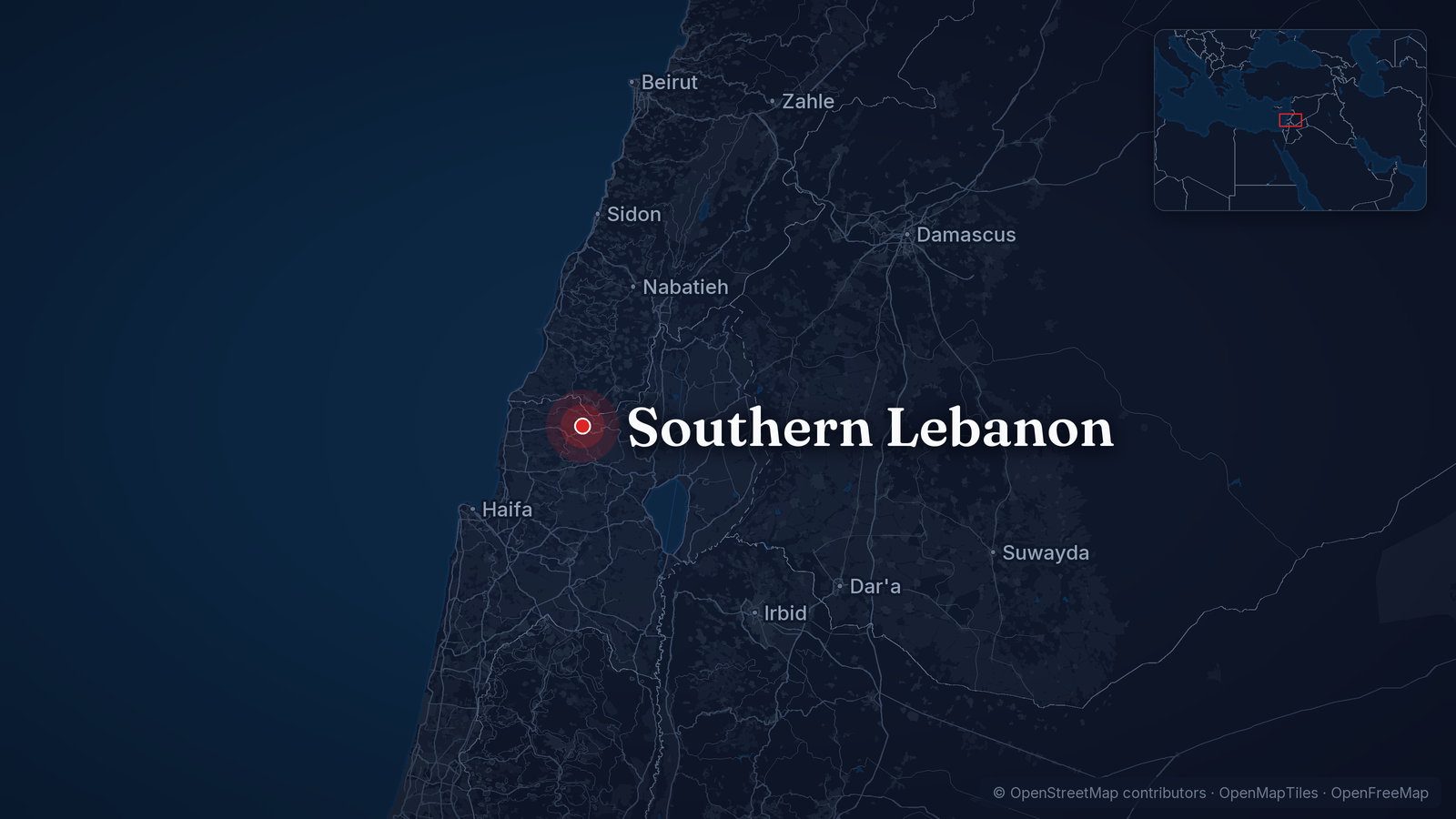
Map: © OpenStreetMap contributors, ODbL · Cropped for layout
This article is an automated aggregation of coverage from news outlets. Our editorials offer in-depth analysis curated by the NewsCord team.
The United States seeks a southern Lebanon ceasefire conditioned on Lebanese action against Hezbollah. Lebanon-Israel disarmament framework stalls, with progress limited to pilot zones.
Save coverage image
US seeks southern ceasefire
The United States is in talks with officials in Lebanon’s presidency and government to secure a ceasefire in southern Lebanon and prevent renewed fighting between Israel and Hezbollah, Lebanese diplomatic sources told the Emirati news site Aram News. The proposed arrangement would require the Lebanese government to step up pressure on Hezbollah and take more effective measures to restrict its movements in the south, the report said. The talks are part of a US effort to prevent an escalation in Lebanon that could undermine mediation efforts between Washington and Tehran, and progress in US-Iran negotiations depends on maintaining relative calm on the various fronts.
The report said the Lebanese government rejected any military or security actions launched from Lebanese territory outside the framework of state institutions, and it said the Lebanese Cabinet instructed all military and security agencies to prevent any military operations, rocket launches, or drone attacks from Lebanese territory and to arrest violators in accordance with applicable laws. The report said the government requested that the Army Command begin immediately and firmly implementing the plan presented at the February 16, 2026, Cabinet session regarding the restriction of weapons north of the Litani River, using all necessary means to ensure its execution.
Disarmament standoff and pilot zones
A U.S. State Department spokesperson told MTV that Lebanon's political, economic, and security crises share a single root cause: Hezbollah, and the spokesperson said Washington expects the Lebanese army to proceed with disarming Hezbollah and dismantling its infrastructure nationwide.
The spokesperson said Lebanon must choose between remaining under Iranian influence or reclaiming control of its future, and the report framed the expectation as starting from pilot areas.
A CRS report said implementation of the U.S.-brokered Israel-Lebanon framework had not expanded beyond the two initial pilot zones as of October, and it said an eighth round of Lebanon-Israel talks that month ended inconclusively.
The CRS report said Hezbollah refuses to discuss disarmament until Israel withdraws, and it said the Israeli buffer zone is around 5% of Lebanon's territory.
The FDD-linked reporting said Hezbollah was reportedly rebuilding intelligence networks in three southern Lebanese villages designated to test the group’s disarmament, and it said the Military Coordination Group for Lebanon assessed the pilot program as unsuccessful in Zawtar al Gharbiyeh, Froun, and Srifa.
After UNIFIL, security gap
The scheduled end of the mission of the United Nations Interim Force in Lebanon (UNIFIL) on December 31, 2026, presents the Lebanese government with another challenge, and the article said UNSC Resolution 2790 gives UNIFIL one year from the beginning of 2027 to complete a phased withdrawal from southern Lebanon. The article said no alternative security arrangement has been found to replace the departing force, and it warned that the gap may exacerbate tensions on the border, hinder the Lebanese state’s efforts to assert its authority over the entire country, and allow the Israeli military to continue violating Lebanon’s sovereignty at will. The UNSC must devise an alternative solution to deliver peace and security that effectively monitors Israel’s and Hezbollah’s actions on the border, provides protection for all communities in Lebanon, and respects international law.
The article described three potential scenarios for the post-UNIFIL period, including a scenario in which the UNSC fails to provide an alternative international force to monitor the border and another scenario in which the UNSC replaces UNIFIL with another international force with a clearer mandate to disarm Hezbollah and dismantle its infrastructure in southern Lebanon. The Lebanese government has expressed its support for a plan that would maintain a UN-sanctioned international force and provide international support to the Lebanese Armed Forces, and it argued that the Lebanese army currently cannot achieve what the Lebanese government and the international community demand of it.