Protests22 October, 20252 min read
Australian Prime Minister Forces Emergency Landing After Crew Member Suffers Medical Emergency Mid-Flight
Australian Prime Minister Anthony Albanese’s plane made emergency landing in St. Louis. Emergency landing occurred due to a medical emergency involving a Royal Australian Air Force crew member.

21 outlets told this the same way.
Outlets did split on France Suspends Police Stun Grenades at High School Protests After 15-Year-Old Loses Hand →
Emergency Landing of Australian PM Flight
Australian Prime Minister Anthony Albanese’s Royal Australian Air Force flight made an emergency diversion to St. Louis after a crew member was struck by falling overhead luggage.
“Australian Prime Minister Anthony Albanese's Royal Australian Air Force plane made an emergency landing in St. Louis, Missouri, after a crew member suffered a concussion caused by falling luggage during a flight from Washington, D.C. to Honolulu. The crew member was hospitalized, and the Prime Minister's office confirmed the incident.”
The crew member suffered a concussion and required hospital treatment shortly after departing the Washington, D.C. area.
Multiple outlets describe the unscheduled stop at St. Louis Lambert International Airport, noting the incident occurred soon after takeoff from Joint Base Andrews.
Officials expected only a brief pause while the injured crew member underwent medical checks.
The Prime Minister had been returning from high-level meetings in the United States when the onboard medical emergency forced the landing.
US-Australia Mineral Supply Initiatives
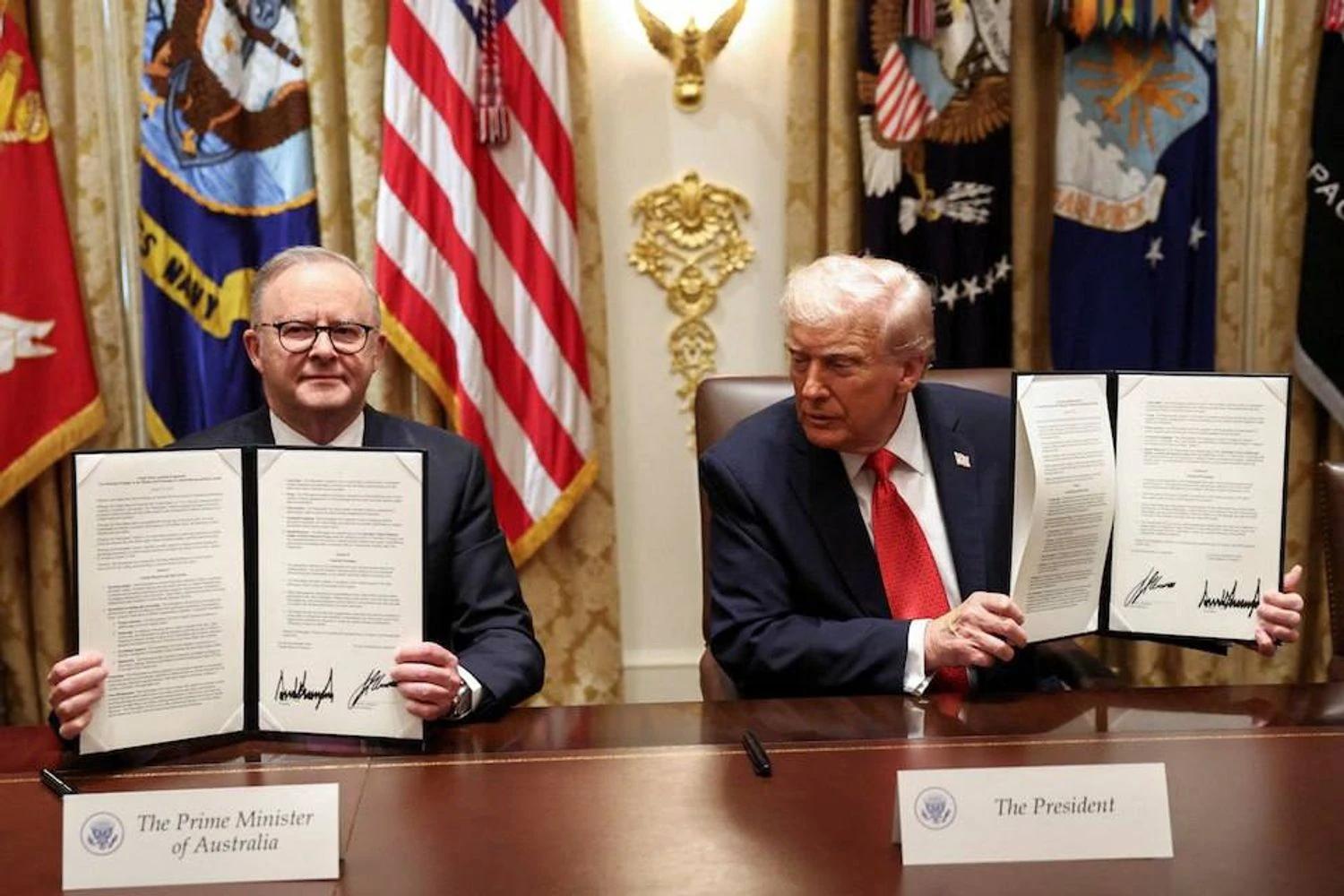
The diversion came amid a high-stakes U.S. visit where Albanese and President Donald Trump announced a suite of critical minerals initiatives framed as reducing reliance on China. Several outlets report a headline figure of up to US$8.5 billion to boost Australian production and processing of rare earths and other strategic inputs. Other reports detail components like a White House-announced US$3 billion tranche and near-term disbursements.
The broad thrust across sources is supply-chain security, with projects spanning mining, refining and joint ventures including with Japan. There are explicit links to tightening Chinese export controls.
AUKUS Defense and Supply Strategy
Beyond the mid-air medical emergency, the visit was framed by defense integration under AUKUS and long-horizon supply security. West Asian coverage highlights that Trump confirmed Australia will receive nuclear-powered Virginia-class submarines. The AUKUS program is valued at up to $235 billion over 30 years.
“Former U.S. President Donald Trump confirmed that Australia will receive nuclear-powered Virginia-class submarines under the AUKUS security pact with the UK, with construction of at least three submarines advancing quickly. The AUKUS agreement, valued at up to $235 billion over 30 years, aims to strengthen Australia’s maritime defense and reduce dependence on China for critical minerals... Australia... plans to establish a strategic reserve...”
Australian and other outlets link minerals policy to military supply chains and friendshoring. Some reports also connect the minerals initiative to strategic reserves and refinery projects. These projects include a Pentagon-linked gallium facility as part of efforts to diversify away from China.
Media Reactions to Diplomatic Trip
Media coverage varied regarding the political optics of the trip. Several outlets highlighted a tense exchange involving Australia’s ambassador Kevin Rudd. DW reported that both Rudd and Trump expressed mutual dislike following Rudd’s earlier criticisms.
Daily Mail described an awkward question posed to Trump and a subsequent apology that Trump accepted, which sparked domestic debate about Rudd’s role. Sharjah24 portrayed the moment as tense but also humorous. In contrast, some Western mainstream media, such as Fox News and 7NEWS, focused on the landing and the minerals deal without mentioning the Rudd incident.

Emergency Landing and Minerals Strategy
Across sources, the through-line is an in-flight medical emergency resolved by an immediate landing. This event is juxtaposed with a broader U.S.–Australia push to secure critical minerals and defense supply chains. Asian outlets add caution about timelines and market dynamics.
“On October 20, US President Donald Trump and Australian Prime Minister Anthony Albanese signed an $8.5 billion agreement... Experts caution that while the deal may quickly increase rare earth availability, achieving full independence from China could take decades, with fair contract pricing being key...”
Swarajyamag notes experts warn full independence from China could take decades and stresses fair pricing. United News of Bangladesh highlights the need for price protections against Chinese market manipulation. Western alternative coverage underscores financing tools and the desire to decouple without severing ties.

Other outlets emphasize jobs, friendshoring, and a new gallium refinery. Coverage roundups like TOI reflect the breadth of stories tied to the trip, pairing the emergency landing with the minerals push.