Technology and Science24 September, 20263 min read
Bishkek Ceremony Launches COMAC C909 Airplane Hospital Charity With Kyrgyz Deputy Minister
This article is an automated aggregation of coverage from news outlets. Our editorials offer in-depth analysis curated by the NewsCord team.
Ceremony launches the C909-based Air Silk Road of Health charity in Bishkek. ENT surgery on allergic rhinitis performed aboard the aircraft, first globally.

5 outlets told this the same way.
Flying hospital opens in Bishkek
A ceremony in Bishkek marked the “C909 Airplane Hospital” charity project, with Kyrgyz Deputy Minister of Health Nurbek Bukuev saying the initiative would contribute to providing medical care and serve as a platform for “professional training, medical knowledge exchange and stronger institutional ties between medical institutions in the two countries.”
Sun Dapeng, charge d'affaires of the Chinese Embassy in Kyrgyzstan, said cooperation in healthcare was an important component of Chinese-Kyrgyz relations and called the project “a significant development, opening up new opportunities for bilateral cooperation in civil aviation.”
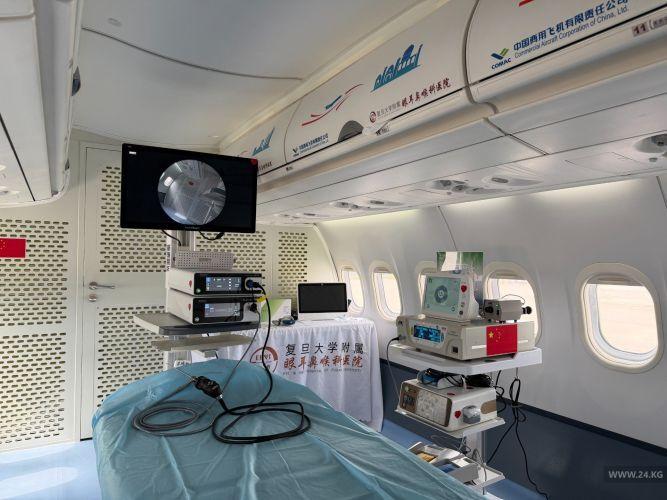
The project used a C909 aircraft from the Commercial Aircraft Corporation of China, Ltd. (COMAC), and the aircraft was described as available in various configurations, including emergency response and medical versions.
A Kyrgyz woman with allergic rhinitis underwent surgery aboard a Chinese C909 aircraft parked at Manas International Airport in Bishkek, and she said, “Everything went very well. I didn't expect it to be so quick.”
Sun Xicai, a chief physician of the otolaryngology department at the Eye & ENT Hospital of Fudan University, said the charitable medical activities were proceeding smoothly and that all the medical equipment on board the “C909 Airplane Hospital” was made in China.
First ENT surgery aboard
On September 24, Chinese surgeons performed surgery on a patient with allergic rhinitis aboard a hospital aircraft at Manas Airport in Bishkek, and 24.KG said it was the first time such an ENT procedure had been performed aboard an aircraft anywhere in the world. Sun Xicai explained that a minimally invasive technique developed by his team was selected for the patient’s treatment, and he said the method “minimizes tissue trauma.” The surgery was performed under local anaesthesia, and 24.KG reported that the patient remained calm and experienced no pain or discomfort.
Akchabar said the surgery was the first ENT procedure of its kind to be performed directly on board an aircraft, and it added that Sun Xicai noted that it was his first time operating on board an aircraft. Akchabar also reported that about 10 surgeries were scheduled to be performed directly on board the flying hospital in Bishkek, while the mission’s program called for more than 100 surgical procedures, both on the plane and at a local hospital.

Training, telemedicine, and scale
COMAC and the Fudan University Ophthalmology and Otolaryngology Hospital organized the “Aerial Silk Road of Health” project, which aimed to provide specialized medical assistance and develop cooperation between Kyrgyzstan and China in aviation and healthcare. Daniyar Bostono, the director of the State Agency for Civil Aviation, emphasized the importance of applying aviation technologies for humanitarian purposes and strengthening bilateral partnerships, and he expressed gratitude to the Chinese partners for the initiative. The Global Times account said the month-long action provided free diagnosis and treatment, academic exchanges and telemedicine services in ophthalmology and otolaryngology, and it expected to benefit more than 2,000 local patients with over 170 surgeries to be performed free of charge.
Akchabar said the mission included free consultations and examinations, training for Kyrgyz doctors, telemedicine consultations, and academic exchanges, and it reported that organizers expected to provide at least 2,000 free medical services in Kyrgyzstan. Akchabar further described the C909 aircraft as specially converted for medical purposes and said it was “the first in China and the only one in the world—a flying hospital specializing simultaneously in ophthalmology and otolaryngology.”