Technology and Science11 May, 20263 min read
Digg Returns As AI News Aggregator Using X Real-Time Data And Sentiment Analysis
This article is an automated aggregation of coverage from news outlets. Our editorials offer in-depth analysis curated by the NewsCord team.
Digg returns as an AI news aggregator powered by X engagement data. Uses real-time X data to track AI issues and reactions, shaping rankings.
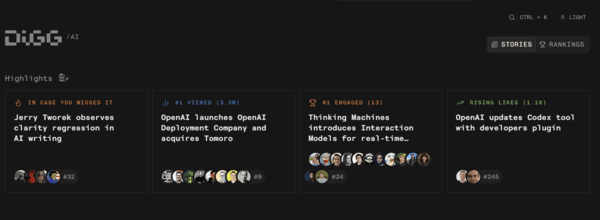
Digg pivots to AI
Digg has returned as an AI-focused news aggregation service, with TechCrunch reporting on May 11 that the relaunch reflects real-time data from X to track AI issues and reactions from influential people. Digg’s beta homepage currently highlights four items at the top—most-read stories, stories with surging discussion, fastest-rising stories and "did you miss this"—and it also shows a list of the day’s top stories with engagement metrics such as views, comments, likes and saves. In an email to beta testers, Digg said its goal is to "track the most influential voices in a field and uncover news that is actually worth watching," and it plans to start in AI and expand to other topics if it delivers results.
The service ingests X content in real time and uses sentiment analysis, clustering and signal detection to decide importance, while Kevin Rose explained on X that when Sam Altman reacts to an AI-related article, the topic almost always spreads across X as a whole. Digg’s previous version halted service in March after it failed to manage bot traffic effectively and failed to differentiate itself from Reddit, and Rose said, "The version released this time still has bugs and is a first preview rather than an official launch."

How it ranks and tracks
TechCrunch says Digg showcases four main stories at the top—"the most viewed story, a story seeing rising discussion, the fastest-climbing story" and one "In case you missed it"—and below that it provides a ranked list of top stories with engagement metrics like views, comments, likes, and saves. But TechCrunch adds that the engagement metrics aren’t generated on Digg itself, because Digg is ingesting content from X in real time while also performing sentiment analysis, clustering, and signal detection to determine what matters most. On X, Rose highlighted that when OpenAI CEO Sam Altman engages with a story about AI, it almost always sets off a chain reaction that includes deep discussion and propagation of that topic throughout X.
The platform also ranks the top 1,000 people involved in AI, as well as the top companies and the top politicians focused on AI issues, and it is designed to track increased engagement with charts and graphs. CryptoRank frames the same pivot as Digg becoming an AI-driven news aggregator focused on ranking the most influential stories in a specific vertical: artificial intelligence, after a brief and unsuccessful attempt to compete with Reddit earlier this year.

Trust, bots, and expansion
Digg’s relaunch comes after earlier failures tied to automated activity, with TechCrunch saying the new Digg found that it wasn’t able to effectively manage the bot traffic invading its platform and hadn’t differentiated itself enough from Reddit.
Startup Fortune says Digg is testing whether AI summaries, personalization, and community voting can still build trust in news discovery, while also trying to avoid bot manipulation and give publishers a fair reason to participate.
The same piece describes Digg’s earlier shutdown as a result of bots and automated accounts overwhelming the voting system that was supposed to tell users what mattered, and it notes that Digg said it banned tens of thousands of accounts and used internal tools and outside vendors but still could not keep automated activity from undermining the system.
For publishers and users, the stakes include whether Digg can provide enough value beyond X’s own "For You" feed, because TechCrunch says it’s unclear whether there’s enough underlying value for an everyday user beyond seeing that an @sama tweet can make something go viral.
Gizmodo adds that Digg’s AI vertical is only the first step—"AI is the first vertical. More are coming," Rose writes—while also describing the current Digg.com homepage as a barebones, beige newsfeed with a "Highlights" section at the top.