Crypto15 September, 20263 min read
Ethereum And Base Abandon EIP-8130 And EIP-8141 Account Abstraction Talks
This article is an automated aggregation of coverage from news outlets. Our editorials offer in-depth analysis curated by the NewsCord team.
Ethereum and Base end joint Frames collaboration; split into EIP-8141 and EIP-8130 paths. Both standards maintain gasless transactions and passkey wallet support.
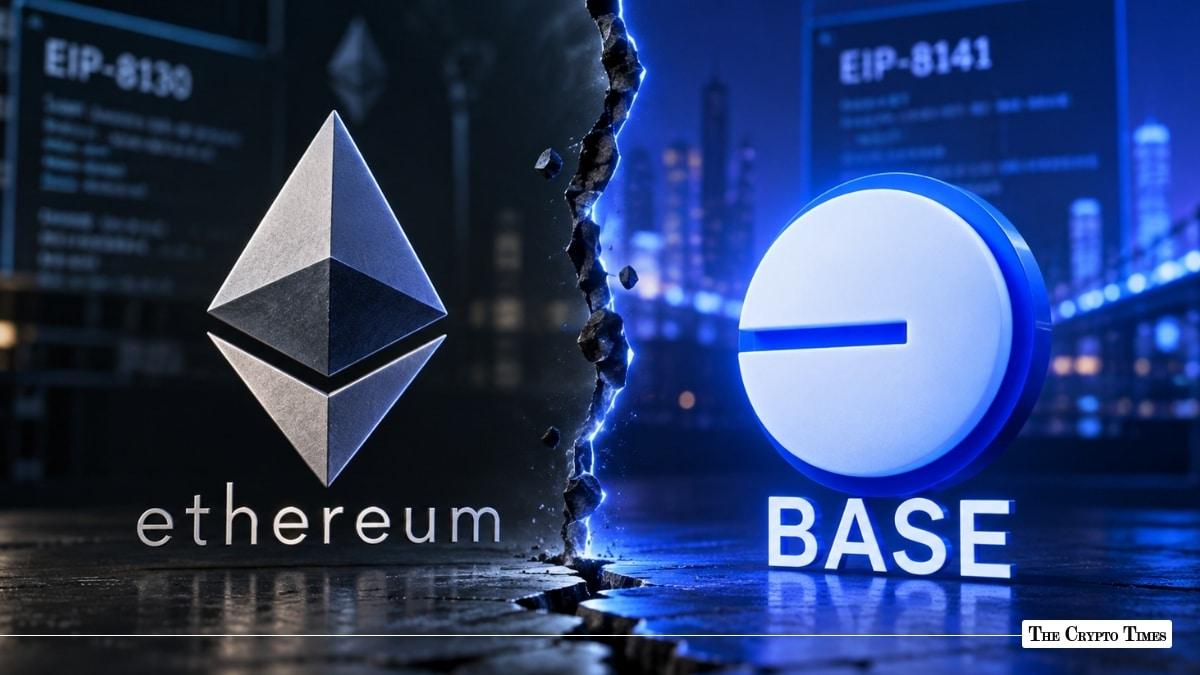
Frames talks collapse
Ethereum and Base will pursue separate native account abstraction standards after their joint effort to reconcile EIP-8130 and EIP-8141 ended last week, leaving both proposals as drafts. Ethlabs researcher Derek Chiang said the collaboration broke down after the two sides failed to agree on a design that met both networks’ goals, with Ethereum emphasizing censorship resistance, privacy and security while Base and other Layer 2 networks prioritize scalability, customization and compliance. The split centers on Base-led EIP-8130 and Ethereum’s Frame Transactions proposal, EIP-8141, which is scheduled for inclusion in the Hegotá upgrade targeted for 2027.
EIP-8141 would make account abstraction a native part of Ethereum using programmable frames for transaction validation, gas payment, and execution, and it also supports post-quantum security, native key rotation, and batch transactions. EIP-8130 instead introduces a new transaction type and an onchain keystore, which Base has been testing on its Vibenet devnet, and it supports custom authentication, transaction batching, and gas sponsorship.

Burden shifts to wallets
Chiang framed the outcome as each chain choosing its own best version rather than compromising, saying, “Ethereum wanted to be the best version of Ethereum, and Base wanted to be the best version of Base,” while adding that interoperability was ultimately secondary to each network’s core goals. In a separate account of the same breakdown, Cointelegraph reported Chiang said the divergence would require wallet developers to support separate transaction formats, and it quoted him describing the result as “putting the burden on wallets.” Cointelegraph also tied Ethereum’s direction to Frame Transactions under EIP-8141 as a “headliner” item under its Hegotá upgrade, while describing Base’s approach as native account abstraction via Keystore under EIP-8130, currently live on devnet.
The Crypto Times described how the design difference could create more work for wallet developers and applications that support multiple EVM networks, because wallets may need to support different native transaction formats across Ethereum and Base. Even with the fragmentation risk, Chiang said the decision does not necessarily have to be negative, arguing that wallets and applications could eventually hide technical differences by supporting the native transaction formats of different chains.
What happens next
With EIP-8130 and EIP-8141 now on separate paths, the official Ethereum Improvement Proposal registry lists both designs as drafts, and multiple outlets describe the immediate consequence as shifting integration work to wallet and application developers. Cryptonews.net said Ethlabs backs Frame Transactions for Hegotá and intends to work with Layer 2s and wallets on a rollout, while also noting that incompatible native transaction types would shift more integration work to wallet and application developers. The Crypto Times described two possible paths for the ecosystem after the split: creating a broader coordination system that gives Layer 2 networks more influence over shared EVM standards, or accepting fragmentation and building wallets and applications that hide technical differences from users.
Coin Edition’s market-focused coverage also reflected ongoing crypto volatility around Ethereum, stating ETH trades near $2,488.94 and is down 1.05% over the past 24 hours while retesting support after pulling back from the $2,550 to $2,600 zone. In parallel, Coin Edition cited Santiment data that “Only 6.06 million ETH now sits on exchanges,” down 73% from a June 2020 peak of 22.9 million, framing the shrinking exchange supply as a factor that can make price move more with even modest buying pressure.