Technology and Science24 June, 20263 min read
France’s Senate Adopts Ddadue Bill With Renewable Energy, Transport, And Circular Economy Changes
This article is an automated aggregation of coverage from news outlets. Our editorials offer in-depth analysis curated by the NewsCord team.
Senate adopted the 5th Ddadue bill in first reading, revising energy and circular economy provisions. Omnibus Ddadue bill carries provisions for adaptation to EU law across multiple sectors.

France advances, EU adapts
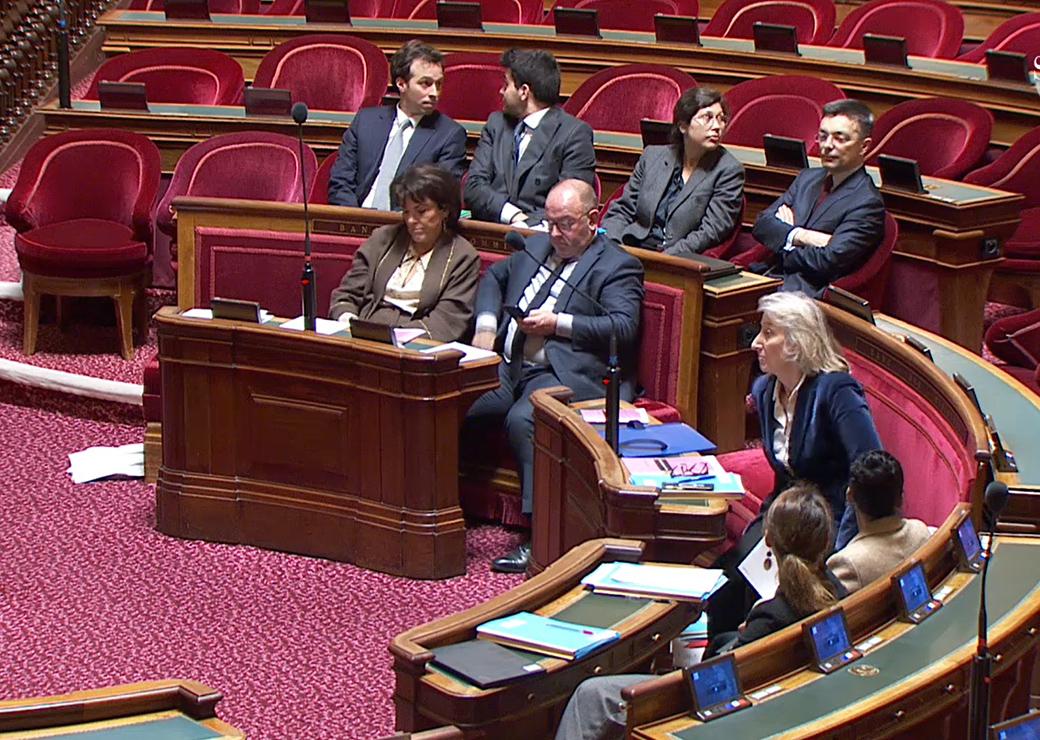
France’s Senate adopted, in first reading, on February 18 a bill “carrying various provisions for adaptation to EU law in economic, financial, environmental, energy, information, transport, health, agriculture and fishing matters” (Ddadue). The Senate Economic Affairs Committee said it had adopted the text on February 4 with “no fewer than 135 amendments,” and in session “154 amendments were again adopted,” including “more than a third” submitted by the government. In energy provisions, the bill sets the maximum duration for processing renewable-energy projects at “1 year” for projects located in strengthened acceleration zones and “2 years” for those outside these zones, while also setting “30 days” for determining the completeness of environmental permit applications in these zones and “45 days” outside them.
For transport and charging infrastructure, the bill requires “the installation of ‘pilotable’ charging points” as part of pre-wiring for parking spaces and adjusts obligations for charging points in non-residential buildings according to the “utilization rate of existing charging points.” The bill also revises circular-economy related rules by reinstating “the removal of the chewing-gum EPR (Extended Producer Responsibility) stream” and narrowing “the scope of the sanitary-textile EPR to only wipes.”
EPR, enforcement, and pushback
The EU environmental simplification plan hit resistance over extended producer responsibility, after the Council agreed its negotiating position on parts of the package but “discontinued negotiations on two proposals relating to extended producer responsibility.” The Council’s move was framed as a test of whether Brussels can ease business obligations “without weakening enforcement in waste, packaging, batteries and product compliance,” with opponents warning that weakening authorised-representative requirements could make enforcement harder. In the EPR mechanics described by Recycling Europe, Article 8a(4)(c) of the Waste Framework Directive requires producers to bear at least “80% of the ‘necessary costs’” of end-of-life waste management, while “Three words the law never defines.”
Recycling Europe argues that Producer Responsibility Organisations (PROs) decide what counts as necessary costs, and that in markets where multiple PROs compete, the incentive is to define “necessary costs” narrowly so recyclers absorb the gap. The same broader policy direction is reflected in the Circular Economy Act debate, where the European Commission is preparing the act “expected by end of 2026” to take another pass at EPR reform across product categories.

Circular economy stakes and timelines
Across Europe, the Circular Economy Act is positioned as a major legislative step, with Climate Home News saying that “In autumn, the European Commission is due to adopt the Circular Economy Act (CEA)” aimed at supporting the EU’s goal to become a world leader in circularity by 2030. The same report links the act to supply-chain resilience, noting that “100% of its heavy rare earth metals come from China” and “71% of its platinum from South Africa,” while also citing European Environment Agency data that “in 2024, secondary recovered materials made up 12% of total material use across Europe.” In France’s legislative process, the Senate Study Group on the Circular Economy chaired by Marta de Cidrac said the Finance Bill 2026 was a “Missed Opportunity for the Circular Economy,” adding that none of the study group’s four cross-party amendments were retained in the latest version.
That Senate critique focused on the abandonment of the upstream General Tax on Polluting Activities (TGAP), and it warned that an increase estimated at “150 to 300 million euros in additional funds by 2030” was “not sustainable” for local authorities. Meanwhile, the Xpert.Digital pre-release ties the CEA to logistics and investment timing, saying “Formal legislative action is scheduled for the third or fourth quarter of 2026,” and describing the need for companies to prepare for regulatory obligations like reverse logistics and the “Digital Product Passport.”