Technology and Science23 September, 20263 min read
Nearly 9 in 10 Americans Fear AI Surpassing Human Intelligence, CNN Poll Finds
This article is an automated aggregation of coverage from news outlets. Our editorials offer in-depth analysis curated by the NewsCord team.
68% of Americans who use AI daily are worried about the technology. A majority fear AI's impact and want greater government regulation.
Fear Outweighs Hope
CNN’s poll found that nearly 9 in 10 Americans say they are more concerned than excited by the possibility that AI could one day surpass human intelligence, and about 8 in 10 express negative sentiments about the rapid pace of AI development and about the chance that AI technology may fundamentally change their way of life.
CNN’s poll also found that 75% of Americans say their feelings about the growth and development of AI technology are closer to fear and concern than hope and excitement, and 43% feel that way strongly.

SSRS conducted the CNN poll online and by telephone September 16-17 among a random national sample of 1,206 adults, and the results showed a bipartisan mandate for federal action with 85% of Democrats, 67% of independents, and 63% of Republicans saying the government has not yet done enough.
CNN reported that President Donald Trump dismissed concerns about AI as a “HOAX” and touted the potential economic gains of the technology, while progressive Vermont Sen. Bernie Sanders and former Trump strategist Steve Bannon called for curbs on AI development.
CNN’s poll further reported that 48% of Americans say AI technology has a negative effect on their own finances, compared with 18% who say it has a positive effect.
Daily Users Still Worried
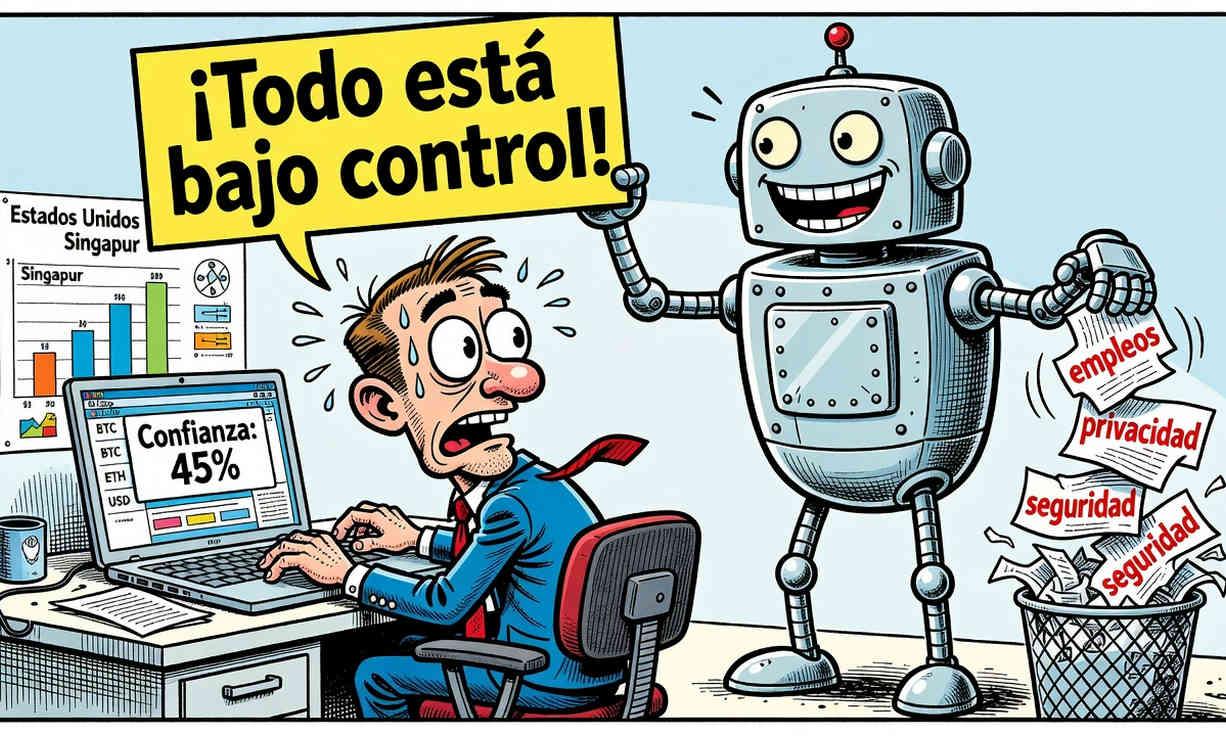
Gallup survey results commissioned by Microsoft showed that 68% of Americans who use AI daily are worried about the technology, and the overall figure reaches 74%. Gallup found that only 45% of daily users in the United States have a high level of trust in their results, and TechCrunch reported that this skepticism persists even as people use AI for everyday tasks. TechCrunch said the Gallup study currently has results from 37 countries, where researchers polled about 1,000 people in each country between April and July, and the project will eventually span 140 countries.
TechCrunch reported that in Singapore, which had the highest portion of daily users in the study at 46%, more than 80% of those aware about AI expect the tech to improve their everyday lives, and 77% think it’ll help the country. TechCrunch quoted Pablo Diego-Rosell, senior scientist at Gallup, saying, “One of the clearest findings is that attitudes toward AI are multidimensional.”
Elections and Regulation Stakes
FactsChequeado reported that 76% of Americans are “concerned that AI-created audio or video deepfakes and deceptive content could affect the 2026 midterm elections,” and it said almost 8 out of 10 surveyed adults share that worry. FactsChequeado said the survey of 5,016 adults was conducted September 1–9, 2026 by the Center for Transparent and Trusted Elections at the University of California, San Diego, and it reported that confidence that “national midterm votes will be counted according to voters’ intent” fell by another 5 points. FactsChequeado quoted Lauren Prather, associate professor of Political Science at UC San Diego’s School of Global Policy and co-director of the Center, saying, “The United States is now experiencing a phenomenon of distrust in elections that many Latin American countries and other parts of the world experienced long ago.”
POLITICO Poll results described a preference for caution across six countries, with roughly half of adults surveyed in the U.S., Canada, the United Kingdom, France, Spain and Germany supporting a pause on further development to reduce risks. POLITICO Poll reporting also said more than half in every country surveyed and up to almost two-thirds in the U.S., France, the U.K. and Canada said there was at least a “moderate” risk that the technology could “destroy humanity.”