Iran25 September, 20263 min read
Masoud Pezeshkian Tells Fox News Iran Will Respond Strongly If Fighting Continues
This article is an automated aggregation of coverage from news outlets. Our editorials offer in-depth analysis curated by the NewsCord team.
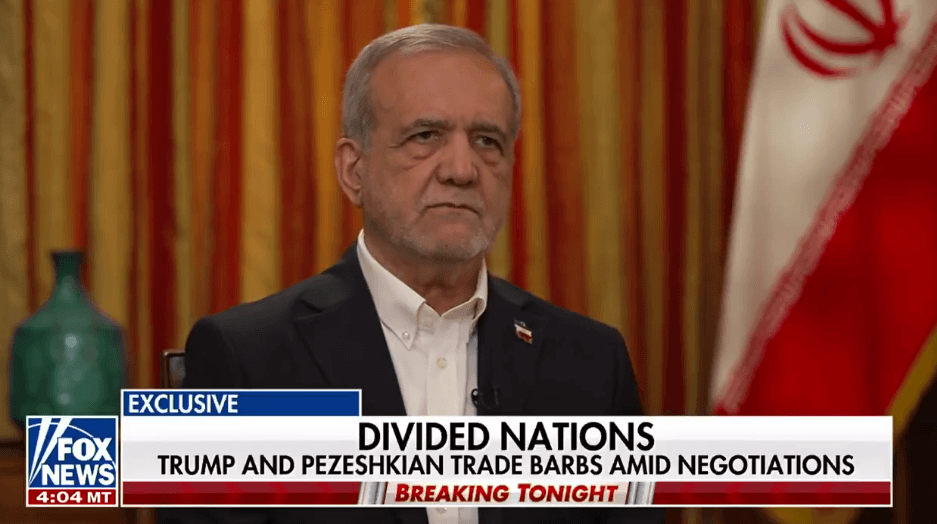
Iran did not start the war and will respond strongly if fighting continues. Pezeshkian warned against U.S. aggression and vowed a strong, resolute response.
7 outlets told this the same way.
Outlets did split on Iran Reviews US Negotiation Proposals As Pakistan And Qatar Mediate Strait Of Hormuz Dispute →
Pezeshkian sets terms
Iranian President Masoud Pezeshkian told Fox News host Bret Baier that Iran did not choose war and does not seek further conflict, but it will respond “strongly, resolutely” if fighting continues. Pezeshkian said, “We never initiated a war, but if they [US] wish to keep fighting with us, we will respond strongly and resolutely,” during an interview conducted on the sidelines of his trip to New York for the 81st United Nations General Assembly. Pezeshkian argued that Iran has been forced to defend itself whenever it has come under attack, and he rejected pressure aimed at forcing Iran to surrender outside the framework of international law.
Pezeshkian linked the current confrontation to the US-Israeli war on Iran that began with air raids on February 28, which he said assassinated high-ranking Iranian officials and military commanders, along with more than 160 schoolchildren and staff in Minab. Pezeshkian said Iran and the United States signed the Islamabad Memorandum of Understanding on June 17 to end the war, but he said the US breached its commitments and ignited more rounds of fighting as the MoU collapsed.

Diplomacy and mistrust
Pezeshkian told Fox News that negotiations must stay within international law, saying, “That which is discussed and negotiated is within the framework of international law, and what would be rightfully ours under international law.” Pezeshkian said Tehran is “willing” to move forward with the Islamabad MoU, while he described the central obstacle in negotiations with the US as the “deep mistrust” that has developed between the sides. Pezeshkian tied that mistrust to the fate of the 2015 nuclear agreement, saying Iran had previously reached an agreement with the United States before Trump withdrew from it unilaterally in May 2018.
Pezeshkian questioned how the two sides could resolve outstanding disputes if they could not establish trust through dialogue, saying, “If we're unable to trust one another within the framework of a dialogue, how can we hope that these issues will ever be resolvable?” Pezeshkian also said the Strait of Hormuz was fully open before the start of the “terrorist US-Israeli aggression on Iran,” and he argued that Iran’s restrictions were a response to aggression and an illegal blockade imposed by the US against Iranian vessels.

Strait of Hormuz and oil
ABC News reported that when Iran shut down the Strait of Hormuz at the start of the war, it choked off sea passage for some 15 million barrels of oil a day, and analysts feared prices would skyrocket.
ABC News said oil is expensive but not exorbitant nearly seven months on, and it reported that Adm. Brad Cooper, head of U.S. Central Command, said U.S. forces had assisted 2,000 commercial ship transits and the transport of more than 1 billion barrels of oil from Gulf partner nations over “the past couple of months.”
ABC News described how Saudi Arabia shifted to its East-West pipeline to its Red Sea port of Yanbu, and it said the UAE used a pipeline across Oman to Fujairah to route around the strait.
ABC News reported that in May ship operators used a U.S.-supervised route near Oman, and it said Iranian-backed Houthi rebels in Yemen disrupted the Yanbu workaround in July by declaring a blockade of Saudi oil shipments.
ABC News added that the East-West pipeline was attacked earlier this month and forced to shut down, and it reported that on Monday six supertankers loaded 12 million barrels at Saudi terminals on the Persian Gulf, according to shipping data company Kpler.