Climateupdated 1h ago2 min read
Pezeshkian Urges Caspian States To Unite On Long-Term Environmental Plan In Ashgabat Summit
This article is an automated aggregation of coverage from news outlets. Our editorials offer in-depth analysis curated by the NewsCord team.
Pezeshkian urges Caspian states to unite on a long-term plan under the Tehran Convention. Leaders form a high-level commission of deputy heads to draft a comprehensive action plan.
11 outlets told this the same way.
Outlets did split on U.S. Supreme Court Weighs Boulder Climate Lawsuit Against Suncor And ExxonMobil →
Water levels drive summit
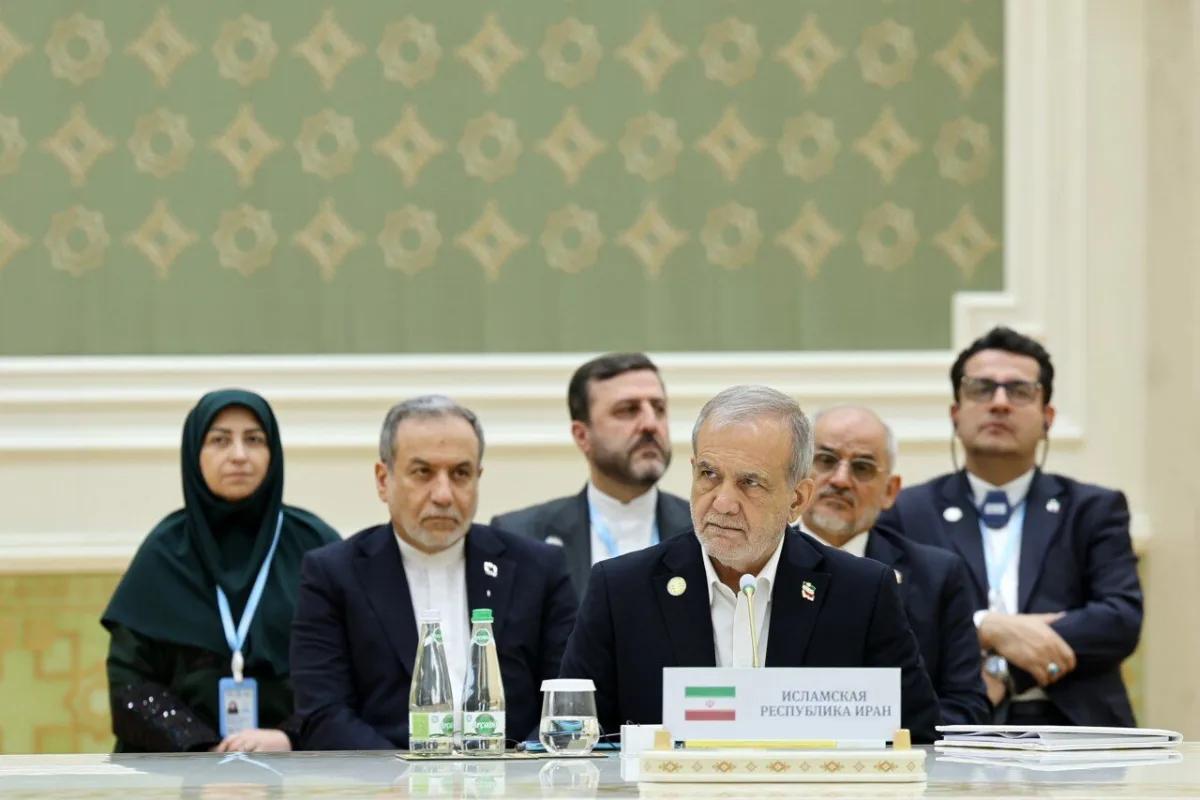
Iranian President Masoud Pezeshkian urged Caspian littoral states to unite on a long-term environmental protection plan to address the declining water level of the Caspian Sea at an extraordinary summit in Ashgabat, Turkmenistan. Pezeshkian said the action should be within the framework of the Tehran Convention and argued that no single country can save the inland body of water on its own. Pezeshkian warned that the Caspian faces serious and escalating threats including a drop in water levels, climate change, rising air and water temperatures, oil and industrial pollution, and the destruction of natural habitats.
Pezeshkian welcomed the summit’s decision to establish a high-level commission comprising the deputies of the heads of government of the littoral states to deal with issues related to the Caspian Sea. Pezeshkian emphasized that environmental cooperation can serve as a vital link for building trust and fostering convergence among regional nations despite geopolitical rivalries, wars, unilateral sanctions, and the absence of multilateralism.

Science, monitoring, and priorities
Pezeshkian told the summit that Iran believes the first principle in addressing the crisis should be reliance on science, shared data, and regional cooperation. Pezeshkian said climate change, rising temperatures and evaporation, shifting precipitation patterns, changes in river flows, and human interventions must all be examined within an integrated scientific framework. Pezeshkian stressed that the region must move beyond merely observing and describing the crisis toward a new phase of joint crisis management.
Pezeshkian said the proposed long-term plan under the Tehran Convention should cover at least seven key areas, including joint scientific monitoring and stronger joint mechanisms to combat marine pollution and protect biodiversity. Pezeshkian also called for mobilization of financial and technological resources to implement environmental protection and adaptation measures.

Russia quantifies decline
Russian President Vladimir Putin said the average annual water level of the Caspian Sea is decreasing by 9 centimeters and attributed the changes to climate variations based on research by Russian and international scientists. Putin warned that the shallowing of the Caspian Sea leads to a reduction of biological resources, damage to fisheries, and coastal soil erosion, posing a serious threat to all Caspian littoral countries. Putin said Russia is obliged to allocate a substantial annual budget for dredging to ensure navigation, and he linked the need to the coastline’s desiccation on Russian territory over the past 20 years reaching 20,000 square kilometers.
Putin said an important agreement was reached on the rapid adoption of an action plan for fluctuations in the Caspian water level, covering the period up to 2036. Putin called for the full use of the capacities of existing international structures, including the capabilities created under the framework Convention on the Protection of the Environment of the Caspian Sea, known as the Tehran Convention of 2003.