Technology and Science06 October, 20263 min read
Technology Innovation Institute Builds UAE Probe To Land On Asteroid 269 Justitia
This article is an automated aggregation of coverage from news outlets. Our editorials offer in-depth analysis curated by the NewsCord team.
UAE's Technology Innovation Institute built, tested, and ships the MBR Explorer asteroid probe. Five-billion-kilometre, eight-year mission launching March 2028 from Japan with gravity assists.
Probe heads for Justitia
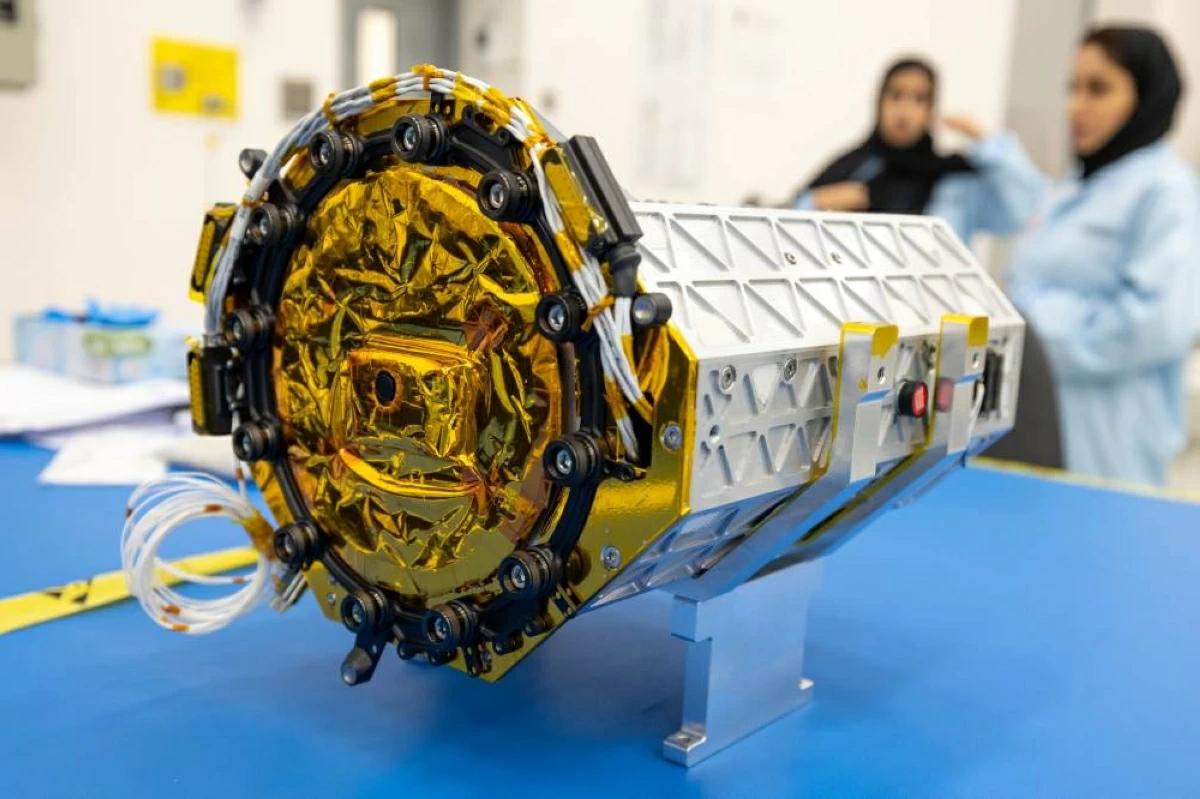
The Technology Innovation Institute disclosed a probe it developed and built in the United Arab Emirates to participate in the UAE’s mission to explore the asteroid belt, with the probe scheduled to head soon to the state of Colorado in the United States for final integration and merging operations with the spacecraft Explorer Mohamed bin Rashid. The probe will detach from the spacecraft Explorer Mohamed bin Rashid to reach asteroid 269 Justitia at the farthest point in its mission path, where it will operate independently in deep space, taking close-up images and conducting drilling and sampling operations. The mission is planned to launch in 2028, and the probe is described as capturing images of two planets and seven asteroids while flying close to six asteroids in the main belt before reaching asteroid 269 Justitia.
Faisal Abdulaziz Al-Banaei, Advisor to the President of the State for Strategic Research and Advanced Technology, said, “we must undertake challenges that push us beyond what we know and what we can achieve today.” Faisal Abdulaziz Al-Banaei added, “developing a probe capable of making its own decisions and operating autonomously in deep space.”

Autonomous landing plan
The mission described by Arabian Gulf Business Insight sets an eight-year journey that will blast off from Japan in March 2028, using “gravity assists” from Venus, Earth and Mars. The spacecraft will conduct fly-bys of six asteroids before rendezvousing with 269 Justitia in 2036, and the report describes Justitia as a 54km-wide asteroid hiding in the main asteroid belt between Mars and Jupiter. The impactor will begin a two-to-three-hour ballistic descent, capturing increasingly detailed images, and it is expected to hit the surface at 15 to 27 metres per second.
Anton Ivanov, principal investigator and executive director of TII’s Space and Propulsion Center, said, “The probe will provide an opportunity to peek a little bit underneath this thick exposed layer.” Anton Ivanov added, “The probe will provide an opportunity to peek a little bit underneath this thick exposed layer,” as the probe’s final image is transmitted before impact.

AI data processing and stakes
EnterpriseAM said the UAE’s first fully homebuilt deep-space probe is ready to ship, and Etihad Airways will transport the probe to the University of Colorado Boulder for integration into the spacecraft.
EnterpriseAM reported that the probe was developed in roughly 18 months after funding came through, and it said the project lead and executive director for space exploration at TII, Dr. Anton Ivanov, described a team that grew from 40 to 55 people.
EnterpriseAM also said the probe includes a data processing unit built into the probe, and it described the AI-capable board as allowing it to make decisions because the probe will not be receiving commands from Earth once it’s separated from the spacecraft.
Faisal Al Bannai, secretary-general of the Advanced Technology Research Council, said, “Sovereign technology has to have a practical meaning,” at the press conference.
Ahmad Belhoul Al Falasi, chairman of the UAE Space Agency, pointed to other commercial applications for space exploration like remote sensing, while EnterpriseAM said the probe’s DPU technology could be used for Earth observation and autonomous exploration.