Technology and Science25 September, 20262 min read
Tesla Launches High-Volume Semi Production In Sparks, Nevada, Targets 50,000 Trucks Per Year
This article is an automated aggregation of coverage from news outlets. Our editorials offer in-depth analysis curated by the NewsCord team.
Tesla began high-volume production of the Semi at a Nevada factory designed for the model. The plant's targeted capacity is 50,000 electric trucks per year.

Semi Enters Volume Production
Tesla held a livestreamed but invite-only event in Sparks, Nevada, to launch high-volume production of the Tesla Semi at its factory next to Gigafactory Nevada, where the first truck came off the high-volume line back in April.
Tesla CEO Elon Musk said in a pre-taped video played during the evening event, "It’s going to be, really, a driver’s truck. It’s like a sports car in truck form."
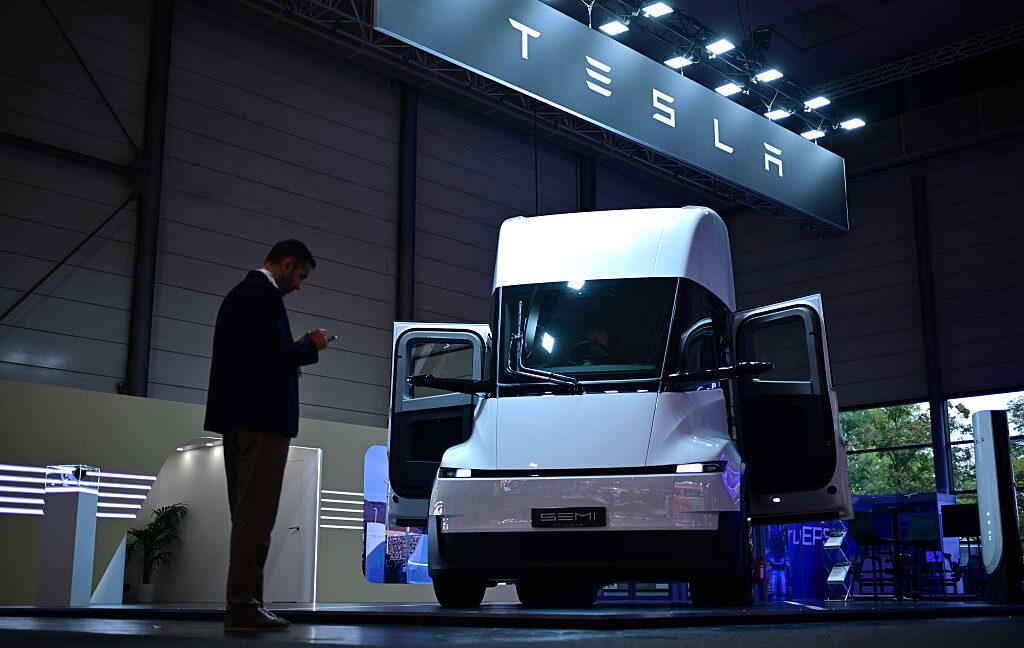
Tesla’s vice president of Vehicle Engineering Lars Moravy confirmed at the event that the long-range version will travel an estimated 500 miles per charge, while the standard version will get an estimated 325 miles per charge.
Tesla says the plant can build 50,000 electric trucks per year and covers 1.8 million square feet, and Tesla says it builds every variant, Standard, Long Range, and a European spec, on the same line.
Tesla’s Semi program director Dan Priestley said the company plans to open 30 megawatt chargers by the end of the year, as the truck’s charging needs a countrywide network of specialized megawatt chargers.
Battery, Charging, and Cost
Tesla moved the Semi from 2170 cells to its in-house 4680 cells, and Tesla says the change means "less battery mass & fewer kWh with no compromise on range." Tesla says the long-range Semi uses three packs for a total of 850-ish kWh and 500 miles of driving range, while the standard-range Semi needs only two battery packs for 325 miles of driving range. Tesla says on a Megacharger drivers get up to 60% of their range back in 30 minutes, and Tesla shared a map of Megacharger sites along major freight corridors.
Tesla’s economic pitch compared diesel at 7 mpg with a Semi at 1.7 kWh per mile, and Tesla’s chart put diesel at roughly $0.80 per mile this year while electricity stayed in the $0.20 to $0.30 range. Tesla’s event also emphasized uptime, with Tesla claiming its Semi fleet has had over 98% uptime so far in 2026 and that the truck "requires almost no maintenance."

Who Gets It Next
Tesla’s Semi rollout event in Sparks, Nevada, included customer trucks carrying logos from PepsiCo, DHL, US Foods, ABF, Einride, IMC Logistics, and WattEV, as Tesla demonstrated the truck to fleets. Tesla said it will use Semis to haul its own freight, and Tesla also said the ZET SCALE alliance picked Tesla as primary supplier for 2,500 electric trucks. Tesla’s long-range Semi is expected to travel 500 miles or more on one charge depending on the size of the load, and Tesla’s event materials tied that capability to a fully loaded 500-mile figure.
Tesla CEO Elon Musk praised the Semi in a prerecorded message, saying, "This is really going to be a revolutionary truck," and the message added that it is "capable of carrying the heaviest loads over very long distances." Tesla’s event still left open questions about order numbers and pricing, as Tesla did not reveal order numbers and did not update the price of the Semi, with the Verge describing a rumored $290,000 figure for the long range version.