Technology and Science05 August, 20263 min read
WindBorne Systems Raises $37 Million Series B to Expand AI Weather Forecasting Platform
This article is an automated aggregation of coverage from news outlets. Our editorials offer in-depth analysis curated by the NewsCord team.
WindBorne Systems raised $37 million in a Series B led by Khosla Ventures and Galvanize. Funding aims to expand its global atmospheric sensing network and AI-powered weather forecasting platform.

Series B for Weather AI
WindBorne Systems raised a $37 million oversubscribed Series B to expand its global atmospheric sensing network and accelerate development of its artificial intelligence-powered weather forecasting platform. The Palo Alto-based company said the round co-led by Khosla Ventures and Galvanize brings its total funding to more than $62 million, and it also reported that its recently launched WeatherMesh-6 model ranks as the world’s most accurate weather forecasting model based on publicly available benchmarks. WindBorne said it tripled annual revenue while also tripling the size of its atmospheric sensing network to more than 600 autonomous balloons operating simultaneously around the world.
CEO John Dean said, “We’re building something that has never existed before: a planetary nervous system that continuously observes Earth’s atmosphere and transforms those observations into dramatically better forecasts,” as the company aims to deliver earlier and more accurate insight into hurricanes and other severe weather events. The company said its data is currently assimilated into the National Oceanic and Atmospheric Administration’s Global Forecast System, described as one of the primary public weather forecasting models used worldwide.

Balloons, Laptops, Customers
TechCrunch described how deep learning techniques behind LLMs have also given weather simulations that can run on laptops instead of supercomputers, and it said WindBorne’s approach is to collect data with the world’s longest-flying weather balloons and feed it into a powerful forecasting model.
Founded in 2019, WindBorne said it has 20 launch sites around the world and about 600 balloons in the air at any given time, collecting data in hard-to-reach areas like the eye of a typhoon.
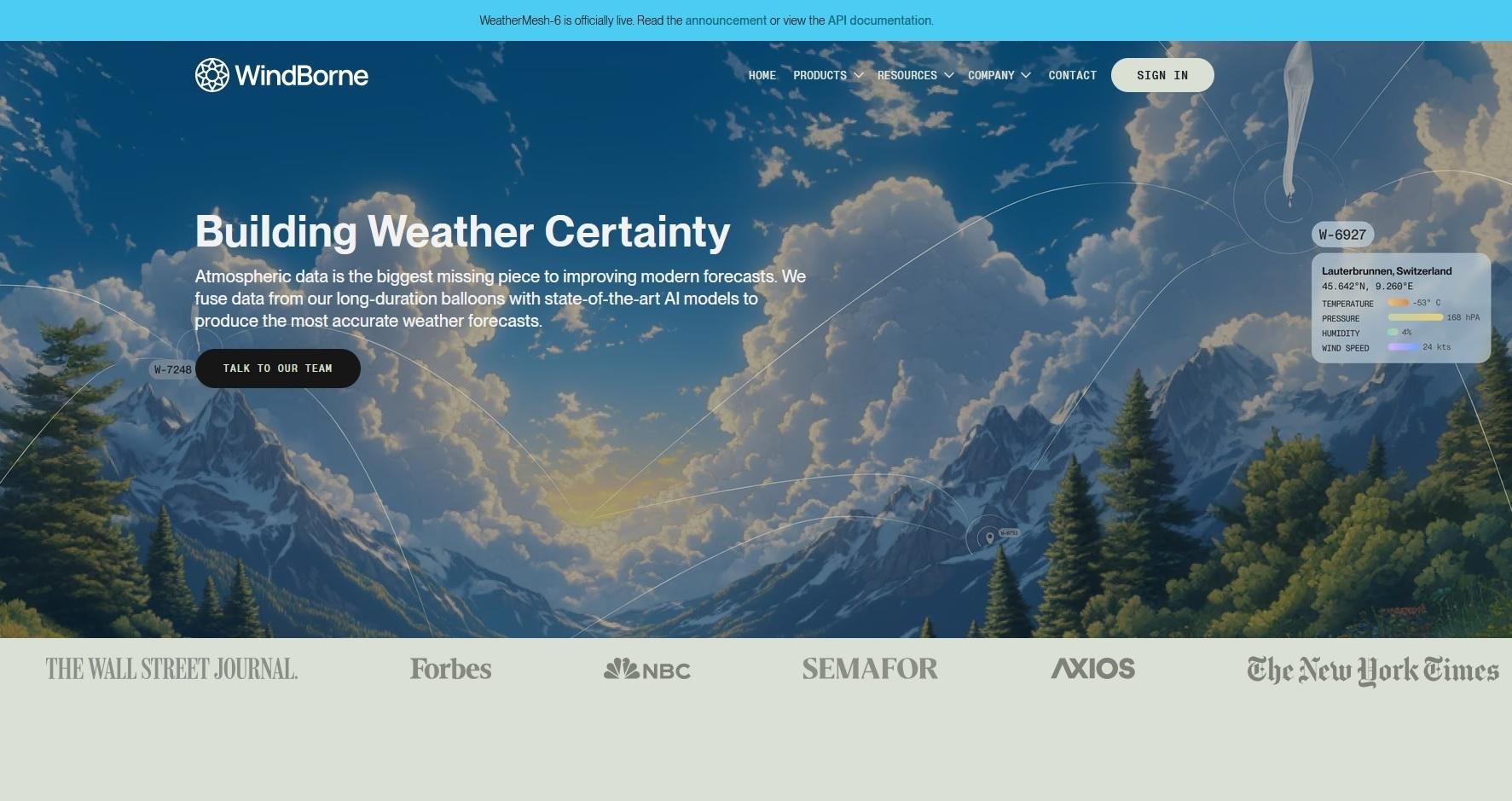
The company said it is beginning to deploy aerial sensor packages that can fall into the ocean and continue collecting measurements as floating buoys, and it said its proprietary dataset generated by this “planetary nervous system” ingests datasets generated by government weather agencies around the world.
Dean told TechCrunch, “We demonstrated that when you add balloons to the forecast, you get more accurate forecasts, and the value per data point is much stronger than satellites,” and he added that the company has been growing revenue while doing so.
TechCrunch also said WindBorne’s main customers are government agencies, including the U.S. National Weather Service, while the U.S. Air Force and U.S. Navy are paying through research partnerships, including an effort to develop forecasting models that can be run onboard ships with intermittent connections.
Private Market Bet
Multiple outlets framed the Series B as a step toward commercial expansion, with TechCrunch saying WindBorne is beginning to deploy its go-to-market team to expand its customer base in the private sector.
TechCrunch said commercial business is mainly focused on investment funds that use weather data to predict commodity prices and other business outcomes, while it described a barrier for private companies because extracting value from data requires experience and established workflows.
Saloni Multani, a partner at Galvanize who co-led the round, said, “integrating weather forecasts into broader business decision-making has traditionally been expensive and difficult. We think AI changes that equation,” and she added that better forecasts make the effort worthwhile.
In citybiz’s account, investors said the financing reflects growing confidence in combining proprietary data collection with AI-powered forecasting, and it said Galvanize linked the push to climate-related risks creating greater economic uncertainty for businesses, governments and communities.
WindBorne said the additional capital will expand its access to computing resources, enabling faster development of new forecasting models and weather intelligence products built on its proprietary atmospheric data, as it continues expansion of its sensing infrastructure and the next generation of WeatherMesh.