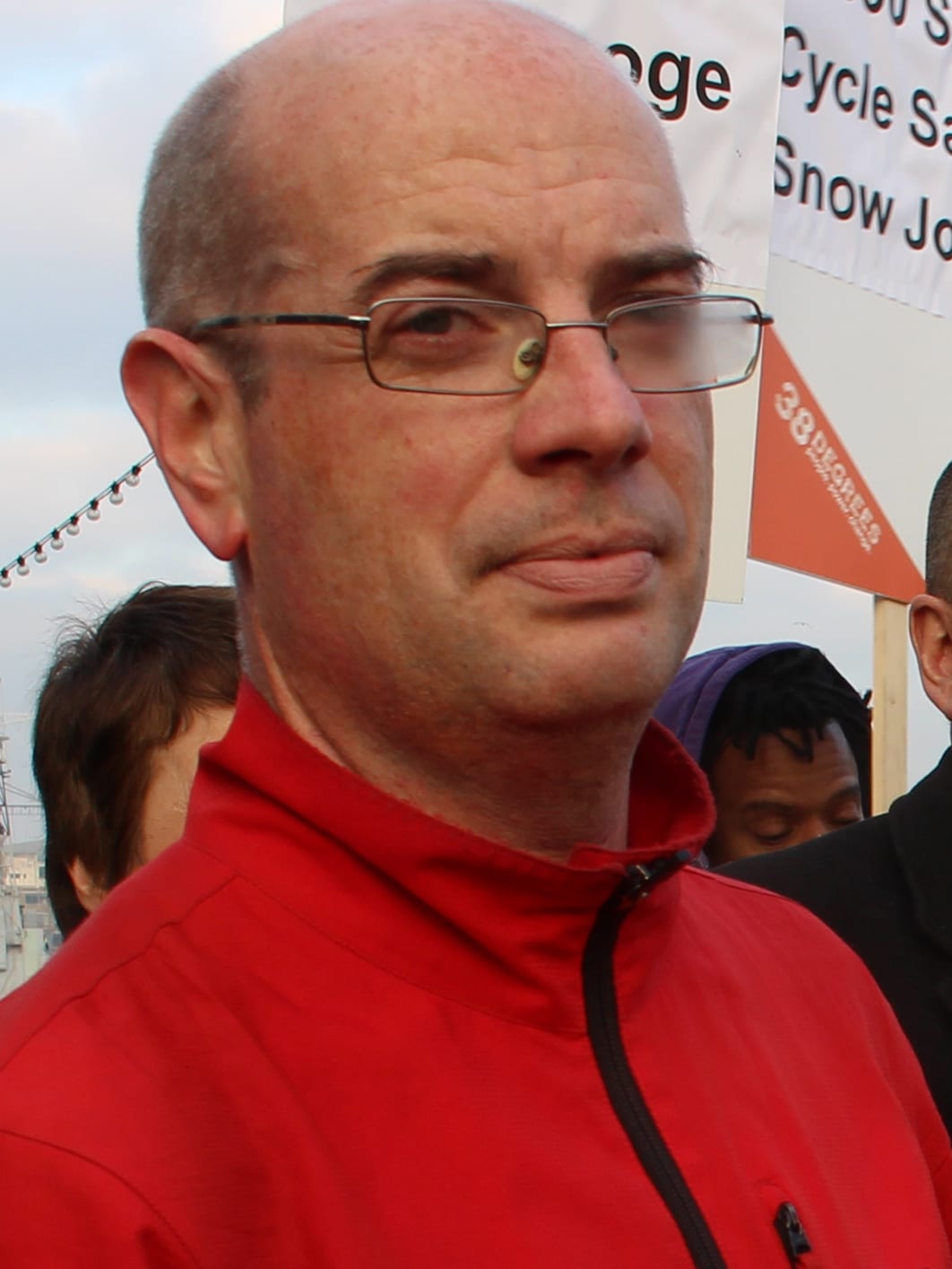
Andrew Gilligan writes about British Muslims more than anything else. Since June 2025, 35 of his 56 articles for The Spectator have been about Muslims, Muslim organisations or the Palestine movement, and not one of those 35 is neutral or sympathetic towards the people it is about.
He has been writing against Muslim groups he calls Islamist since 2009. He is now a senior fellow at the Policy Exchange think tank and, as his Spectator byline says, a former No 10 adviser.
We read every article on his Spectator author page since June 2025, every Policy Exchange paper with his name on it since October 2024 and the 515 posts on his own copy of his Telegraph blog. What they show:
- 35 of 56. Five in every eight of his Spectator articles since June 2025 are about Muslims or the Palestine movement. All 35 are hostile.
- 12 of 14. Of the 14 Policy Exchange papers carrying his name since October 2024, 12 are about Muslims, Muslim organisations or Islamism. The other two are about transport. None is about any other faith or minority.
- 31 of 35. The NewsCord Watchdog found at least one problem in 31 of his 35 articles about Muslims or the Palestine movement. In 15 of them he smears a named person.
- 95 of 204. In 2010, his first full year at the Telegraph, nearly half the posts on his blog had a headline about Tower Hamlets, Muslims or Islamism.
- None. Across his 515 blog posts, his Policy Exchange papers and his Spectator articles since 2025, we found no piece about what Israel has done in Gaza.
35 of his 56 Spectator articles are about Muslims or the Palestine movement
Every article on his Spectator author page from 1 June 2025 to 31 October 2026, by quarter. He published nothing in the magazine from October to December 2025. The full list is in the table below and in the download.
See the figures
| Quarter | About Muslims or the Palestine movement | About anything else |
|---|---|---|
| 2025 Q2 | 0 | 1 |
| 2025 Q3 | 1 | 1 |
| 2025 Q4 | 0 | 0 |
| 2026 Q1 | 4 | 2 |
| 2026 Q2 | 16 | 5 |
| 2026 Q3 | 8 | 11 |
| 2026 Q4 | 6 | 1 |
Where he has worked
Gilligan made his name as a defence reporter at the BBC. He has worked in newspapers, at the BBC, on Iran's state television, at City Hall and in Downing Street:
Where Andrew Gilligan has worked
1995 to 1999
The Sunday Telegraph
Defence correspondent.
1999 to 2004
BBC Radio 4, Today
Defence and diplomatic correspondent. On 29 May 2003 he reported, citing a source, that the government had "sexed up" its dossier on Iraq's weapons. He resigned on 30 January 2004, two days after the Hutton report.
2004
The Spectator
Boris Johnson, then its editor, hired him after he left the BBC.
From 2004
The Evening Standard
Reporter. In 2007 and 2008 he wrote a series of stories about Ken Livingstone's City Hall.
2008 to 2010
Press TV
Presenter of Forum, a studio debate show on the English-language channel of Iran's state broadcaster. By his own account he stopped in December 2009, and he presented two more shows in May 2010.
2009 to 2016
The Telegraph
London editor, and a blogger on its website. He later became a senior reporter, and left in May 2016 in a round of senior redundancies.
2013 to 2016
Cycling commissioner for London
A part-time post advising Boris Johnson as Mayor of London, held while he went on writing for the Telegraph.
2016 to 2019
The Sunday Times
Senior correspondent, part-time, from August 2016.
2019 to 2022
10 Downing Street
Adviser on transport and infrastructure to Boris Johnson as Prime Minister.
2022
Policy Exchange
Senior fellow. He had run the think tank's Capital City Foundation before.
2023 to 2024
10 Downing Street
Special adviser to Rishi Sunak as Prime Minister.
Now
Policy Exchange and The Spectator
Senior fellow and head of transport, infrastructure and liveable London at Policy Exchange, and since June 2025 a regular writer for The Spectator.
Who he writes about
Since June 2025 his Spectator articles have attacked these Muslim organisations and people:
- Muslim organisations: the Muslim Council of Britain, the National Association of Muslim Police, the British Muslim Trust and MEND.
- Muslim public figures: Haringey's Labour leader Ibrahim Ali, the Labour Muslim Network's Ali Milani and Sayeeda Warsi.
- Farah Ahmed, a Cambridge academic, in five articles in August and September 2026.
- Muslim independents in politics: the councillors elected in May 2026, and the campaigns The Muslim Vote and Vote Palestine.
Links to Iran are one of his charges against Muslims:
- In January 2025, in a paper he wrote alone on the Muslim Council of Britain's new leaders, he wrote: "For his part, Adrees has strongly supported the dictatorial regime in Iran."
- In May 2026 a Policy Exchange report with Gilligan the first of three authors called the Islamic Human Rights Commission "a group which strongly supports the Iranian regime and has close links to the Iranian state". It held against a former acting mayor of Tower Hamlets that he had retweeted a clip of a show "which airs on Iran's Press TV".
- The next day, in The Spectator, he quoted Shakeel Afsar, co-leader of an independent group that won seats in Birmingham, "in a previously unreported interview with Iran's Press TV".
- On 9 October 2026 he called the Al-Mahdi Islamic Centre in Glasgow "a mosque described as Scotland's unofficial base for the regime", citing a report in The Times, and added that its imam was filmed at Ayatollah Khamenei's funeral "weeping and paying respects before his coffin".


What the Watchdog found in his articles
We put all 35 of his articles about Muslims or the Palestine movement through the NewsCord Watchdog, which reads an article and flags only what it can show from the article's own words.
What it found:
- 31 of 35 articles carry at least one finding.
- 15 smear a named person.
- 7 use guilt by association.
- 7 carry a headline that says more than the article shows.
- 6 make a claim the article's own material contradicts.
- 3 use figures that mislead.
- 1 judge a whole people on a few.
- 2 vilify a community.
The worst of what it flagged, in his own words:
- Shakeel Afsar. He wrote that Afsar was "demanding that the British government arm Hamas". The words he then quoted were "I want us to fund the Palestinians" and "I want us to give them weapons". Hamas is not in them. The Watchdog scored the article 8 out of 10.
- Ibrahim Ali, Haringey's new Labour leader. He asked readers: "Could he still be working for Cage, or another Islamist organisation, in some capacity?" The Watchdog scored the article 8 out of 10.
- The Green party. His headline said "Polanski's party are the real racists". His first paragraph asked "what if parts of the Greens are the far right?" His evidence was "at least 17 Green candidates". The Watchdog scored it 7.3 out of 10.
- Sayeeda Warsi. His column put the heading "Refuses to distance herself from extremists" over a quote in which she says she will no longer be held responsible for other Muslims' views. The Watchdog read this column on its own, before any of the others, with no pointer from us.
- The British Muslim Trust. He wrote that the Trust "has decided it needs as many of those as possible, even if some have to be heavily massaged". The Watchdog found that nothing in his article shows any such decision, and that the sentence before it admits it is his guess: "I think we know what's happening here."
- Farah Ahmed, a Cambridge academic. His first article summed up her Cambridge work as a world where "celebrating Christmas is forbidden". The Christmas warnings he quotes come from a separate website, Salafi Homeschool, which, his own article says, the group she directs links to while saying it does not endorse it.
- The same academic, two weeks later. His headline put "to produce weaponry for Jihad" in quotation marks after "study engineering". The 2002 chapter she co-wrote ties engineering to "machinery for Jihad" and computer technology to "advanced weaponry for Jihad". The headline joins two sentences into one quotation.
- Sarah Helm, the national security adviser's wife. After listing her posts about Gaza, he asked readers: "What on earth must the pillow-talk in the Powell-Helm household be like?"
It is not only the articles about Muslims. In a piece on inclusivity training at Cambridge he wrote of "Muslim grooming scandals" in his own voice, which the Watchdog flags as vilifying a community.
Every Watchdog reading of his articles about Muslims or the Palestine movement
Swipe or scroll sideways to compare columns. The first column stays in view.
How we did this
How the Watchdog read them
NewsCord staff sent 32 of the 35 articles to the Watchdog with the same one-line pointer for each: read how the piece treats the Muslim and pro-Palestine people and organisations it names, and whether each charge is backed by the article itself. The other three were read with no pointer at all: the Warsi column automatically, and two more in the Watchdog's own follow-up reading of his archived articles. The Watchdog quotes the article for every finding, and a second pass checks each one against the text. It reads an article's words, not its links or pictures, so where a finding said a claim had no source and the online article links one, as in his Glasgow mosque passage, we have not counted it here. Each article's Watchdog page says how it was chosen.
How his writing on Muslims changed
Gilligan did not always write this way. In July 2005, two weeks after the London bombings, he wrote that "Iraq has radicalised a significant cadre of British Muslims". A month later he warned that if "mosques are to be closed, non-violent organisations and books to be suppressed, that can only reduce Muslims' willingness to inform."
By November 2009 he was blogging for the Telegraph and writing about Muslim groups he called Islamist. On 30 November he celebrated a libel win by Policy Exchange, the think tank he now works for, over a north London mosque as "a significant victory against Islamists' use of the libel laws". In The Spectator's issue of 5 December, he wrote about Farah Ahmed, a Muslim head teacher, over a chapter she had written for a Hizb ut Tahrir pamphlet:

That month he also wrote three blog posts about Hizb ut Tahrir, which he called "the Islamic equivalent of the BNP".
He is still writing about the same woman. His five Spectator articles about her in August and September 2026 went back to the same pamphlet. The first told readers: "Ahmed first came to public attention in 2009, when I exposed the fact that she was running two private primary schools".
On 1 March 2010 Channel 4 broadcast his Dispatches film on the Islamic Forum of Europe and the East London Mosque. That week he started a series on his blog called "Islamist Blogpost of the Day".
In June 2010 he called Prevent "clumsy" and "inevitably tainted by their government sponsorship", and wrote: "There should be no more mass stop-and-search programmes in Muslim areas". In the same piece he set a rule for anyone he calls an Islamist: "no public money, no official contact, no posts in policymaking bodies".
Six years later his Sunday Telegraph story on Prevent's critics ran under the headline "Muslim extremists' 'campaign of lies' to undermine government's anti-terror Prevent policy".
By 2026 his Policy Exchange papers had a new name for Muslim independents who campaigned on Palestine: "Islamopopulists".
The woman the Telegraph apologised to
That 2016 story named Ifhat Smith, a Hackney mother who had spoken publicly, including to Sky News, about her son being questioned at school under Prevent after he used the word "eco-terrorist" in a French lesson. That October the Sunday Telegraph apologised to her and paid her compensation:
“We wish to make clear that Mrs Smith is not a member of or affiliated to the Muslim Brotherhood or an Islamic extremist and that in fact her complaint over her son's treatment was brought in good faith.”
Ifhat Smith: an apology, The Sunday Telegraph, 29 October 2016Read the originalArchived copy
In April 2026 Gilligan wrote about her again in The Spectator, under the line "The Green party's embrace of extremists is gathering pace." His case this time rested on her posts about Zionists and the 7 October attack. He identified her through the same Prevent story and the same Sky News interview. He did not mention the apology.
What Palestine is in his writing
Palestine appears in Gilligan's work almost only as a charge against someone:
- 12 of 14. Of his 14 Spectator articles on the Green party since April 2026, 12 are about candidates' posts on Zionism, Israel or antisemitism.
- Three articles in five days in October 2026 on Sarah Helm, the wife of the national security adviser, over her posts about Gaza and Hamas.
- A Gaza ceasefire speech used as evidence against the new leader of the Muslim Council of Britain in his January 2025 paper: "We refuse to accept building our lives, our communities, our future here in this country on the dead bodies of our brothers and sisters overseas".
- "Only 25%". A May 2026 Policy Exchange report he co-wrote said "only 25% of British Muslims put Gaza in their top three issues", and that Gaza is "best understood not as an accurate reflection of Muslim voters' priorities, but as an "organising idea"". The first report in the same series found that 25% of British Muslim respondents picked Israel-Gaza, more than picked the economy (21%), housing (20%) or healthcare (19%).
- Palestinians become Hamas. In May 2026 he turned a Birmingham politician's call to arm "the Palestinians" into a demand to "arm Hamas".
- "And they don't like Jews much." When Tower Hamlets council voted for sanctions on Israel in 2011, he called it "Islamist ideology" and wrote that line about the councillors' backers.
The one sympathetic line we found, "It is a noble cause. The Palestinians are an oppressed people", sits in a 2011 post about a Palestinian leader in which he also wrote that lying is "of course one of their principal techniques", meaning Islamists.
We found no piece by him about what Israel has done in Gaza.
Every article we counted
Here is the full split of his 56 Spectator articles. Where it was arguable whether an article was about Muslims or the Palestine movement, we counted it as not. Counting those 5 would make it 40 of 56.
What his 56 Spectator articles are about
Coded by what each article is about, never by anyone's faith. An article about both counts once, under Both.
See the figures
| Subject | Articles |
|---|---|
| Muslims only | 15 |
| Palestine movement only | 15 |
| Both | 5 |
| Neither | 21 |
All 56 Spectator articles, 1 June 2025 to 31 October 2026
Swipe or scroll sideways to compare columns. The first column stays in view.
His Telegraph blog: 95 of 204 posts in 2010
His own copy of his Telegraph blog, 515 posts from 2009 to 2018, counted by headline. Headlines undercount: a post on Tower Hamlets politics often names neither Muslims nor Islam in its title.
See the figures
| Year | Headline about Tower Hamlets, Muslims or Islamism | Other posts |
|---|---|---|
| 2009 | 5 | 24 |
| 2010 | 95 | 109 |
| 2011 | 35 | 79 |
| 2012 | 11 | 115 |
| 2013 | 6 | 5 |
| 2014 | 15 | 1 |
| 2016 | 2 | 3 |
| 2017 | 1 | 7 |
| 2018 | 0 | 2 |
His Policy Exchange papers since October 2024: 12 of 14 about Muslims or Islamism
The rest of his record
Corrections, apologies and settlements involving Muslim people and organisations are part of Gilligan's record, and we have set out every one of them, case by case, in Andrew Gilligan's record.
How we did this
How we did this
The Spectator. Every article on his author page from 1 June 2025 to 31 October 2026, 56 in all, each opened and read on 1 November 2026. Each is coded for what it is about, never anyone's faith: Muslims, Islam, a mosque, a Muslim organisation or a Muslim public figure singled out in that role; and Palestine, Israel, Gaza, antisemitism allegations against pro-Palestine people, or the pro-Palestine movement. An arguable case was coded no. Attitude was coded from a quoted line in each article. Policy Exchange. Every paper on his author page, with authorship checked on each PDF's title page. His blog. The 515 posts on his own copy of his Telegraph blog, counted by headline; his Telegraph print reports are not included. His career. Press Gazette's reports of his moves, Policy Exchange's biography of him, the government's special adviser data, contemporary reports of his BBC resignation and his City Hall appointment, and, for Press TV, his own account on his Telegraph blog. The Watchdog. The UK politics engine of the NewsCord Watchdog, as described above.
The data
- Andrew Gilligan's Spectator articles, 1 June 2025 to 31 October 2026CSV, 56 rows
- What the NewsCord Watchdog found in his 35 articles about Muslims or the Palestine movementCSV, 35 rows
- His Spectator articles by quarterCSV, 7 rows
- What his 56 Spectator articles are aboutCSV, 4 rows
- Policy Exchange papers carrying his name since October 2024CSV, 14 rows
- His Telegraph blog by yearCSV, 9 rows
Andrew Gilligan has been writing against Muslim groups he calls Islamist since 2009. Since June 2025 he has written 35 Spectator articles about Muslims or the Palestine movement, every one of them hostile, and the Watchdog found a problem in 31.
Conversation
Be specific, respectful and constructive. Comments are public to readers who can access this article. Publishers can hold or remove comments.
Loading the conversation…