Lebanon · updated 2h ago · 3 min read
Nawaf Salam Tells Masoud Veshkian Lebanon Won’t Be Arena For Regional Conflicts
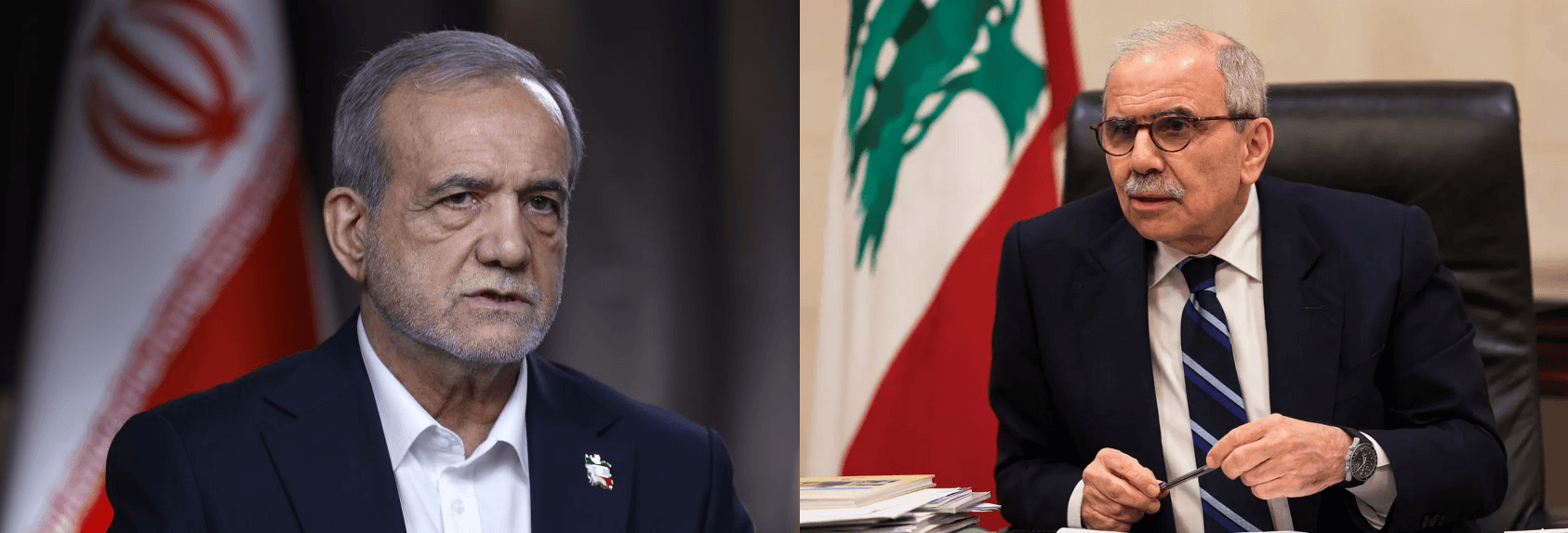
Salam told Pezeshkian Lebanon won't be an arena for regional wars. Remarks were made on UN General Assembly sidelines in New York.
9 outlets told this the same way.
6 of 7 outlets skipped it: lebanon seeks a message that war and peace rest with the Lebanese state..
The Times of Israel was read line by line by the Watchdog: 4.3. See the score →
9outlets compared
Salam rejects regional arena
Lebanese Prime Minister Nawaf Salam met Iranian President Masoud Veshkian in New York on the sidelines of the United Nations General Assembly and told Iran that Lebanon does not want to be a playground for regional conflicts. Salam said Lebanon has paid a heavy price in its security, stability, and economy, and he stressed that it does not want to become a battleground for regional conflicts or a venue for the exchange of messages between others. Salam also urged Iran to nominate a new ambassador to Lebanon, and he said Lebanon’s priority is Israel’s full withdrawal from its territories and an end to its aggressions.
Salam affirmed that Lebanon wants to extend the Lebanese state's authority over its entire territory and that the state should hold the monopoly of armaments. Salam’s meeting took place at the UN headquarters in New York during the 81st session of the United Nations General Assembly, which runs from September 22 to 28.

State-to-state and arms
Salam told Iranian President Masoud Pezeshkian that Lebanon does not want to be an arena for regional wars, after Tehran-backed Hezbollah drew Lebanon into the Middle East conflict. Salam’s office said Salam stressed that Lebanon has paid a heavy price in terms of its security, stability and economy, and that it does not want to become an arena for regional conflicts or a venue for the exchange of messages between others. Salam called for building a sound state-to-state relationship based on mutual respect for each country’s sovereignty and independence, non-interference in each other’s affairs and shared interests.
Salam said Lebanon’s priority was for Israel to fully withdraw from Lebanese territory and cease its attacks, and for Lebanon to move forward with extending the authority of the Lebanese state over all of its territory. Salam said Lebanon needed to ensure that weapons are held exclusively by the state, in a jab at Hezbollah, which has so far refused to lay down its arms.

Diplomatic and security stakes
The meeting between Beirut and Tehran came after war resumed on March 2, when Hezbollah announced renewed attacks on Israel “in retaliation” for the death of former Iranian Supreme Leader Ali Khamenei, killed on Feb. 28 during the Israeli-American offensive against Iran.
L’Orient Today said the encounter concluded a week of diplomatic talks led by the Lebanese prime minister, focusing on international support for the Lebanese Army and the establishment of a new international force to replace the UNIFIL peacekeepers in the South, whose mandate expires at the end of 2026.
L’Orient Today said Israel still occupies more than 600 square kilometers in southern Lebanon, while Hezbollah refuses to discuss dismantling its arsenal north of the Litani River.
The Lebanese presidency statement cited by L’Orient Today said President Joseph Aoun warned of a “security vacuum” in southern Lebanon if no force is present in 2027 after the UN Interim Force in Lebanon peacekeepers' mandate ends in December 2026.
The United States delivered $16 million worth of ammunition to Lebanon to enable the Lebanese Army to “strengthen Lebanon's sovereignty, secure its borders, confront internal threats, and disrupt activities facilitating terrorism,” according to a statement on X from the U.S. Embassy in Beirut.