Technology and Science30 August, 20263 min read
Elon Musk Says SpaceX Builds Bastrop Texas Foundry for Gas Turbine Blades for AI Data Centers
This article is an automated aggregation of coverage from news outlets. Our editorials offer in-depth analysis curated by the NewsCord team.
SpaceX building a Bastrop, Texas gas turbine blade and vane foundry. Foundry aims to address AI data center energy shortages with in-house parts.

Bastrop Foundry for Turbines
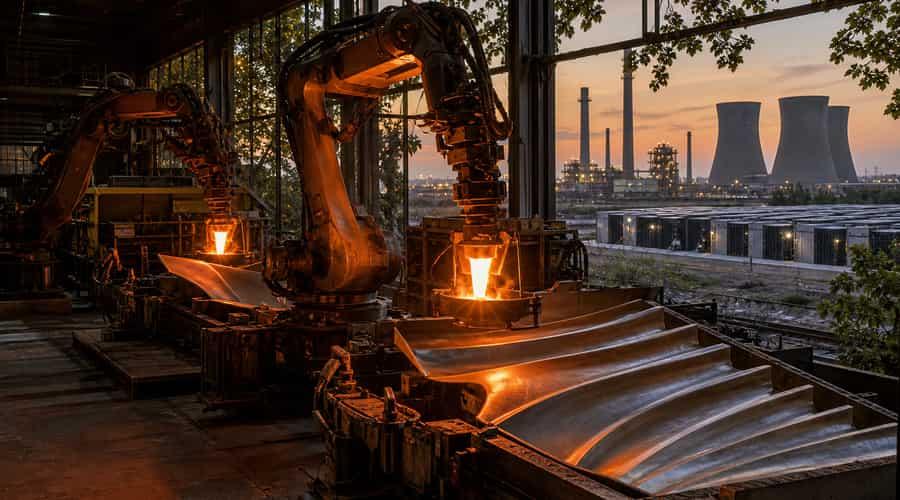
Elon Musk confirmed that SpaceX is building a foundry in Bastrop, Texas, to manufacture gas turbine blades and vanes, aiming to address a casting bottleneck that is slowing new power projects for AI data centers. TechCrunch reported that Musk said on X that “The limiting factor for nat gas turbine production is casting the blades & vanes,” and that in-house casting at SpaceX could accelerate turbines coming online by up to 18 months. The same TechCrunch account tied the move to the International Energy Agency projection that global data center electricity use will roughly double by 2030, and to GE Vernova’s claim that it’s essentially sold out of production capacity through 2030 due largely to AI infrastructure demand.
TechCrunch also described the manufacturing constraint as blades inside a gas turbine’s hottest section running at temperatures around 3,000 to 3,600 degrees Fahrenheit, roughly 800 degrees hotter than the melting point of the metal alloy they’re made from. In the reporting, SpaceX’s foundry is being developed next to the existing Starlink factory in Bastrop, and SpaceX acquired roughly 830 acres of land near the facility between March and June.

Musk’s Timing Promise
Musk’s X post framed the foundry as a way to “supplement and bootstrap solar for several years,” while still relying on natural gas to bring new capacity online. TechCrunch said Musk’s confirmation came after The Information published a report citing job listings that explicitly mention a “blades and vanes foundry,” plus findings from Corey Trinetti that SpaceX bought roughly 830 acres near its existing Starlink factory in Bastrop between March and June. The UA.NEWS account likewise said Musk called the casting of blades and vanes a limiting factor in gas turbine production, and it repeated that casting these components in-house could shorten the time needed to bring gas turbines online by up to 18 months.
UA.NEWS also reported that the International Energy Agency forecasts global electricity consumption by data centers will approximately double by 2030, and that GE Vernova said its production capacity is effectively sold out through 2030. In the same body of reporting, Musk’s plan was linked to a broader strategy where SpaceX and Tesla are building 100 GW per year of solar power capacity as quickly as possible.
Pollution Fight and Health Impacts
TechCrunch warned that faster deployment of gas turbines would mean more turbines in the ground, and it described how those turbines are already drawing federal lawsuits and peer-reviewed health research over pollution. In Memphis, TechCrunch said the NAACP has repeatedly accused SpaceXAI of operating turbines without the permits or pollution controls required by federal law, and it added that the organization’s concern is that turbines like these emit smog-forming compounds and hazardous chemicals like formaldehyde. TechCrunch also reported that University of Memphis researchers said that in their limited analysis, air pollution grew “slightly worse” because of the data center.
In Virginia’s “Data Center Alley,” TechCrunch cited a study commissioned by the Piedmont Environmental Council using the EPA’s COBRA health-impact model, finding that emissions from a single facility’s eight full-time gas turbines could reach more than 2.5 million people across multiple counties and cause an estimated 3.4 to 6.5 additional premature deaths a year. The UA.NEWS account echoed the Memphis dispute by saying the NAACP has repeatedly accused SpaceXAI of operating turbines to power the Colossus data centers without permits or pollution-control equipment required by federal law.