Iran · updated 1h ago · 2 min read
Iran’s Armed Forces Vow More Defeats Against The United States And Israel
Iran's armed forces vow to inflict further defeats on the US, Israel, and allies. They claim they have forced the US and Israel to submit, seizing strategic maritime routes.
20 outlets, one story, no spin found.
5 of 8 outlets skipped it: iran claims it took over management of the Strait of Hormuz.
20outlets compared
Sacred Defense Week Threats
Iran’s Armed Forces General Staff and the Khatam al-Anbiya Central Headquarters issued a joint statement for Sacred Defence Week, warning that foreign aggressors would face “more defeats” if they challenged the country. The statement, carried by ISNA, said Iran’s military leadership would safeguard the nation’s borders and strategic interests against external threats, specifically referencing the United States and Israel. The statement also claimed Iran had “taken direct control of strategic maritime trade routes in the region,” and it framed that reach as operational influence over the Strait of Hormuz.
The statement tied the warning to the 1980–1988 Iran-Iraq War commemoration and said the “eight years of sacred defense” strengthened national self-reliance and regional deterrence. The joint statement asserted that “the taking over of the management of the Strait of Hormuz” showed Iran’s impact on foreign security interests in West Asia.

Hatami’s Readiness Message
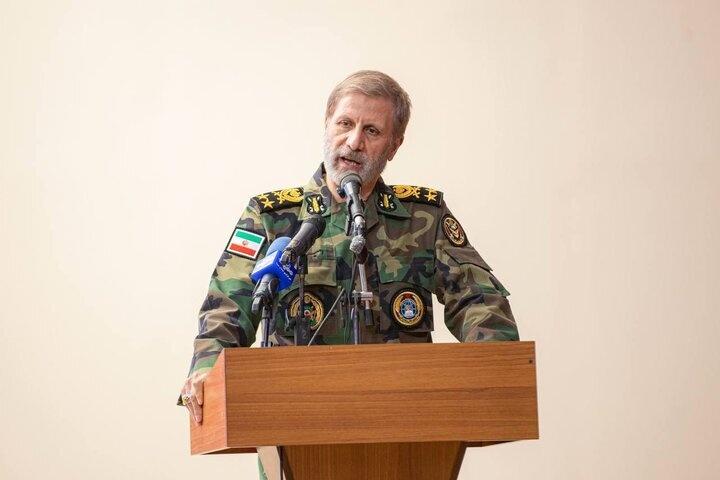
Major General Amir Hatami, commander-in-chief of the Islamic Republic of Iran Army, marked Sacred Defence Week by saying the armed forces would not hesitate to defend Iran’s independence, dignity and territorial integrity. Hatami said Sacred Defence taught Iran that “reliance on faith and national will, the unity and insight of the people, and the capability of the armed forces are a solid foundation for the country's security and authority,” and he linked that lesson to readiness across Iran’s skies, land and waters. Hatami’s message also said the armed forces, “under the command of the Commander-in-Chief,” would stand with “full vigilance and readiness” and “will not hesitate for a moment” in defending Iran.
The Tasnim report quoted Hatami emphasizing that “any aggression against the security and territorial integrity of Iran will be met with a decisive and regret-inducing response.” The Mehr report similarly stressed Hatami’s warning that the armed forces would “not waver for a single moment in defending beloved Iran’s independence, security, and territorial integrity.”

IRGC and Strategic Stakes
Middle East Eye described the Islamic Revolutionary Guard Corps as a force that “has underpinned” Iran’s response to attacks by the US and Israel this year, and it said the IRGC is “often called a state within a state.” Middle East Eye said the IRGC sits alongside Iran’s official army under the ultimate authority of the supreme leader, Mojtaba Khamenei, and it outlined the IRGC’s five main arms including a navy and the Quds Force. Middle East Eye said the IRGC controls Iran’s ballistic missiles and is tasked with safeguarding border security and the country’s nuclear facilities, while it also described Basij as a volunteer paramilitary.
The ANI report’s joint statement claimed Iran had already forced the US and Israel to submit and had taken direct control of strategic maritime trade routes, presenting that as a deterrence outcome. The PressTV statement added that Iran’s management of the Strait of Hormuz through “Iranian arrangements” had “changed the security equations in favor of the Muslim community and the Iranian people,” and it vowed further defeats for the US and Israel’s allies.