Technology and Scienceupdated 2h ago3 min read
Anthony Albanese Leads 14 Leaders to Tuvalu for Pre-COP Climate Adaptation Tour
Anthony Albanese leads 14 leaders to Tuvalu to witness climate impacts first-hand. Pacific leaders call for faster climate finance access and firm fossil fuel transition commitments.

Tuvalu pre-COP spotlight
Leaders touched down on the tiny Pacific atoll nation of Tuvalu on Tuesday for a first-hand look at an ecosystem wiped out due to climate change, as the trip unfolded on the sidelines of the Pacific "pre-COP" gathering hosted by Fiji.
“The decisions we make at Pre-COP and COP31 will be felt by our communities first.”
Fourteen leaders including Australia Prime Minister Anthony Albanese arrived in Funafuti on Tuesday morning, and the group planned to tour the Tuvalu Coastal Adaptation Project, a land reclamation effort aimed at mitigating rising sea levels.
The AFP report said Tuvalu is already laying plans to relocate its population of 10,600 if the country is consumed by the ocean, and it said scientists fear the entire archipelago could be unliveable by the end of the century.
Marine biologist Austin Bowden-Kerby described the reef devastation, saying, "You can swim for hours and hours along the reef in the lagoon, just skeleton after skeleton. It's all dead," and he added, "The very system that created the islands has died."
Tuvalu climate minister Maina Vakafua Talia said the decisions made at Pre-COP and COP31 would be felt first by communities, telling AFP, "The decisions we make at Pre-COP and COP31 will be felt by our communities first."
Fossil fuel red lines
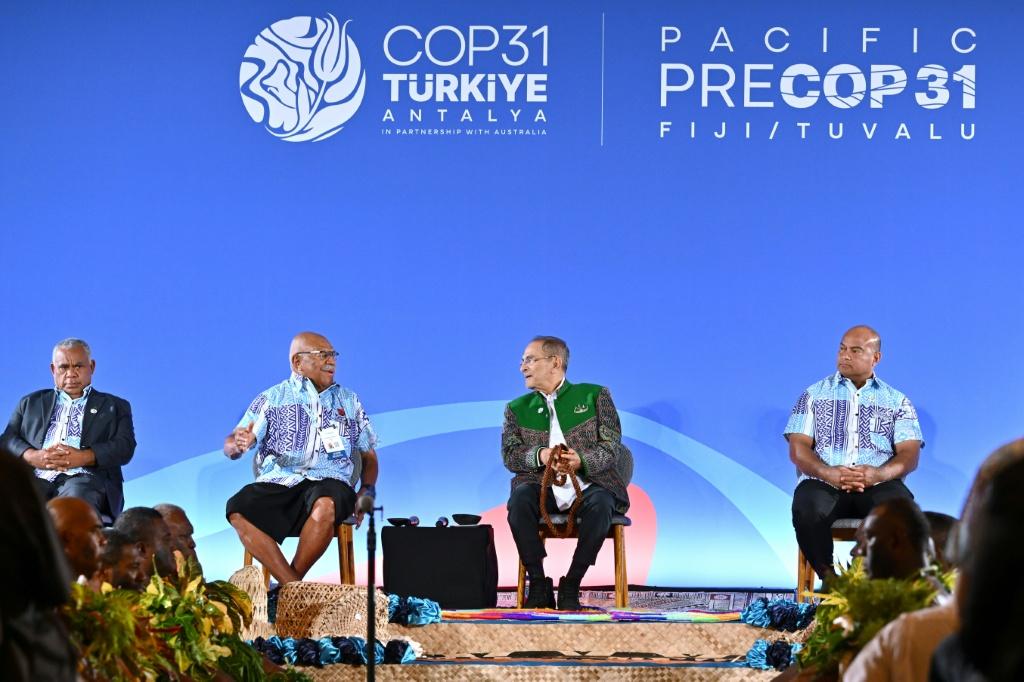
Pacific island leaders gathered in Funafuti to insist that the historic 2023 Dubai agreement to transition away from fossil fuels remains non-negotiable ahead of COP31, with the AFP report describing the Tuvalu trip as a first-hand look at climate impacts.
Fijian Prime Minister Sitiveni Rabuka delivered a rebuttal to any attempts to walk back the Dubai text, stating, "The transition away from fossil fuels was agreed to by all of us in Dubai. It is not a new ask, and it is not open for renegotiation."
Australia Prime Minister Anthony Albanese said climate change was "a daily reality" for the Pacific rather than a future challenge, and he told US social media company X, "Here in Tuvalu the stakes are higher than any other part of the world."
Tuvalu Prime Minister Feleti Teo argued that island nations require faster and more accessible global climate funding, saying, "Why should countries like Tuvalu take on more debt to protect ourselves from a climate crisis we did so little to cause? We should not have to borrow our way out of a crisis," as leaders pressed for restructuring of climate finance.
The AFP report said Tuvalu’s highest point in Funafuti is just two metres (6.6 feet) above sea level, and it reported that rising waters have already largely swamped two of Tuvalu's nine coral atolls.
Finance, adaptation, and COP31
After witnessing sea-level rise in Tuvalu, Pacific leaders on Tuesday used the pre-COP31 summit in Fiji to voice frustration at difficulties tapping the global climate finance system, as they said the process has been slow and the terms bad.
“‘Right now, our islands are like a canoe that has been rammed by a massive foreign ship.”
Palau's President Surangel Whipps Jr. framed the problem as a sinking emergency, asking, "Right now, our islands are like a canoe that has been rammed by a massive foreign ship. Our canoe is taking on water, we are sinking, and what is the world's response?"
Pacific leaders and Australia called again for investment in the new Pacific Resilience Facility (PRF), which the report said is seeking $500 million in investments by COP31 in November and had around $180 million so far.
The Guardian reported that Anthony Albanese warned Australia faces a hazardous summer, likely including floods, cyclones and extreme heat, and he said the goal of limiting global heating to 1.5C could not be allowed to slip.
Tuvalu’s director of climate change, Jamie Ovia, told the visitors that sea-level rise is projected to increase the annual cost of damage from flooding and storm surges to US$34m a year by 2050 and $63m by 2100, and he urged, "We need time to adapt," adding, "Will you act with Tuvalu, and will you act in time?"