Technology and Science28 August, 20263 min read
NASA Launches Nancy Grace Roman Space Telescope Sunday From Kennedy Space Center on Falcon Heavy
This article is an automated aggregation of coverage from news outlets. Our editorials offer in-depth analysis curated by the NewsCord team.
Nancy Grace Roman Space Telescope launches Aug 30, 2026 at 7:26 a.m. from KSC. Liftoff aboard SpaceX Falcon Heavy from Kennedy Space Center, Florida.
15 outlets told this the same way.
Roman Telescope Set for Sunday
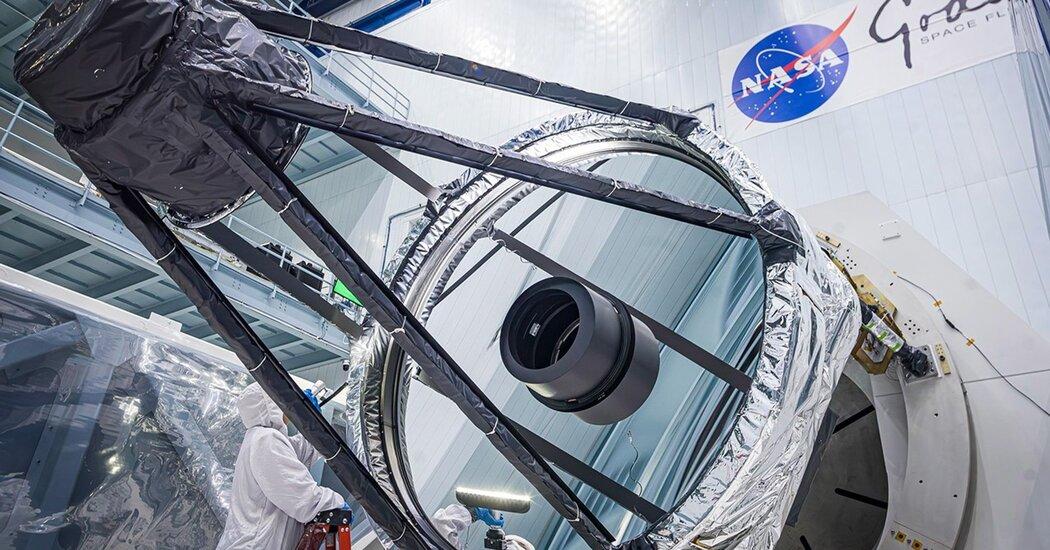
NASA is set to launch the Nancy Grace Roman Space Telescope on Sunday at 7:26 a.m. ET from NASA’s Kennedy Space Center in Florida, with the observatory going into orbit atop a SpaceX Falcon Heavy rocket.
NBC News says the mission is expected to survey hundreds of millions of stars and billions of galaxies, and it is designed to survey more of the sky than any space telescope before it.

The mission has a five-year prime plan, and NBC News reports it is expected to capture panoramic views of the cosmos, study little-explored parts of the Milky Way, and uncover more than 100,000 planets around other stars.
After launch, NBC News reports Roman will spend more than three months journeying to its final destination, located roughly 1 million miles from Earth at L2, where the gravitational acceleration from the sun and Earth balance out.
In a separate report, Jambalaya News Louisiana says the mission received this week the approval of experts after completing the last review of preparation, allowing it to advance nine months compared with the initially planned schedule.
Dark Matter, Dark Energy
NBC News frames Roman’s science around dark energy and dark matter, quoting astrophysicist Neil deGrasse Tyson as saying, “Some of our longest-standing mysteries in modern astrophysics are: What is the nature of dark matter and the nature of dark energy?”
In the same NBC News report, Tyson adds, “We have ideas, but we don’t know what they are. This telescope is going to try to give us the best data available to address those questions.”

The New York Times describes Roman’s wide and deep view as promising a breakthrough, saying it would take “over half a million high-definition TVs to display just one image in full.”
NPR similarly highlights the telescope’s $4.3 billion price tag and says it is scheduled for launch Aug. 30, with the observatory expected to reveal new information about the expansion of the universe and discover multitudes of planets orbiting distant stars.
NPR also quotes Julie McEnery, saying, “That one month of observations to survey our Milky Way galaxy would take about a century with Hubble.”
Scale, Data, and Operations
Telemundo reports Roman will monitor more than 2,000 galaxies, and it says the telescope’s field of view is 100 times larger than Hubble’s. Telemundo adds that in a single month Roman will capture images of an area of the sky 50 times larger than Hubble covered in 30 years, and it says Roman will be able to detect up to half of the stars in the Milky Way. The same Telemundo report says Roman will generate 11 terabytes of data per day, equivalent to downloading about 350 movies in 4K Ultra HD every 24 hours.
SpaceNews says Roman is ready for launch after a 16-year journey, and it reports the $4.3 billion telescope has a five-year prime mission surveying the universe using a 300-megapixel infrared camera. SpaceNews also quotes Julie McEnery saying, “Roman is poised to conduct revolutionary surveys that will impact every area of astronomy,” and it describes Roman’s coronagraph as a technology demonstration to precisely block light from an individual star to directly observe any planets orbiting it.